- 540 pages
- English
- ePUB (mobile friendly)
- Available on iOS & Android
eBook - ePub
Carbon Materials for Advanced Technologies
About this book
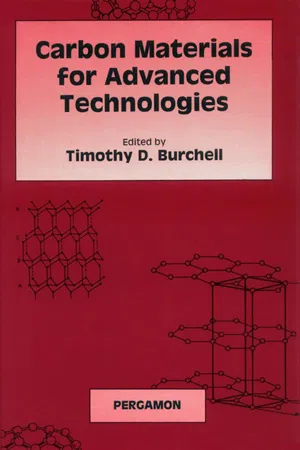
The inspiration for this book came from an American Carbon Society Workshop entitled "Carbon Materials for Advanced Technologies" which was hosted by the Oak Ridge National Laboratory in 1994. Chapter 1 contains a review of carbon materials, and emphasizes the structure and chemical bonding in the various forms of carbon, including the four allotropes diamond, graphite, carbynes, and the fullerenes. In addition, amorphous carbon and diamond films, carbon nanoparticles, and engineered carbons are discussed. The most recently discovered allotrope of carbon, i.e., the fullerenes, along with carbon nanotubes, are more fully discussed in Chapter 2, where their structure-property relations are reviewed in the context of advanced technologies for carbon based materials. The synthesis, structure, and properties of the fullerenes and nanotubes, and modification of the structure and properties through doping, are also reviewed. Potential applications of this new family of carbon materials are considered.The manufacture and applications of adsorbent carbon fibers are discussed in Chapter 3. The manufacture, structure and properties of high performance fibers are reviewed in Chapter 4, and the manufacture and properties of vapor grown fibers and their composites are reported in Chapter 5. The properties and applications of novel low density composites developed at Oak Ridge National Laboratory are reported in Chapter 6.Coal is an important source of energy and an abundant source of carbon. The production of engineering carbons and graphite from coal via a solvent extraction route is described in Chapter 7. Applications of activated carbons are discussed in Chapters 8-10, including their use in the automotive arena as evaporative loss emission traps (Chapter 8), and in vehicle natural gas storage tanks (Chapter 9). The application of activated carbons in adsorption heat pumps and refrigerators is discussed in Chapter 10. Chapter 11 reports the use of carbon materials in the fast growing consumer electronics application of lithium-ion batteries. The role of carbon materials in nuclear systems is discussed in Chapters 12 and 13, where fusion device and fission reactor applications, respectively, are reviewed. In Chapter 12 the major technological issues for the utilization of carbon as a plasma facing material are discussed in the context of current and future fusion tokamak devices.The essential design features of graphite moderated reactors, (including gas-, water- and molten salt-cooled systems) are reviewed in Chapter 13, and reactor environmental effects such as radiation damage and radiolytic corrosion are discussed. The fracture behaviour of graphite is discussed in qualitative and quantitative terms in Chapter 14. The applications of Linear Elastic Fracture Mechanics and Elastic-Plastic Fracture Mechanics to graphite are reviewed and a study of the role of small flaws in nuclear graphites is reported.
Information
Topic
Physical SciencesSubtopic
Physical & Theoretical ChemistryTable of contents
- Cover image
- Title page
- Table of Contents
- Copyright
- Contributors
- Acknowledgments
- Preface
- Chapter 1: Structure and Bonding in Carbon Materials
- Chapter 2: Fullerenes and Nanotubes
- Chapter 3: Active Carbon Fibers
- Chapter 4: High Performance Carbon Fibers
- Chapter 5: Vapor Grown Carbon Fiber Composites
- Chapter 6: Porous Carbon Fiber-Carbon Binder Composites
- Chapter 7: Coal-Derived Carbons
- Chapter 8: Activated Carbon for Automotive Applications
- Chapter 9: Adsorbent Storage for Natural Gas Vehicles
- Chapter 10: Adsorption Refrigerators and Heat Pumps
- Chapter 11: Applications of Carbon in Lithium-Ion Batteries
- Chapter 12: Fusion Energy Applications
- Chapter 13: Fission Reactor Applications of Carbon
- Chapter 14: Fracture in Graphite
- Index
Trusted by 375,005 students
Access to over 1.5 million titles for a fair monthly price.
Study more efficiently using our study tools.
Frequently asked questions
Yes, you can cancel anytime from the Subscription tab in your account settings on the Perlego website. Your subscription will stay active until the end of your current billing period. Learn how to cancel your subscription
No, books cannot be downloaded as external files, such as PDFs, for use outside of Perlego. However, you can download books within the Perlego app for offline reading on mobile or tablet. Learn how to download books offline
Perlego offers two plans: Essential and Complete
- Essential is ideal for learners and professionals who enjoy exploring a wide range of subjects. Access the Essential Library with 800,000+ trusted titles and best-sellers across business, personal growth, and the humanities. Includes unlimited reading time and Standard Read Aloud voice.
- Complete: Perfect for advanced learners and researchers needing full, unrestricted access. Unlock 1.5M+ books across hundreds of subjects, including academic and specialized titles. The Complete Plan also includes advanced features like Premium Read Aloud and Research Assistant.
We are an online textbook subscription service, where you can get access to an entire online library for less than the price of a single book per month. With over 1.5 million books across 990+ topics, we’ve got you covered! Learn about our mission
Look out for the read-aloud symbol on your next book to see if you can listen to it. The read-aloud tool reads text aloud for you, highlighting the text as it is being read. You can pause it, speed it up and slow it down. Learn more about Read Aloud
Yes! You can use the Perlego app on both iOS and Android devices to read anytime, anywhere — even offline. Perfect for commutes or when you’re on the go.
Please note we cannot support devices running on iOS 13 and Android 7 or earlier. Learn more about using the app
Please note we cannot support devices running on iOS 13 and Android 7 or earlier. Learn more about using the app
Yes, you can access Carbon Materials for Advanced Technologies by T.D. Burchell in PDF and/or ePUB format, as well as other popular books in Physical Sciences & Physical & Theoretical Chemistry. We have over 1.5 million books available in our catalogue for you to explore.