eBook - ePub
Logistics Operations and Management
Concepts and Models
- 486 pages
- English
- ePUB (mobile friendly)
- Available on iOS & Android
eBook - ePub
About this book
This book provides a comprehensive overview of how to strategically manage the movement and storage of products or materials from any point in the manufacturing process to customer fulfillment. Topics covered include important tools for strategic decision making, transport, packaging, warehousing, retailing, customer services and future trends.
- An introduction to logistics
- Provides practical applications
- Discusses trends and new strategies in major parts of the logistic industry
Information
1. Overview
Reza Zanjirani Farahani1, Shabnam Rezapour2 and Laleh Kardar3
1Department of Informatics and Operations Management, Kingston Business School, Kingston University, Kingston Hill, Kingston Upon Thames, Surrey KT2 7LB
2Industrial Engineering Department, Urmia University of Technology, Urmia, Iran
3Department of Industrial Engineering, University of Houston, Houston, TX, USA
In this section, we try to provide a comprehensive view about the purpose, scale, and organization of this book. First, we start with the history and evolution of logistics over time. Then, comparing this book with the other books in the field of logistics, we highlight its main focus and advantages. In the last, we will see the sequence and organization of the book chapters.
Key Words
Logistics, supply chain, coordination, cooperation, distribution, transportation
1.1. History
Many people believe that logistics is a word, but from a semantics point of view its origin was from ancient Greek and meant the “science of computation.” In fact, it is originally from combat environments and not from business or academia. It seems the ancient Greeks referred the word logistikos to military officers who were expert in calculating the military needs for expeditions in war. As a science, it seems the first book written on logistics was by Antoine-Henri Jomini (1779–1869), a general in the French army and later in the Russian service, titled Summary of the Art of War (1838). The book was on the Napoleonic art of war [1] and [2].
1.2. Definition of Logistics
Jomini defined logistics as “the practical art of moving armies” and included a vast range of functions involved in moving and sustaining military forces: planning, administration, supply, billeting and encampments, bridge and road building, and even reconnaissance and intelligence insofar as they were related to maneuvers off the battlefield [1].
What is logistics? This section is an adoption of the first chapter in Farahani et al. (2009b) [3]. Many different definitions for logistics can be found. The most well known are the following: (a) “Logistics is … the management of all activities which facilitate movement and the co-ordination of supply and demand in the creation of time and place utility”[8]. (b) “Logistics management is … the planning, implementation and control of the efficient, effective forward and reverse flow and storage of goods, services and related information between the point of origin and the point of consumption in order to meet customer requirements” (CSCMP 2006) [7](c) “Logistics is… the positioning of resources at the right time, in the right place, at the right cost, at the right quality” (Chartered Institute of Logistics and Transport, UK, 2005) [7]. (d) “In civil organizations, logistics’ issues are encountered in firms producing and distributing physical goods”[4]. (e) “Logistics is that part of the supply chain process that plans, implements, and controls the efficient, effective forward and reverse flow and storage of goods, services, and related information between the point of origin and the point of consumption in order to meet customers’ requirements” (Council of Logistics Management 2003) [7].
1.2.1. Why Is Logistics Important?
In each country, a huge amount of money is spent annually in logistical activities. For instance, in 2003 US logistical activity costs were 8.5% of the country’s GDP. Given that the US GDP in 2003 was approximately $12,400 billion, the logistical activity cost was approximately $1054 billion (Seventeenth Annual State of Logistics Report of USA 2006)! [9].
1.3. Evolution of Logistics Over Time
Logistics has an ancient history. A quick look back can be enlightening. Its history dates to the wars of the Greek and Roman empires in which the military officials called logistiks were responsible for supplying and distributing needed resources and services. Providing them had an important and essential role in the outcomes of these wars. These logistiks also worked to damage the stores of their enemies while defending their own. This gradually guided the development of current logistics systems.
Logistics systems developed extensively during World War II (1939–1945). Throughout this war, the United States and its allies’ armies were more efficient than Germany’s. German army stores were damaged extensively, but Germany could not impose the same destruction on its enemies’ stores. The US army could supply whatever was needed by its forces at the right time, at the right place, and in the most economical way. From that time, several new and advanced military logistic techniques started to take off. Gradually, logistics started to evolve as an art and science.
Today, experts in logistics perform their duties based on their skills, experiences, and knowledge. In modern industries, the task of logistics managers is to provide appropriate and efficient logistics systems. They guarantee that the right goods will be delivered to the right customers, at the right time, at the right place, and in the most economical way.
Although logistics is a dilemma for many companies, logistical science can bring some relief to them. In today’s business environment, logistics is a competitive strategy for the companies that can help them meet the expectations of their customers. Logistics helps members of supply chains integrate in an efficient way. Logistics does not consist of one single component but involves a group of various activities and disciplines such as purchasing, planning, coordinating, warehousing, distributing, and customer service [5].
1.4. Other Logistical Books
As noted earlier, logistics was traditionally used in the military environments. Therefore, it is rational that the first books explicitly or implicitly relevant to logistics were combat oriented. The oldest one was Jomini’s Summary of the Art of War (1838). Another and more recent example was the book coauthored by Lieutenant General William Gus Pagonis, the director of logistics during the 1991 Gulf War, and Jeffrey Cruikshank, Moving Mountains[6].
Nowadays logistics is being used in business environments as widely as in wars, and we can find different books recently written by researchers in academia. However, although many books talk about logistical processes individually—such as transportation, warehousing, distribution, vehicle routing problems (VRPs), and packaging—few comprehensive books encompass all of the logistical processes. Two examples of complete books that are basically applicable to private organizations are those by Riopel et al. (2005) and Ghiani et al. (2004) [4].
Sometimes, we can see cooperation between logistical areas among several private organizations, governmental organizations, and also militants. For example, in case of a natural disaster such as an earthquake, tsunami, or hurricane or typhoon, all of these organizations will be involved. Integration and coordination of materials, information, and financial flows between two or more private organizations can promote a traditional logistical system to become an advanced supply chain. To see a book in this area, interested readers can refer to [3].
1.5. The Focus of This Book
The question that might arise is, what is specifically different about this book? We explicitly highlight the following issues as the main point of this book.
• We have worked to include updated sources such as journal papers, conference proceedings, books, and Internet sources, so you may see references from recent years.
• Many of the references highlight some of the logistical processes such as the VRP and transportation. We have tried to equally cover all of the main logistics processes and thus have allocated separate chapters to each.
• There are two main classifications in a book such as this: (1) qualitative concepts and (2) quantitative models. We have tried to view both equally. Of course, we believe different topics need different degrees of focus. For instance, when talking about information and communication technology in logistical systems, most texts look at these areas from qualitative angles whereas the VRP is viewed mainly in quantitative terms. However, aside from the nature of a chapter, by default we have considered the importance of quantitative models and qualitative concepts at the same time.
• We are covering some topics in logistics that are not predominant in most large and private enterprises, for instance, disaster logistics and retail logistics. Moreover, some approaches and modeling concepts such as robustness and risk are highlighted in separate chapters.
• Then last but not the least, some chapters such as those covering logistical parties, logistical philosophies, and logistical future trends will interest readers and are not found in other sources.
1.6. Organization
This book is organized in 4 parts and 21 chapters such that the reader can study each chapter not only independently but also as part of a whole. If someone wants to study the book more deeply, our suggestion is observing the strategy in Figure 1.1.
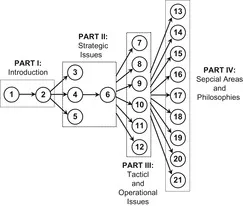 |
| Figure 1.1 Sequencing the chapters dependently. |
Part I, Introduction, has two chapters. Chapter 1 (Overview) and Chapter 2, Physical Flows, which looks at the physical entities of a logistical system, including fixed and static components and moving entities. To do this, the author focuses on transportation modes, including land, air, water, and pipeline as well as warehousing systems. This chapter also summarizes intermodal, multimodal, and material-handling equipment.
Part II, Strategic Issues, includes four chapters. Chapter 3, Logistics Strategic Decisions, covers the strategic decisions that should be made in a logistical system such as network design, outsourcing, and integration. It also includes the objectives of making a strategic decision and informs interested readers on how to do that. Chapter 4, Logistical Philosophies, introduces different approaches to logistics and their advantages and disadvantages. These philosophies are mainly lean logistics, cross docking, just-in-time, agile logistical quick response, efficient consumer response, vendor-managed inventory (VMI). Chapter 5, Logistical Parties, examines definitions, activities, advantages, disadvantages, and types of first-, second-, third-, fourth-, and fifth-party logistical providers. Finally, Chapter 6, Logistics Future Trends, introduces the main future trends of logistics and considers emerging technologies, trends, new strategies in industries, and recent technical reports and surveys, and it predicts logistical future focusing, especially on globalization, information technology (IT) and e...
Table of contents
- Cover Image
- Table of Contents
- Front-matter
- Copyright
- List of Contributors
- 1. Overview
- 2. Physical Flows
- 3. Logistics Strategic Decisions
- 4. Logistics Philosophies
- 5. Logistics Parties
- 6. Logistics Future Trends
- 7. Transportation
- 8. The Vehicle-Routing Problem
- 9. Packaging and Material Handling
- 10. Storage, Warehousing, and Inventory Management
- 11. Customer Service
- 12. Logistics System
- 13. Reverse Logistics
- 14. Retail Logistics
- 15. Humanitarian Logistics Planning in Disaster Relief Operations
- 16. Freight-Transportation Externalities
- 17. Robust Optimization of Uncertain Logistics Networks
- 18. Integration in Logistics Planning and Optimization
- 19. Optimization in Natural Gas Network Planning
- 20. Risk Management in Gas Networks
- 21. Modeling the Energy Freight-Transportation Network
Trusted by 375,005 students
Access to over 1.5 million titles for a fair monthly price.
Study more efficiently using our study tools.
Frequently asked questions
Yes, you can cancel anytime from the Subscription tab in your account settings on the Perlego website. Your subscription will stay active until the end of your current billing period. Learn how to cancel your subscription
No, books cannot be downloaded as external files, such as PDFs, for use outside of Perlego. However, you can download books within the Perlego app for offline reading on mobile or tablet. Learn how to download books offline
Perlego offers two plans: Essential and Complete
- Essential is ideal for learners and professionals who enjoy exploring a wide range of subjects. Access the Essential Library with 800,000+ trusted titles and best-sellers across business, personal growth, and the humanities. Includes unlimited reading time and Standard Read Aloud voice.
- Complete: Perfect for advanced learners and researchers needing full, unrestricted access. Unlock 1.5M+ books across hundreds of subjects, including academic and specialized titles. The Complete Plan also includes advanced features like Premium Read Aloud and Research Assistant.
We are an online textbook subscription service, where you can get access to an entire online library for less than the price of a single book per month. With over 1.5 million books across 990+ topics, we’ve got you covered! Learn about our mission
Look out for the read-aloud symbol on your next book to see if you can listen to it. The read-aloud tool reads text aloud for you, highlighting the text as it is being read. You can pause it, speed it up and slow it down. Learn more about Read Aloud
Yes! You can use the Perlego app on both iOS and Android devices to read anytime, anywhere — even offline. Perfect for commutes or when you’re on the go.
Please note we cannot support devices running on iOS 13 and Android 7 or earlier. Learn more about using the app
Please note we cannot support devices running on iOS 13 and Android 7 or earlier. Learn more about using the app
Yes, you can access Logistics Operations and Management by Reza Farahani,Shabnam Rezapour,Laleh Kardar in PDF and/or ePUB format, as well as other popular books in Technology & Engineering & Engineering General. We have over 1.5 million books available in our catalogue for you to explore.