- 394 pages
- English
- ePUB (mobile friendly)
- Available on iOS & Android
eBook - ePub
About this book
Advances in Cellular Neurobiology, Volume 5 focuses on cellular neurobiology, drawing on some aspects of biochemistry, endocrinology, embryology, morphology, genetics, pharmacology, pathology, and physiology. This book deals with humoral influences on brain development. Organized into three sections encompassing 10 chapters, this volume begins with an overview of the proposed functions for neurohumoral agents, including cell division, neural tube closure, palate formation, myoblast differentiation, and regulation of cell movements. This text then examines how growth factors regulate autonomic nerve development. Other chapters consider the morphology, physiology, and biochemistry of the neuronal cytoskeleton. This book discusses as well the connective tissue components in the normal peripheral nervous system and in two pathological conditions. The final chapter deals with the advantages and preparation of monoclonal antibodies in the identification of neurons. This book is a valuable resource for neurobiologists and researchers. Scientists in all fields of life sciences will also find this book useful.
Information
Section 1. Cell Differentiation and Interaction
Humoral Influences on Brain Development
Jean M. Lauder and Helmut Krebs, Laboratory of Developmental Neurobiology, Department of Anatomy, University of North Carolina School of Medicine, Chapel Hill, North Carolina
Publisher Summary
This chapter describes neurotransmitters as developmental signals in key ontogenic processes, such as neural tube formation, germinal cell proliferation, and neuronal and glial differentiation during brain organogenesis. It further discusses the hormonal regulation of brain development during postnatal neurogenesis and explains the key interrelationships, which may link neurotransmitters and hormones in a humoral milieu, providing a variety of control mechanisms for the central and peripheral nervous system during the key phases of their development. The development of the central nervous system (CNS) begins very early in gestation with the formation of the neural plate. Within hours of induction of the neural ectoderm by the chordamesoderm, neural folds elevate at the lateral edges of the neural plate. As the neural folds approximate near the midline, they fuse, forming a continuous neural tube. The chapter further describes monoamines as early-developing neurotransmitters that can be endogenously detected by the formaldehyde-induced fluorescence method or by immunocytochemistry.
I Neurotransmitters as Developmental Signals
It is interesting to speculate on the possible metabolic origins and significance of the transmitters. Some of these substances, such as acetylcholine, occur in organisms under circumstances where they serve no apparent neural function. This suggests that the evolutionary appearance of the transmitters preceded that of the nervous system. Their hormonal function in modern organisms implies that they might have arisen as regulatory molecules—perhaps metabolic symbols, in the sense defined here. A possible clue to the biochemical origins of the neurotransmitters is provided by the fact that all the compounds currently accepted as transmitters are either amino acid metabolites—for example, the catecholamines, serotonin, γ-aminobutyric acid, acetylcholine—or are themselves amino acids (for example, glycine). Thus, perhaps the transmitters acted in primitive cells as intracellular symbols representing changes in environmental amino acid concentration. Eventually, these primordial nerve cells might have utilized the symbols in short-range intercellular (hormonal) roles, originally concerned with transducing information related to amino acid accumulation, and gradually with many other aspects of the environment. [Tomkins, 1975.]
The hypothesis that particular neurotransmitters might have had developmental functions prior to the evolutionary and developmental onset of neurotransmission derives from the presence of these substances in primitive organisms and during key phases of embryogenesis and neurogenesis in higher organisms (Table I). Proposed functions for these neurohumoral agents include control of cell division and morphogenetic cell movements during early phases of embryogenesis, neural tube closure, palate formation, myoblast differentiation, and regulation of cell differentiation during formation of the central nervous system (CNS), as well as involvement in such processes as metamorphosis and morphogenetic and regenerative processes in lower animals.
Table I
Nontransmission Roles For Neurotransmitters And Neurohumors In Developmenta
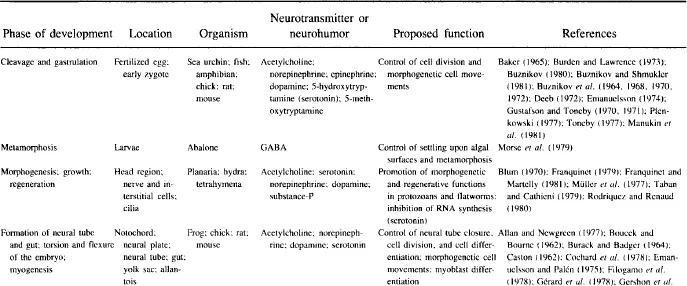
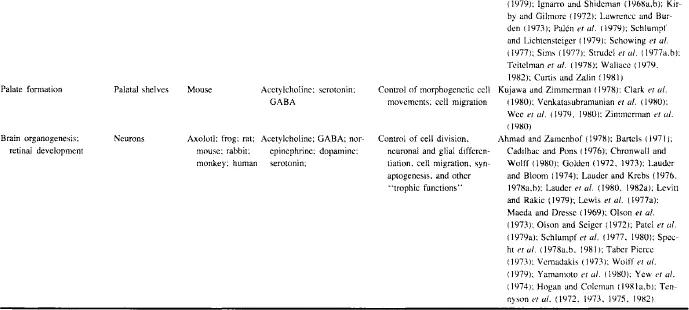
aRevised from Lauder et al. (1982a), with permission of Ankho Int., Inc
A Monoamines and Neurulation
The development of the central nervous system begins very early in gestation with the formation of the neural plate. Within hours of the induction of the neural ectoderm by the chordamesoderm, neural folds elevate at the lateral edges of the neural plate. As the neural folds approximate near the midline, they fuse, forming a continuous neural tube. Neurulation, the process of the formation of the neural tube, advances in both rostral and caudal directions from the initial point of contact of the neural folds and is complete with the closure of the rostral and caudal neuropores.
During this early period of neurogenesis, catecholamines and serotonin (5-HT) have been detected in chick embryos and have been implicated in the initial phases of nervous system development. In whole embryo extracts, the catecholamines norepinephrine and dopamine (NE, DA) have been biochemically measured as early as day 1 of incubation (Ignarro and Shideman, 1968a,b), whereas extracts of the notochord have revealed the presence of 5-HT as well as catecholamines (Strudel et al., 1977a,b). Various embryonic structures, discussed later, have been shown to accumulate these amines during the period of embryonic morphogenesis (Kirby and Gilmore, 1972; Lawrence and Burden, 1973; Wallace, 1979, 1982). This early presence of monoamines may influence the development of the chick embryo, as illustrated by the teratological effects of drugs which interfere with the metabolism of these transmitter substances. Alterations in catecholamine metabolism result in defects in neural tube closure and failure in the development of embryonic torsion and flexure (Lawrence and Burden, 1973). Certain drugs which interfere with 5-HT synthesis, release, and receptor interactions are also able to disturb the processes of blastoderm growth, primitive streak formation, neurulation, brain formation, and somatogenesis (Jurand, 1980; Palén et al., 1979). The locations of these disturbances resulting from perturbations in monoamine metabolism may be related to the specific embryonic sites which concentrate the amines during morphogenesis.
Wallace (1979, 1982) has demonstrated sites of 5-HT and NE uptake and/or synthesis in the neural tube and notochord of chick embryos cultured with these compounds, using fluorescence histochemistry and anti-5-HT immunocytochemistry. In these studies, 5-HT uptake and synthesis were found in specific portions of the developing brain (within the floor plate of the mesencephalon and caudal myelencephalon) soon after neural tube closure. Similarly,...
Table of contents
- Cover image
- Title page
- Table of Contents
- Copyright page
- Contributors
- Preface
- Contents of Previous Volumes
- Section 1. Cell Differentiation and Interaction
- Section 2. Pathology
- Section 3. Methodologies
- Index
Trusted by 375,005 students
Access to over 1.5 million titles for a fair monthly price.
Study more efficiently using our study tools.
Frequently asked questions
Yes, you can cancel anytime from the Subscription tab in your account settings on the Perlego website. Your subscription will stay active until the end of your current billing period. Learn how to cancel your subscription
No, books cannot be downloaded as external files, such as PDFs, for use outside of Perlego. However, you can download books within the Perlego app for offline reading on mobile or tablet. Learn how to download books offline
Perlego offers two plans: Essential and Complete
- Essential is ideal for learners and professionals who enjoy exploring a wide range of subjects. Access the Essential Library with 800,000+ trusted titles and best-sellers across business, personal growth, and the humanities. Includes unlimited reading time and Standard Read Aloud voice.
- Complete: Perfect for advanced learners and researchers needing full, unrestricted access. Unlock 1.5M+ books across hundreds of subjects, including academic and specialized titles. The Complete Plan also includes advanced features like Premium Read Aloud and Research Assistant.
We are an online textbook subscription service, where you can get access to an entire online library for less than the price of a single book per month. With over 1.5 million books across 990+ topics, we’ve got you covered! Learn about our mission
Look out for the read-aloud symbol on your next book to see if you can listen to it. The read-aloud tool reads text aloud for you, highlighting the text as it is being read. You can pause it, speed it up and slow it down. Learn more about Read Aloud
Yes! You can use the Perlego app on both iOS and Android devices to read anytime, anywhere — even offline. Perfect for commutes or when you’re on the go.
Please note we cannot support devices running on iOS 13 and Android 7 or earlier. Learn more about using the app
Please note we cannot support devices running on iOS 13 and Android 7 or earlier. Learn more about using the app
Yes, you can access Advances in Cellular Neurobiology by Sergey Fedoroff in PDF and/or ePUB format, as well as other popular books in Biological Sciences & Zoology. We have over 1.5 million books available in our catalogue for you to explore.