
- 652 pages
- English
- ePUB (mobile friendly)
- Available on iOS & Android
eBook - ePub
Electrokinetics in Microfluidics
About this book
A lab-on-a-chip device is a microscale laboratory on a credit-card sized glass or plastic chip with a network of microchannels, electrodes, sensors and electronic circuits.These labs on a chip can duplicate the specialized functions as performed by their room-sized counterparts, such as clinical diagnoses, PCR and electrophoretic separation. The advantages of these labs on a chip include significant reduction in the amounts of samples and reagents, very short reaction and analysis time, high throughput and portability.Generally, a lab-on-a-chip device must perform a number of microfluidic functions: pumping, mixing, thermal cycling/incubating, dispensing, and separating. Precise manipulation of these microfluidic processes is key to the operation and performance of labs on a chip.The objective of this book is to provide a fundamental understanding of the interfacial electrokinetic phenomena in several key microfluidic processes, and to show how these phenomena can be utilised to control the microfluidic processes. For this purpose, this book emphasises the theoretical modelling and the numerical simulation of these electrokinetic phenomena in microfluidics. However, experimental studies of the electrokinetic microfluidic processes are also highlighted in sufficient detail.
- The first book which systematically reviews electrokinetic microfluidics processes for lab-on-a chip applications
- Covers modelling and numerical simulation of the electrokinetic microfluidics processes
- Providing information on experimental studies and details of experimental techniques, which are essential for those who are new to this field
Information
Topic
Physical SciencesSubtopic
Analytic ChemistryChapter 1
Lab-on-a-chip, microfluidics and interfacial electrokinetics
The microfabrication technology has advanced microelectronics and computer technologies in an amazing speed, making the modern telecommunication and Internet technology possible, and consequently changed the way we work and the way we live profoundly. It allows rapid new technology development and dramatic cost reduction. Scientists and engineers have realized the tremendous advantages of the microfabrication technology and the enormous potential of applying the microfabrication technology to other fields such as mechanical engineering and biomedical engineering. This leads to the recent rapid development of Micro-Electro-Mechanical Systems (MEMS) and Laboratory-on-a-Chip (LOC) devices.
A lab-on-a-chip (LOC) is a microscale chemical or biological laboratory built on a thin glass or plastic plate with a net work of microchannels, electrodes, sensors and electronic circuits. The width or the height of a typical microchannel ranges from 20 to 200 μm. Applying electrical fields through the electrodes along microchannels controls the liquid flow and other operations in the chip. These labs on a chip can duplicate the specialized functions as their room-sized counterparts, such as clinical diagnoses of bacteria and viruses, and DNA electrophoretic separation. The advantages of these labs on a chip include dramatic reduction in the amount of the samples and reagents, very short reaction and analysis time, high throughput, automation and portability [1–5].
In conventional chemistry and biology laboratories, an experiment is generally carried out as a series of separate operations (such as measuring samples, mixing solutions, and incubating) using separate tools and techniques. Many different instruments are involved from simple devices such as beakers, pipettes, stirring hot plate, centrifuge and incubator to more sophisticated instruments for PCR amplification, electrophoresis and fluorescent microscopy. Generally, the sample preparation prior to measurements is conducted manually and is labour intensive. Due to the relatively large size of the instruments, a large amount of the reagents or samples is required. This results in higher operating cost and longer time for completing the reaction and analysis. Conducting experiments with different samples or reagents require performing the costly and time-consuming separate experiments. These manual and individual experimental procedures may result in more chances for errors.
A LOC device generally consists of a number of integrated microfluidic components such as pump, mixer, reactor, dispenser and separator, as illustrated in Figure 1. Therefore, multiple steps of an experiment can be conducted automatically on a single chip. For example, a sample of an unknown, single-stranded DNA solution and a solution containing a known, single-stranded DNA tagged with fluorescent dye are pumped from the reagent loading wells into a mixer by applying electric fields through the related electrodes. The mixed solution will then flow into a reactor where the unknown DNA fragments will react with the dye tagged DNA probe molecules (i.e., hybridization) at a specified temperature. The matched DNA samples will bind with the DNA probe. Following that, the reaction product will be pumped to the dispenser section. Then, by switching on another electrical field, a plug of DNA molecules will be dispensed into a buffer solution and flow into a separation microchannel where they are separated according to the charge to mass ratio by electrophoresis. Finally, when the separated DNA molecules enter the detection section of the microchannel, a laser beam is applied. The dye causes the DNA fragments to give off light when a laser beam is shone on them. The larger the separated fragment, the stronger the fluorescence. The detected light intensities are fed to a computer which sorts through signals from separated fragments to provide a sample analysis. Because of the size of the microchanncls, the amount of the liquids involved in such a LOC is of the order of nanoliters, and hence the required amount of the samples and reagents are significantly less than that required in conventional lab experiments. Furthermore, using the microfabrication technology, we can easily make many parallel microchannel systems on a single chip, so that one chip can perform multiple tasks at the same time.
Currently, improving the technology and reducing the cost in health care is a major driving force for rapid development of LOC technology. The demand to apply LOC technology to genomics and proteomics research, high-throughput screening, drug discovery, point-of-care clinical diagnostic devices has been increasing remarkably over the last decade. There are many examples of the applications of LOC, including micro-total analysis system (μ-TAS) [6], microfluidic capillary electrophoretic separation [7,8], electrochromatography [9], PCR amplification [10–14], mixing [15,16], flow cytometry [17], sample injection of proteins for analysis via mass spectrometry [18–20], DNA analysis [21–24], cell manipulation [25], cell separation [26], cell patterning [27,28], fluid handling [29], immunoassay [30–37], enzymatic reactions [38–41], and molecular detection [42]. A recent review of integrated LOC devices can be found elsewhere [43]
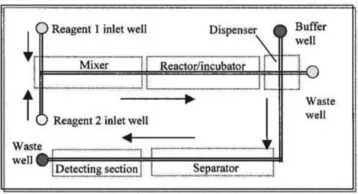
Figure 1.1 Illustration of microfluidic components in a lab-on-a-chip device.
The most important media in the biomedical analysis and diagnostics are liquids. Common liquids used in LOC devices include whole blood samples, bacterial cell suspensions, protein or antibody solutions and various buffers. Therefore, a key to the functions of the LOC is the quantitatively controlled flow, mass (e.g., sample molecules and particles) transport and heat transfer processes in microchannels. The studies of the transport processes in microchannels are referred to as the microfluidics. Generally, a lab-on-a-chip device must perform the following microfluidic functions: pumping, metering, mixing, flow switching, thermal cycling or incubating, sample dispensing or injection, and separating molecules or particles, etc. Precise manipulation of these microfluidic processes is key to the operation and performance of LOC.
Generally, we may classify the transport processes into three categories according to the characteristic dimension, Lc, of the systems: (1) Macroscale systems: LC> 200 μm. (2) Microscale systems: 100 nm < LC < 200 μm. (3) Nanoscale systems: LC< 100 nm. The characteristics of the transport processes change significantly as the characteristic dimension of the system changes from one category to anothe...
Table of contents
- Cover image
- Title page
- Table of Contents
- Interface Science and Technology Series Editor: Arthur Hubbard
- Front Matter
- Copyright page
- Preface
- Chapter 1: Lab-on-a-chip, microfluidics and interfacial electrokinetics
- Chapter 2: Basics of electrical double layer
- Chapter 3: Electro-viscous effects on pressure-driven liquid flow in microchannels
- Chapter 4: Electroosmotic flows in microchannels
- Chapter 5: Effects of surface heterogeneity on electrokinetic flow
- Chapter 6: Effects of surface roughness on electrokinetic flow
- Chapter 7: Experimental studies of electroosmotic flow
- Chapter 8: Electrokinetic sample dispensing in crossing microchannels
- Chapter 9: Electrophoretic motion of particles in microchannels
- Chapter 10: Microfluidic methods for measuring zeta potential
- Subject Index
Trusted by 375,005 students
Access to over 1.5 million titles for a fair monthly price.
Study more efficiently using our study tools.
Frequently asked questions
Yes, you can cancel anytime from the Subscription tab in your account settings on the Perlego website. Your subscription will stay active until the end of your current billing period. Learn how to cancel your subscription
No, books cannot be downloaded as external files, such as PDFs, for use outside of Perlego. However, you can download books within the Perlego app for offline reading on mobile or tablet. Learn how to download books offline
Perlego offers two plans: Essential and Complete
- Essential is ideal for learners and professionals who enjoy exploring a wide range of subjects. Access the Essential Library with 800,000+ trusted titles and best-sellers across business, personal growth, and the humanities. Includes unlimited reading time and Standard Read Aloud voice.
- Complete: Perfect for advanced learners and researchers needing full, unrestricted access. Unlock 1.5M+ books across hundreds of subjects, including academic and specialized titles. The Complete Plan also includes advanced features like Premium Read Aloud and Research Assistant.
We are an online textbook subscription service, where you can get access to an entire online library for less than the price of a single book per month. With over 1.5 million books across 990+ topics, we’ve got you covered! Learn about our mission
Look out for the read-aloud symbol on your next book to see if you can listen to it. The read-aloud tool reads text aloud for you, highlighting the text as it is being read. You can pause it, speed it up and slow it down. Learn more about Read Aloud
Yes! You can use the Perlego app on both iOS and Android devices to read anytime, anywhere — even offline. Perfect for commutes or when you’re on the go.
Please note we cannot support devices running on iOS 13 and Android 7 or earlier. Learn more about using the app
Please note we cannot support devices running on iOS 13 and Android 7 or earlier. Learn more about using the app
Yes, you can access Electrokinetics in Microfluidics by Dongqing Li in PDF and/or ePUB format, as well as other popular books in Physical Sciences & Analytic Chemistry. We have over 1.5 million books available in our catalogue for you to explore.