- 430 pages
- English
- ePUB (mobile friendly)
- Available on iOS & Android
eBook - ePub
About this book
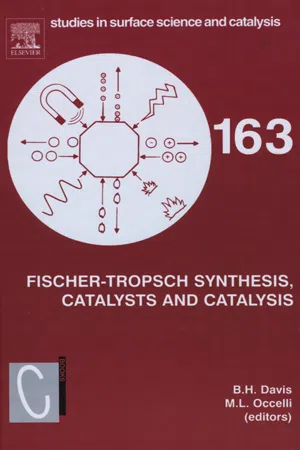
The declining supply of crude oils worldwide and the ever increasing demand for petroleum products from China, India, Europe and the US have recently propelled crude prices to unprecedented levels. The future availability of traditional crudes is becoming a source of discussion and debate.Fischer-Tropsch Synthesis, Catalysts and Catalysis offers a timely and comprehensive report on the processing of relatively inexpensive coal deposits into transportation fluids using Fisher-Tropsch process Technology. In addition to recent catalysts and process developments, the book contains the history of the Fisher-Tropsch in Germany and Japan based on captured documents by allied forces.* Increase the understanding of FT process development* Addresses four major areas of interest in Fischer-Tropsch synthesis (FTS)
Information
A History of the Fischer-Tropsch Synthesis in Germany 1926–45
Anthony N. Stranges, Department of History, Texas A&M University, College Station, TX 77843-4236
1. Introduction: twentieth-century synthetic fuels overview
The twentieth-century coal-to-petroleum, or synthetic fuel, industry evolved in three stages: (1) invention and early development of the Bergius coal liquefaction (hydrogenation) and Fischer-Tropsch (F-T) synthesis from 1910 to 1926; (2) Germany’s industrialization of the Bergius and F-T processes from 1927 to 1945; and (3) global transfer of the German technology to Britain, France, Japan, Canada, the United States, South Africa, and other nations from the 1930s to the 1990s.
Petroleum had become essential to the economies of industrialized nations by the 1920s. The mass production of automobiles, the introduction of airplanes and petroleum-powered ships, and the recognition of petroleum’s high energy content compared to wood and coal, required a shift from solid to liquid fuels as a major energy source. Industrialized nations responded in different ways. Germany, Britain, Canada, France, Japan, Italy, and other nations having little or no domestic petroleum continued to import petroleum. Germany, Japan, and Italy also acquired by force the petroleum resources of other nations during their 1930s-40s World War II occupations in Europe and the Far East. In addition to sources of naturally-occurring petroleum, Germany, Britain, France, and Canada in the 1920s-40s synthesized petroleum from their domestic coal or bitumen resources, and during the 1930s-40s war years Germany and Japan synthesized petroleum from the coal resources they seized from occupied nations. A much more favorable energy situation existed in the United States, and it experienced few problems in making an energy shift from solid to liquid fuels because it possessed large resources of both petroleum and coal.
Germany was the first of the industrialized nations to synthesize petroleum when Friedrich Bergius (1884–1949) in Rheinau-Mannheim in 1913 and Franz Fischer (1877–1947) and Hans Tropsch (1889–1935) at the Kaiser Wilhelm Institute for Coal Research (KWI) in Mulheim, Ruhr, in 1926 invented processes for converting coal to petroleum. Their pioneering researches enabled IG Farben, Ruhrchemie, and other German chemical companies to develop a technologically-successful synthetic fuel industry that grew from a single commercial-size coal liquefaction plant in 1927 to twelve coal liquefaction and nine F-T commercial-size plants that in 1944 reached a peak production of 23 million barrels of synthetic fuel.
Britain’s synthetic fuel program evolved from post-World War I laboratory and pilot-plant studies that began at the University of Birmingham in 1920 on the F-T synthesis and in 1923 on coal liquefaction. The Fuel Research Station in East Greenwich also began research on coal liquefaction in 1923, and the program reached its zenith in 1935 when Imperial Chemical Industries (ICI) constructed a coal liquefaction plant at Billingham that had the capacity to synthesize annually 1.28 million barrels of petroleum. British research and development matched Germany’s, but because of liquefaction’s high cost and the government’s decision to rely on petroleum imports rather than price supports for an expanded domestic industry, Billingham remained the only British commercial-size synthetic fuel plant. F-T synthesis in the 1930s-40s never advanced beyond the construction of four small experimental plants: Birmingham, the Fuel Research Station’s two plants that operated from 1935 to 1939, and Synthetic Oils Ltd. near Glasgow [1].
Britain and Germany had the most successful synthetic fuel programs. The others were either smaller-scale operations, such as France’s three demonstration plants (two coal liquefaction and one F-T), Canada’s bitumen liquefaction pilot plants, and Italy’s two crude petroleum hydrogenating (refining) plants, or technological failures as were Japan’s five commercial-size plants (two coal liquefaction and three F-T) that produced only about 360,000 barrels of liquid fuel during the World War II years [2].
The US Bureau of Mines had begun small-scale research on the F-T synthesis in 1927 and coal liquefaction in 1936, but did no serious work on them until the government expressed considerable concern about the country’s rapidly increasing petroleum consumption in the immediate post-World War II years. At that time the Bureau began a demonstration program, and from 1949 to 1953 when government funding ended, it operated a small 200–300 barrel per day coal liquefaction plant and a smaller fifty barrel per day F-T plant at Louisiana, Missouri. In addition to the Bureau’s program, American industrialists constructed four synthetic fuel plants in the late 1940s and mid-1950s, none of which achieved full capacity before shutdown in the 1950s for economic and technical reasons. Three were F-T plants located in Garden City, Kansas; Brownsville, Texas; and Liberty, Pennsylvania. The fourth plant was a coal liquefaction plant in Institute, West Virginia [3].
Following the plant shutdowns in the United States and until the global energy crises of 1973–74 and 1979–81, all major synthetic fuel research and development ceased except for the construction in 1955 of the South African Coal, Oil, and Gas Corporation’s (SASOL) F-T plant in Sasolburg, south of Johannesburg. South Africa’s desire for energy independence and the low quality of its coal dictated the choice of F-T synthesis rather than coal liquefaction. Its Johannesburg plant remained the only operational commercial-size synthetic fuel plant until the 1970s energy crises and South Africa’s concern about hostile world reaction to its apartheid policy prompted SASOL to construct two more F-T plants in 1973 and 1976 in Secunda.
The 1970s energy crises also revitalized synthetic fuel research and development in the United States and Germany and led to joint government-industry programs that quickly disappeared once the crises had passed. Gulf Oil, Atlantic Richfield, and Exxon in the United States, Saarbergwerke AG in Saarbruken, Ruhrkohle AG in Essen, and Veba Chemie in Gelsenkirchen, Germany, constructed F-T and coal liquefaction pilot plants in the 1970s and early 1980s only to end their operation with the collapse of petroleum prices a few years later [4].
In the mid-1990s two developments triggered another synthetic fuel revival in the United States: (1) petroleum imports again reached 50 percent of total consumption, or what they were during the 1973–1974 Arab petroleum embargo, and (2) an abundance of natural gas, equivalent to 800,000,000,000 barrels of petroleum, but largely inaccessible by pipeline, existed. Syntroleum in Tulsa, Oklahoma; Exxon in Baytown, Texas; and Atlantic Richfield in Plano, Texas, developed modified F-T syntheses that produced liquid fuels from natural gas and thereby offered a way of reducing the United States’s dependence on petroleum imports. The Department of Energy (DOE) at its Pittsburgh Energy Technology Center through the 1980s-90s also continued small-scale research on improved versions of coal liquefaction. DOE pointed out that global coal reserves greatly exceeded petroleum reserves, anywhere from five to twenty-four times, and that it expected petroleum reserves to decline significantly in 2010–2030. Syntroleum, Shell in Malaysia, and SASOL and Chevron in Qatar have continued F-T research, whereas DOE switched its coal liquefaction research to standby. The only ongoing coal liquefaction research is a pilot plant study by Hydrocarbon Technologies Incorporated in Lawrenceville, New Jersey, now Headwaters Incorporated in Draper, Utah.
A combination of four factors, therefore, has led industrialized nations at various times during the twentieth century to conclude that synthetic fuel could contribute to their growing liquid fuel requirements: (1) the shift from solid to liquid fuel as a major energy source, (2) the invention of the Bergius and F-T coal-to-petroleum conversion or synthetic fuel processes, (3) recognition that global petroleum reserves were finite and much less than global coal reserves and that petroleum’s days as a plentiful energy source were limited, and (4) the desire for energy independence.
With the exception of South Africa’s three F-T plants the synthetic fuel industry, like most alternative energies, has endured a series of fits and starts that has plagued its history. The historical record has demonstrated that after nearly 90 years of research and development synthetic liquid fuel has not emerged as an important alternative energy source. Despite the technological success of synthesizing petroleum from coal, its lack of progress and cyclical history are the result of government and industry uninterest in making a firm and a long-term commitment to synthetic fuel research and development. The synthetic fuel industry experienced intermittent periods of intense activity internationally in times of crises, only to face quick dismissal as unnecessary or uneconomical upon disappearance of the crises. Even its argument that synthetic liquid fuels are much cleaner burning than coal, and if substituted for coal they would reduce the emissions that have contributed to acid rain formation, greenhouse effect, and to an overall deterioration of air quality has failed to silence its critics. The hope of transforming its accomplishments at the demonstration stage into commercial-size production has not yet materialized.
The history of the synthetic fuel industry’s fits and starts remains only partially written, with much of the historical interest having focused on Germany’s coal hydrogenation process because it was the more advanced and contributed much more significantly to Germany’s liquid fuel supply than the F-T synthesis. Coal hydrogenation produced high quality aviation and motor gasoline, whereas the F-T synthesis gave high quality diesel and lubricating oil, waxes and some lower quality motor gasoline. The two processes actually were complementary rather than competitive, but because only coal hydrogenation produced high quality gasoline it experienced much greater expansion in the late 1930s and war years than the F-T synthesis, which hardly grew at all. F-T products were mainly the raw materials for further chemical syntheses with little upgrading of its low quality gasoline by cracking because of unfavorable economics. Hydrogenation also experienced greater development because brown coal (lignite), the only coal available in many parts of Germany, underwent hydrogenation more readily than a F-T synthesis. In addition, the more mature and better developed hydrogenation process had the support of IG Farben, Germany’s chemical leader, which successfully industrialized coal hydrogenation beginning in 1927 [5].
Despite its smaller size and lower production, the 9 F-T plants contributed 455,000576,000 metric tons of coal-derived oil per year during the war years 12–15 percent of Germany’s total liquid fuel requirement. The historical analysis that follows examines the T-T’s invention and industrial development during several decades of German social, political, and economic unrest and complements the historical literature on Germany’s coal hydrogenation process. The historical examination of the two processes provides a more complete history of Germany’s synthetic fuel industry.
2. Early development of the F-T synthesis: catalysts, conditions, and converters
Germany has virtually no petroleum deposits. Prior to the twentieth century this was not a serious problem because Germany possessed abundant coal reserves. Coal provided for commercial and home heating; it also fulfilled the needs of industry and the military, particularly the navy. In the opening decade of the twentieth century, Germany’s fuel requirements began to change. Two reasons were especially important. First, Germany became increasingly dependent on gasoline and diesel oil engines. The appearance of automobiles, trucks, and then airplanes made a plentiful supply of gasoline essential. Moreover, ocean-going ships increasingly used diesel oil rather than coal as their energy source. Second, Germany’s continuing industrialization and urbanization led to the replacement of coal with smokeless liquid fuels that not only had a higher energy content but were cleaner burning and more co...
Table of contents
- Cover image
- Title page
- Table of Contents
- Copyright page
- Foreword
- Chapter 1: A History of the Fischer-Tropsch Synthesis in Germany 1926–45
- Chapter 2: Synthetic Lubricants: Advances in Japan up to 1945 Based on Fischer-Tropsch Derived Liquids
- Chapter 3: A History of the BP Fischer-Tropsch Catalyst from Laboratory to Full Scale Demonstration in Alaska and Beyond
- Chapter 4: Loading of Cobalt on Carbon Nanofibers
- Chapter 5: Production of Hard Hydrocarbons from Synthesis-Gas Over Co-Containing Supported Catalysts
- Chapter 6: The Function of Added Noble Metal to Co/Active Carbon Catalysts for Oxygenate Fuels Synthesis via Hydroformylation at Low Pressure
- Chapter 7: Eels-Stem Investigation of the Formation of Nano-Zones in Iron Catalysts for Fischer-Tropsch Synthesis
- Chapter 8: Effect of Mo Loading and Support Type on Hydrocarbons and Oxygenates Produced Over Fe-Mo-Cu-K Catalysts Supported on Activated Carbons
- Chapter 9: Study of Carbon Monoxide Hydrogenation Over Supported Au Catalysts
- Chapter 10: ZrFe Intermetallides for Fischer-Tropsch Synthesis: Pure and Encapsulated into Alumina-Containing Matrices
- Chapter 11: Comparing Fischer-Tropsch Synthesis on Iron- and Cobalt Catalysts
- Chapter 12: Fischer-Tropsch Synthesis: Compositional Modulation Study Using an Iron Catalyst
- Chapter 13: Fischer-Tropsch Synthesis: Influence of Support on the Impact of Co-Fed Water for Cobalt-Based Catalysts
- Chapter 14: Identification of Cobalt Species During Temperature Programmed Reduction of Fischer-Tropsch Catalysts
- Chapter 15: Determination of the Partial Pressure of Water During the Activation of the BP GTL Fischer-Tropsch Catalyst and its Effects on Catalyst Performance
- Chapter 16: Fischer-Tropsch Synthesis: Kinetics and Effect of Water for a Co/Al2O3 Catalyst
- Chapter 17: Early Entrance Coproduction Plant - the Pathway to the Commercial CTL (Coal-to-Liquids) Fuels Production
- Chapter 18: QA and Optimization Issues During Development of the Statoil FT-Catalyst
- Chapter 19: Magnetic Separation of Nanometer Size Iron Catalyst from Fischer-Tropsch Wax
- Chapter 20: Selective Fischer-Tropsch Wax Hydrocracking–Opportunity for Improvement of Overall Gas-to-Liquids Processing
- Chapter 21: Methanol Synthesis in Inert or Catalytic Supercritical Fluid
- Chapter 22: Fischer-Tropsch Based GTL Technology: a New Process?
- Chapter 23: Concepts for Reduction in CO2 Emissions in GTL Facilities
- Back Matter
Trusted by 375,005 students
Access to over 1.5 million titles for a fair monthly price.
Study more efficiently using our study tools.
Frequently asked questions
Yes, you can cancel anytime from the Subscription tab in your account settings on the Perlego website. Your subscription will stay active until the end of your current billing period. Learn how to cancel your subscription
No, books cannot be downloaded as external files, such as PDFs, for use outside of Perlego. However, you can download books within the Perlego app for offline reading on mobile or tablet. Learn how to download books offline
Perlego offers two plans: Essential and Complete
- Essential is ideal for learners and professionals who enjoy exploring a wide range of subjects. Access the Essential Library with 800,000+ trusted titles and best-sellers across business, personal growth, and the humanities. Includes unlimited reading time and Standard Read Aloud voice.
- Complete: Perfect for advanced learners and researchers needing full, unrestricted access. Unlock 1.5M+ books across hundreds of subjects, including academic and specialized titles. The Complete Plan also includes advanced features like Premium Read Aloud and Research Assistant.
We are an online textbook subscription service, where you can get access to an entire online library for less than the price of a single book per month. With over 1.5 million books across 990+ topics, we’ve got you covered! Learn about our mission
Look out for the read-aloud symbol on your next book to see if you can listen to it. The read-aloud tool reads text aloud for you, highlighting the text as it is being read. You can pause it, speed it up and slow it down. Learn more about Read Aloud
Yes! You can use the Perlego app on both iOS and Android devices to read anytime, anywhere — even offline. Perfect for commutes or when you’re on the go.
Please note we cannot support devices running on iOS 13 and Android 7 or earlier. Learn more about using the app
Please note we cannot support devices running on iOS 13 and Android 7 or earlier. Learn more about using the app
Yes, you can access Fischer-Tropsch Synthesis, Catalysts and Catalysis by in PDF and/or ePUB format, as well as other popular books in Technology & Engineering & Chemical & Biochemical Engineering. We have over 1.5 million books available in our catalogue for you to explore.