- 399 pages
- English
- ePUB (mobile friendly)
- Available on iOS & Android
eBook - ePub
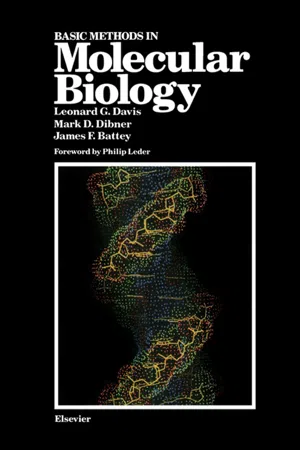
Basic Methods in Molecular Biology
About this book
Basic Methods in Molecular Biology discusses the heart of the most recent revolution in biology—the development of the technology of genetics. The achievements in this field have simply changed what biologists do and, perhaps even more important, the way they think. Moreover, never before have scientists from such a broad range of disciplines rushed into such a small and slightly arcane field to learn and carry off a bit of the technology. This book comprises 21 chapters, opening with three introductory ones that discuss the basics of molecular biology; the tools of the molecular biologist; and general preparations, procedures, and considerations for use of the book. The following chapters then discuss cloning vectors and bacterial cells; preparation of DNA from eukaryotic cells; probing nucleic acids; plasmid DNA preparation; DNA restriction fragment preparation; purification of DNA; and preparation and analysis of RNA from eukaryotic cells. Other chapters cover preparation of DNA from bacteriophage clones; cloning DNA from the eukaryotic genome; subcloning into plasmids; M13 cloning and sequencing; further characterization of cloned DNA; transfection of mammalian cells in culture; protein methods; general methods; and specialized methods. This book will be of interest to practitioners in the fields of biology and molecular genetics.
Information
The Basics of Molecular Biology
Publisher Summary
This chapter describes the methods for performing experiments in molecular genetics. Biological science has been revolutionized by a series of new investigative techniques developed within the past 15 years. These techniques allow the definition of molecular mechanisms and structures that are responsible for such complex processes as cell growth and division, metabolism, differentiation, and development. They provide a way to manipulate molecules critical to these processes and observe the changes in living systems that incorporate the altered molecules. The chapter explains that many molecular biology laboratory methods take advantage of the relative simplicity of prokaryotic cell systems such as bacteria. In prokaryotes, the continuous linear DNA sequence corresponds directly to linear RNA and protein sequences. However, in eukaryotes, the DNA encoding for protein cannot be read continuously as it contains interruptions in the translatable sequence. It also describes monoclonal antibody production techniques, which are used to prepare immunological probes for specific gene products as well as in situ hybridization, which uses nucleotide probes to localize and study specific genetic messages in tissue.
Current biological science has been revolutionized by a series of new investigative techniques developed within the last 15 years. These techniques allow the definition of molecular mechanisms and structures that are responsible for such complex processes as cell growth and division, metabolism, differentiation and development. More significantly, they provide a way to manipulate molecules critical to these processes, and observe the changes in living systems that incorporate the altered molecules.
Nucleic acids and proteins are macromolecules; linear polymers comprised of subunits. Nucleic acids encode the genetic information specifying the primary structure of all proteins unique to an organism. Together with lipids and extracellular supporting stroma, they create cellular activity and physiological function. Thus, biological functions can be understood in part by examining the interrelationships between these key components. The genetic material of the cell, deoxyribonucleic acid (DNA), is a polymer composed of four nucleotide building blocks. Each of the four nucleotides contains a nucleic acid base (A, adenine; G, guanine; T, thymine; C, cytosine), a deoxyribose sugar moiety, and a phosphoester. Each strand is a string of nucleotides covalently bound together by phosphoester linkages between the 5’ carbon on the deoxyribose sugar of one nucleotide and the 3’ carbon of the sugar moiety on the neighboring nucleotide. Chains of these DNA subunits exist as two antiparallel strands in opposite polarity with respect to the phosphate sugar backbone, wound around each other in a double helical structure. One strand binds tightly to the other strand because there is the potential for hydrogen bond formation between specific bases on one strand with bases on the opposite, or complementary, strand. Adenine is always paired with thymine, and guanine with cytosine. The fidelity of base pairing is provided by the nucleic acid synthesizing machinery that normally adds only the “correct” base specified by the template strand when elongating a new strand. It is the constancy and specificity of this complementary base pairing that forms the basis of DNA’s function as a repository of genetic information. The order of nucleotides in DNA corresponds to the order of amino acids in proteins. As such, DNA can encode for proteins, with triplet groups of three adjacent nucleotides representing an mRNA codon, which specifies a particular amino acid. Therefore, the linear nucleotide sequence in DNA specifies the order of amino acids for the cell’s structural, functional, and enzymatic proteins. Other regions of DNA, which do not directly encode protein, contain information directing the regulation of gene product synthesis.
In the synthetic pathway between DNA and protein are the ribonucleic acids (RNA). The strand encoding the protein sequence information of the double-stranded DNA is copied, or transcribed, into a complementary strand of RNA. This RNA contains the same bases as DNA, except that uridine (U) is substituted for T and a ribose moiety is present instead of the deoxyribose. The RNA copy of the gene, called messenger RNA (mRNA), is translated with the assistance of transfer RNA (tRNA) and ribosomes (rRNA and associated proteins) to assemble sequentially the amino acids that form the primary sequence of protein.
Many molecular biology laboratory methods take advantage of the relative simplicity of prokaryotic cell systems such as bacteria. In prokaryotes, the continuous linear DNA sequence corresponds directly to linear RNA and protein sequences. However, in eukaryotes, the DNA encoding for protein cannot be read continuously as it contains interruptions (introns) in the translatable sequence. Eukaryotic DNA is thus first copied to a primary transcript (heteronuclear RNA) that is processed in the nucleus by excision of the protein coding sequences (exons). The exons are joined linearly into mature mRNA that can be processed further in the nucleus and moved to the cytoplasm for translation into protein. Certain newer methods allow the study of genes in eukaryotic cell systems.
Understanding the structure, function, and regulation of genes and their products is essential to an appreciation of biological systems. This also involves understanding the organization of an organism’s nucleic acids. Previously this understanding was confounded by the complexity of the genome in eukaryotic cells, which contains up to 109 nucleotides in 50,000 genes. To analyze the genetic structure and events in this complex situation, one needs the ability to isolate and study a single gene in a purified form. Molecular cloning of DNA provides a mechanism for isolating a single discrete segment of DNA from a population of genes, purifying this segment to homogeneity, and amplifying the DNA segment to produce enough pure material for chemical, genetic, and biological analysis. The process of cloning relies entirely on performing enzymatic reactions in the laboratory, using well characterized bacterial DNA cleaving enzymes (restriction enzymes, REs) and modifying enzymes to copy, cut, and splice together discrete DNA molecules. DNA molecules are thus introduced into bacterial cells after being spliced into autonomously replicating DNA circles (plasmids) or bacterial viruses (bacteriophages). After many rounds of replication, the hybrid molecules are reisolated and purified, yielding sufficient quantities of the cloned DNA segment.
With the isolated, purified DNA segment the nucleotide sequence of bases can rapidly be determined, leading to the prediction of the amino acid sequence of the encoded protein. Radioactive labeling of this purified DNA allows the scientist to specifically probe for copies of related DNA sequences in complex cell genomes or related intracellular mRNA, amidst a background of up to a million unrelated sequences. mRNA synthesis from the purified DNA can be detected and quantitated in amounts as low as one to ten copies per cell. Reengineering of the cloned DNA in bacteria or yeast may allow expression of its protein coding sequence, providing an inexpensive and abundant source of otherwise unattainable proteins of biological or medical importance. Alternative versions of the cloned DNA can be created in the laboratory by changing the structure or sequence. These DNA constructs can then be reintroduced into cells or whole animals to study the results of these man-made changes or mutations, and understand more completely the function and regulation of genes.
In this book, we describe methods for performing these experiments in molecular genetics. In each case, the method is described in a step-by-step, “cookbook” format and has been used, as written, with favorable results.
A WALK THROUGH THIS MANUAL
The methods in this book range from very simple to very complex. First is a description of the plasmid and vector systems and bacterial host cells used in the methods. The initial sections assume that a specific synthetic or cloned DNA probe is already available, allowing the selection, amplification, and examination of the gene of interest. Methods for isolating DNA from tissue, cutting the DNA to usable size, and separating the DNA pieces by size are discussed in Section 5. Sections 6 and 7 present methods for making probes, either synthetic or plasmid derived, to use in selecting DNA of interest. Methods for plasmid preparation and amplification are presented in Section 8. From the amplified plasmids, cloned DNA is excised and purified (Sections 9 and 10).
Section 11 turns to RNA—its preparation, selection, separation, and analysis. In Section 12, another type of cloning vector, the bacteriophage, is described. Please note that up to this point, the methods described involve the selection and amplification of DNA sequences that have already been cloned. The next two sections, 13 and 14, present methods for creating genomic DNA and cDNA libraries in bacteriophage vectors.
From the created library a desired clone is selected. The next step is to grow that DNA on a large scale, as described in Section 15 on subcloning into plasmids for preparative growth. From the higher yield of this cloned DNA, the sequence and other properties can be studied, following cloning into an appropriate M13 vector (Sections 16 and 17). Up to this point, DNA has been studied using the benefits of simpler prokaryotic systems. However, it may be of interest to put modified versions of the cloned gene back into the genome of eukaryotic cells in order to evaluate its regulation and function in a more biologically relevant system. Section 18 describes methods for incorporating DNA into mammalian cells growing in culture.
As mentioned above, proteins are the product of the genetic material, and it may be important to study them in order to understand gene regulation. Also, it is possible to translate RNA into proteins in vitro. These protein-related methods are described in Section 19.
The section on general methods (20) describes basic techniques that are incorporated into many of the other methods discussed in the text, such as DNA extraction, autoradiography, and titration of plaques. It is anticipated that the novice will refer to these methods initially; in time they will become second nature.
Lastly, several more specialized molecular biological methods are described in Section 21. The first, transgenic mouse analysis, involves incorporation of new DNA pieces into a mouse embryo for later analysis in the postpartum animal. We also describe monoclonal antibody production techniques used to prepare immunological probes for specific gene products, as well as in situ hybridization, which uses nucleotide probes to localize and study specific genetic messages in tissue sections. Finally, some general notes are given on the use of yeast host and vector systems to perform molecular biology techniques.
The next few pages describe the use of specific techniques in molecular biological studies, with attention to questions that can be addressed using these methods.
The Tools of the Molecular Biologist
Publisher Summary
This chapter discusses a series of experiments to study a typical gene, X, employing a variety of molecular biology methods. It is desirable to study gene X for its interesting structure or relevant expression in some biological context. The labeled probe is used in DNA blotting to analyze DNA from a tissue or cell line of choice using DNA blots to define the presence of gene X-related sequences in the genome. An altered pattern of hybridizing DNA restriction fragments appears on the Southern blot from DNA made from a specific tissue sample, indicating a change in the gene X structural sequences. The chapter provides a basis for the systematic study of mammalian gene expression. The methods that are used are not always straightforward or simple to use; however, once they are mastered, they will be powerful tools to help the researcher understand the functioning of biological systems. It is also possible to define the genetic basis of certain diseases, physiological reactions, biochemical mechanisms, and cellular processes. Tools are used for the generation of products of biotechnology, including powerful new therapeutics, new diagnostics, and other valuable biomedical products.
To illustrate the use of molecular biology methods, this section follows one possible series of experiments to study a typical gene, X, employing a variety of these methods.
It may be desirable to study gene X for its interesting structure or relevant expression in some biological context. Initially, a radiolabeled DNA probe needs to be obtained with a sequence similar to that on gene X, for example the gene from another species (homology to gene X). This probe can be purified and nick-translated to form a radiolabeled probe in order to detect the presence of gene X in a Southern blot analysis. Alternatively, a synthetic oligonucleotide probe can be synthesized in the laboratory to contain a sequence complementary to a portion of gene X. The labeled probe can then be used in DNA blotting to analyze DNA from a tissue or cell line of choice using DNA blots to define the presence of gene X-related sequences in the genome.
To do these DNA (Southern) blots, DNA from a tissue or cell line is isolated and purified and cut with specific restriction endonuclease(s) (REs) into defined fragments; the fragments of DNA are then fractionated by size using agarose gel electrophoresis. The DNA on. the gel is transferred to a nitrocellulose filter (Southern blot), and the blot is hybridized with probe specific for gene X (Southern hybridization). The probe forms complementary base pairs only with restriction fragments that contain homologous sequences. Nonspecific radioactivity is washed away, and autoradiography of the blot demonstrates one or more bands if gene X is present or no bands if gene X is not found in the DNA tested.
An altered pattern of hybridizing DNA restriction fragments may appear on the Southern blot from DNA made from a specific tissue sample, indicating a change in the gene X structural sequences. For example, if there is a rearrangement of DNA in a specific tissue or tumor, this “somatic” rearrangement can be identified by purifying DNA from different tissue sources and probing, as described above. Genomic DNA from different cell types or tissues might show different size hybridizing fragments on the Southern blot, resulting from the changes introduced by rearrangement in the DNA.
Another example of an altered DNA pattern might be due to restriction fragment length polymorphisms (RFLPs) or different gene forms (alleles). If the genomic DNA from 100 individuals was cut with the RE EcoRI and was probed on Southern blots with the probe for gene X, two or more different subpopulations may appear. Therefore, there may be some individuals whose genomic DNA contains a 10-kb hybridizing restriction fragment, others with a 6-kb hybridizing fragment, and heterozygous individuals with both 6- and 10-kb fragments, representing the two different alleles for the locus of gene X present in the population studied. Some of these RFLPs may be linked to genes responsible for genetically based diseases or a predisposition to malignancy. A correlation between detection of a specific allele of a gene X and developing a genetic disease or malignancy could be established. Southern blotting studies then allow an estimation of the ...
Table of contents
- Cover image
- Title page
- Table of Contents
- Copyright
- Foreword
- Acknowledgments
- Chapter 1: The Basics of Molecular Biology
- Chapter 2: The Tools of the Molecular Biologist
- SECTION 3: General Preparations, Procedures, and Considerations for Use of Manual
- SECTION 4: Cloning Vectors and Bacterial Cells
- SECTION 5: Preparation of DNA from Eukaryotic Cells
- SECTION 6: Probing Nucleic Acids with Labeled Synthetic Probes
- SECTION 7: Probing Nucleic Acids with Plasmid-Derived Probes
- SECTION 8: Plasmid DNA Preparation
- SECTION 9: DNA Restriction Fragment Preparation
- SECTION 10: Purification of DNA
- SECTION 11: Preparation and Analysis of RNA from Eukaryotic Cells
- SECTION 12: Preparation of DNA from Bacteriophage Clones
- SECTION 13: Cloning DNA from the Eukaryotic Genome
- SECTION 14: cDNA Cloning into λgtlO and λgt11
- SECTION 15: Subcloning into Plasmids
- SECTION 16: M13 Cloning and Sequencing
- SECTION 17: Further Characterization of Cloned DNA
- SECTION 18: Transfection of Mammalian Cells in Culture
- SECTION 19: Protein Methods
- SECTION 20: General Methods
- SECTION 21: Specialized Methods
- Stock Solutions
- Enzymes
- Suppliers of Reagents and Equipment
- Index
Trusted by 375,005 students
Access to over 1.5 million titles for a fair monthly price.
Study more efficiently using our study tools.
Frequently asked questions
Yes, you can cancel anytime from the Subscription tab in your account settings on the Perlego website. Your subscription will stay active until the end of your current billing period. Learn how to cancel your subscription
No, books cannot be downloaded as external files, such as PDFs, for use outside of Perlego. However, you can download books within the Perlego app for offline reading on mobile or tablet. Learn how to download books offline
Perlego offers two plans: Essential and Complete
- Essential is ideal for learners and professionals who enjoy exploring a wide range of subjects. Access the Essential Library with 800,000+ trusted titles and best-sellers across business, personal growth, and the humanities. Includes unlimited reading time and Standard Read Aloud voice.
- Complete: Perfect for advanced learners and researchers needing full, unrestricted access. Unlock 1.5M+ books across hundreds of subjects, including academic and specialized titles. The Complete Plan also includes advanced features like Premium Read Aloud and Research Assistant.
We are an online textbook subscription service, where you can get access to an entire online library for less than the price of a single book per month. With over 1.5 million books across 990+ topics, we’ve got you covered! Learn about our mission
Look out for the read-aloud symbol on your next book to see if you can listen to it. The read-aloud tool reads text aloud for you, highlighting the text as it is being read. You can pause it, speed it up and slow it down. Learn more about Read Aloud
Yes! You can use the Perlego app on both iOS and Android devices to read anytime, anywhere — even offline. Perfect for commutes or when you’re on the go.
Please note we cannot support devices running on iOS 13 and Android 7 or earlier. Learn more about using the app
Please note we cannot support devices running on iOS 13 and Android 7 or earlier. Learn more about using the app
Yes, you can access Basic Methods in Molecular Biology by Leonard Davis in PDF and/or ePUB format, as well as other popular books in Biological Sciences & Biology. We have over 1.5 million books available in our catalogue for you to explore.