eBook - ePub
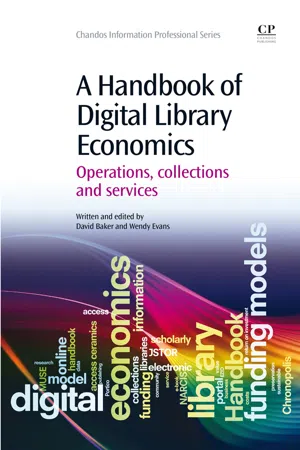
A Handbook of Digital Library Economics
Operations, Collections and Services
- 284 pages
- English
- ePUB (mobile friendly)
- Available on iOS & Android
eBook - ePub
About this book
This book provides a companion volume to Digital Library Economics and focuses on the 'how to' of managing digital collections and services (of all types) with regard to their financing and financial management. The emphasis is on case studies and practical examples drawn from a wide variety of contexts. A Handbook of Digital Library Economics is a practical manual for those involved – or expecting to be involved – in the development and management of digital libraries.
- Provides practical approach to the subject
- Focuses on the challenges associated with the economic and financial aspects of digital developments
- Will be valuable to practitioners, and tutors and students in a wide variety of situations
Information
1
Digital economics: introduction and overview
Abstract.
Chapter 1 provides an overview of digital library economics, describing the main areas to be discussed in more detail in subsequent chapters and case studies. It provides definitions of the term ‘digital library’ and a literature review of recent history and relevant works. It concludes with the key themes relating to all aspects of digital libraries: sustainability, economic models, business plans and resource allocation, and cost-effective decision-making.
Keywords
business plans
cost-effective decision-making
digital library
economic models
history of digital libraries
resource allocation
sustainability
Introduction
This opening chapter aims to provide an overview of digital library economics, describing the main areas to be discussed in more detail in subsequent chapters. It is complemented by Chapter 4, a résumé and critique by Derek Law of the case studies that form an integral part of the later chapters of this publication. For a fuller contextual and environmental analysis of the subject, see Digital Library Economics: An Academic Perspective (Baker and Evans, 2009), especially the first two chapters.
Defining the digital library
In ‘an era of unprecedented technological innovation and evolving user expectations and information-seeking behaviour, we are arguably now an online society, with digital services increasingly common and increasingly preferred’ (Buchanan, 2010; see also Castelli, 2006). Moreover, there continues to be an exponential growth in digital content and an ever greater divergence in its provenance. There is clearly a significant role for digital libraries which, ideally, should ‘enable any citizen to access all human knowledge anytime and anywhere, in a friendly, multi-modal, efficient, and effective way, by overcoming barriers of distance, language, and culture and by using multiple Internet-connected devices’.1
The ‘Library’ is being de- and re-constructed, with a digital future being seen as the norm in many environments. Digital libraries will not necessarily be linked to a physical space or a single organization, though many have grown – and will continue to grow – out of a single entity, which may have a physical base, collections and services as well as digital ones. In most cases, the digital library will bring together content and services from a range of suppliers, both commercial and non-commercial. In the digital library, physical location is immaterial and formats are diverse. (Baker, 2006)
What will the library be for, what will it be doing, in 20 years time? What are the things done now that should be distilled and preserved for the future, the unique roles and tasks that should continue, however technology might develop, and which are so demonstrably vital that funders and policy-makers will want to pay for them? A number of definitions of a digital library have been put forward in recent years. The most popular were analysed in Digital Library Economics (Baker and Evans, 2009). The working definition of the Digital Library Federation is regularly cited and appears to have a wide currency:
Digital libraries are organizations that provide the resources, including the specialized staff, to select, structure, offer intellectual access to, interpret, distribute, preserve the integrity of, and ensure the persistence over time of collections of digital works so that they are readily and economically available for use by a defined community or set of communities. (Digital Library Federation, 1998)
The definition from the Joint Information Systems Committee (JISC) stresses the distributed nature of electronic library provision:
A ‘digital library’ provides access to digital collections (as opposed to print, microform, or other media) using one or more interlinked information retrieval systems. The digital content may be stored locally within the institution, in a repository or stored remotely for example in a JISC data centre or a national repository and accessed via the Janet network.2
More recently, Candela et al. (2011) have provided another variant on the basic definition, as follows:
A potentially virtual organisation, that comprehensively collects, manages and preserves for the long depth of time rich digital content, and offers to its targeted user communities specialised functionality on that content, of defined quality and according to comprehensive codified policies.
Our definition of a ‘digital library’ remains much the same as it was in Digital Library Economics: An Academic Perspective (Baker and Evans, 2009):
…an organizational entity that brings together a wide range of … assets, including metadata, catalogues, primary source materials, learning objects, datasets and digital repositories – in a structured and managed way. It will be a place to search for these assets, to discover their existence, to locate them and then, if required, receive them. It will also recognize and support the core authoring functions of creation, iteration, finalization and publication. (Baker, 2006, cited in Baker and Evans, 2009)
In addition, digital libraries must maintain, store and preserve in ways not envisaged in a traditional library set-up. Elements of a digital library may include the conversion of existing services into digital mode or the creation of new services, for example ‘online delivery, portals, personalised services, online teaching modules, online reference, digitised collections, or electronic publishing’ (Poll, 2005). The emphasis will vary depending upon context, need and priority, though the basic elements identified here are typically always present (see, for example, Digital Library Federation, 1998; Seadle and Greifeneder, 2007).
The need for economics
Libraries – of all types – face an uncertain future (Feather, 2004; Grant, 2010). So do publishers and others involved in the creation, publication and dissemination of information and knowledge (see, for example, Paulson, 2011; Johnson, 2012). Continuing global economic difficulties and increased competition from other services and alternative means of provision mean that libraries will have to fight for resources, including through the development of strategic approaches and partnerships (Rasmussen and Jochumsen, 2003). In Digital Library Economics (Baker and Evans, 2009) we stressed the importance of the financial and related aspects of digital library management and development:
Economics is a complex subject, and there are close links with other elements of the sophisticated and subtle value chain that is library provision and usage. It is more than just being about finances. Information has an economic value, not least in terms of added value, and in particular what it enables people to do once they possess information. (Baker and Evans, 2009)
However, it is only since the late 1990s that the need for a better understanding of all economic aspects of digital libraries – and notably cost, funding, long-term financial implications and the need to ensure sustainability – has been fully recognised. The drive to ensure sustainability has become ever more important and prevalent:
And more and more new projects are being created with the premise that they should develop into sustainable services. Regardless of the initial intention, if the projects cannot achieve financial sustainability, they will either limp along or fail altogether. (Guthrie et al., 2008)
In Digital Library Economics (Baker and Evans, 2009), we discussed in some detail the key themes surrounding the development of the digital library in the first decade of the twenty-first century, as do the other authors in that volume. Those themes were further developed and broadened in Libraries and Society: Role, Responsibility and Future in an Age of Change (Baker and Evans, 2011) and even more so in Trends, Discovery and People in the Digital Age (Baker and Evans, 2013). The fut...
Table of contents
- Cover image
- Title page
- Table of Contents
- Copyright
- Foreword
- Preface
- Acknowledgements
- List of abbreviations
- List of figures and tables
- About the authors
- Chapter 1: Digital economics: introduction and overview
- Chapter 2: Sustainability
- Case Study 1: The JSTOR platform
- Case Study 2: Project MUSE
- Case Study 3: Organic, symbiotic digital collection development
- Case Study 4: Developing a portal framework for humanities scholars
- Chapter 3: Models and tools
- Case Study 5: accessCeramics: building and sustaining a global resource for arts education
- Case Study 6: The Chronopolis digital network: the economics of long-term preservation
- Case Study 7: Economic implications of alternative scholarly publishing models
- Case Study 8: Sustainable economic models: Portico
- Case Study 9: Methods and metrics for assessing the return on investment of public, academic and special libraries
- Case Study 10: EZID: a digital library data management service
- Case Study 11: Adding e-books and audiobooks to the search experience: How one vendor addressed customer needs and created a better e-book system for libraries
- Case Study 12: Woodhead Publishing Online – Chandos Publishing Online
- Case Study 13: A cost study of BMCC electronic reserves with a streaming video service
- Case Study 14: National Academic Research and Collaborations Information System in the Netherlands
- Chapter 4: The universal library: realising Panizzi’s dream
- Index
Trusted by 375,005 students
Access to over 1.5 million titles for a fair monthly price.
Study more efficiently using our study tools.
Frequently asked questions
Yes, you can cancel anytime from the Subscription tab in your account settings on the Perlego website. Your subscription will stay active until the end of your current billing period. Learn how to cancel your subscription
No, books cannot be downloaded as external files, such as PDFs, for use outside of Perlego. However, you can download books within the Perlego app for offline reading on mobile or tablet. Learn how to download books offline
Perlego offers two plans: Essential and Complete
- Essential is ideal for learners and professionals who enjoy exploring a wide range of subjects. Access the Essential Library with 800,000+ trusted titles and best-sellers across business, personal growth, and the humanities. Includes unlimited reading time and Standard Read Aloud voice.
- Complete: Perfect for advanced learners and researchers needing full, unrestricted access. Unlock 1.5M+ books across hundreds of subjects, including academic and specialized titles. The Complete Plan also includes advanced features like Premium Read Aloud and Research Assistant.
We are an online textbook subscription service, where you can get access to an entire online library for less than the price of a single book per month. With over 1.5 million books across 990+ topics, we’ve got you covered! Learn about our mission
Look out for the read-aloud symbol on your next book to see if you can listen to it. The read-aloud tool reads text aloud for you, highlighting the text as it is being read. You can pause it, speed it up and slow it down. Learn more about Read Aloud
Yes! You can use the Perlego app on both iOS and Android devices to read anytime, anywhere — even offline. Perfect for commutes or when you’re on the go.
Please note we cannot support devices running on iOS 13 and Android 7 or earlier. Learn more about using the app
Please note we cannot support devices running on iOS 13 and Android 7 or earlier. Learn more about using the app
Yes, you can access A Handbook of Digital Library Economics by Wendy Evans,David Baker in PDF and/or ePUB format, as well as other popular books in Business & Finance. We have over 1.5 million books available in our catalogue for you to explore.