- 752 pages
- English
- ePUB (mobile friendly)
- Available on iOS & Android
eBook - ePub
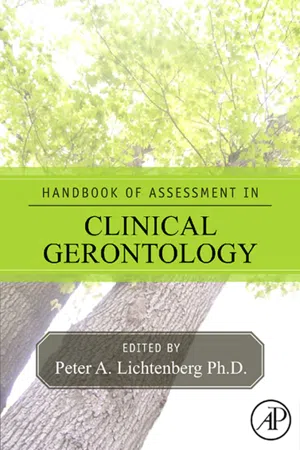
Handbook of Assessment in Clinical Gerontology
About this book
New trends in mental healthcare practice and a rapid increase in the aged population are causing an explosion in the fields of clinical gerontology and geropsychology today. This comprehensive second edition handbook offers clinicians and graduate students clear guidelines and reliable tools for assessing general mental health, cognitive functioning, functional age, psychosocial health, comorbidity, behavior deficits, and more. Psychopathology, behavioral disorders, changes in cognition, and changes in everyday functioning are addressed in full, and a wide range of conditions and disorders common to this patient population are covered. Each chapter provides an empirical review of assessment instruments, assessment scales in their totality, a review of how these instruments are used with and adapted for different cultural groups, illustration of assessments through case studies, and information on how to utilize ongoing assessment in treatment and/or treatment planning. This combination of elements will make the volume the definitive assessment source for clinicians working with elderly patients.
- The most comprehensive source of up-to-date data on gerontological assessment, with review articles covering: psychopathology, behavioral disorders, changes in cognition, and changes in everyday functioning
- Consolidates broadly distributed literature into single source, saving researchers and clinicians time in obtaining and translating information and improving the level of further research and care they can provide
- Chapters directly address the range of conditions and disorders most common for this patient population - i.e. driving ability, mental competency, sleep, nutrition, sexual functioning, demntias, elder abuse, depression, anxiety disorders, etc
- Fully informs readers regarding conditions most commonly encountered in real world treatment of an elderly patient population
- Each chapter cites case studies to illustrate assessment techniques
- Exposes reader to real-world application of each assessment discussed
Information
Chapter 1 Assessment of Depression and Bereavement in Older Adults
1 Department of Psychology, West Virginia University Morgantown, WV, USA
2 Clinical Assessment, Pearson, San Antonio, TX, USA
Abstract
This chapter provides an overview of conceptual, diagnostic, and practical issues associated with the assessment of late life depression and bereavement in older adults. Commonly used assessment instruments are reviewed, followed by case studies illustrating the complexity of assessing older adults who present with symptoms of depression, complicated bereavement, or both. The need for multidimensional and multi-method assessment, and consideration of the importance of cultural factors are emphasized. Shortcomings of the current DSM-IV diagnostic criteria for depression are noted in light of the age-related differences in symptom experience and presentation.
This chapter addresses the assessment of older adult depression and bereavement. The assessment of depression in older adults can be complicated due to age-related differences in the presentation of depression, comorbid medical and mental health problems, and age-related changes in cognitive functioning. Moreover, available assessment instruments may have less utility with older adults, either because they were developed with younger adults, or because they were developed to meet diagnostic criteria that may not be appropriate for older adults (see Jeste, Blazer, & First, 2005). Consequently, clinicians may be failing to identify depression adequately in older adults and to identify and treat older adults with subsyndromal or minor depression, which involves considerable disability but is not formally recognized as a clinical disorder.
This chapter addresses both depression and bereavement because loss is often a significant contributor to and risk factor for depression, and adults face increasing losses as they move through older adulthood. Depression is a normal response to a significant loss. The depression can last for a considerable amount of time and be functionally debilitating. Bereavement is one of the more significant risk factors for the first onset of depression and recurrent depression in older adults (Bruce, 2002). In light of the clinical significance of bereavement, its increasing likelihood over the lifespan, and the paucity of assessment literature addressing the topic, we have included the assessment of bereavement in this discussion of late-life depression assessment.
Epidemiology of late-life depression
Symptoms of depression tend to be approximately as prevalent in late life as in mid-life (Blazer, 2003). The frequency of depressive symptoms among the oldest old appears higher than among younger adults, although factors other than age (e.g., greater proportion of women, increased cognitive impairment, lower socioeconomic status, greater physical disability) may account for the difference (Blazer, 2003). The prevalence of clinically significant symptoms of depression ranges from 8–16% among community-dwelling older adults (Blazer, 2003). The prevalence of major depression in community-dwelling older adults ranges from approximately 1–4% (Beekman, Copeland, & Prince, 1999). Prevalence estimates for minor depression among community-dwelling older adults range from approximately 4–13%, with the highest estimate found in the Netherlands (Beekman et al., 1995). With minor and major depression combined, Steffens, Fisher, Langa, Potter, and Plassman (2009) found an overall prevalence of 11.19%, with the prevalence being similar for community-dwelling older men and women.
Prevalence estimates of major depression vary across settings, with increases in prevalence as one moves from outpatient to inpatient settings. The prevalence of major depression among older adults seen in primary care settings ranges from 5–10% (Lyness et al., 2002; Schulberg et al., 1998). Among hospitalized older adults, prevalence rates of major depression range from 10–12% (Blazer, 1994; Koenig, Meador, Cohen, & Blazer, 1988). Prevalence estimates for major depression among long-term care residents are even higher, ranging from 12.4% to 14.4% (Parmalee, Katz, & Lawton, 1989; Teresi, Abrams, Holmes, Ramirez, & Eimicke, 2001).
These epidemiological findings must be tempered by the questionable adequacy of our current diagnostic system for older adults (see discussion below) and the finding of different relations between age and depression across studies. Researchers have noted varied relations between age and depression, including negative linear, curvilinear, and positive linear relations (Nguyen & Zonderman, 2006). Nguyen and Zonderman suggest that the differences in relations can be attributed, in part, to the nature of the assessment measures employed. Measures of depressive symptoms reveal a negative linear relation or positive curvilinear relation. Such relations suggest fewer symptoms of depression as one ages, or increased symptoms among younger and older adults when compared with an intermediate age group. The authors note that when diagnostic measures of major depression are used, there tends to be a positive linear or negative curvilinear relation between age and depression. Thus, major depression increases with age, or is lower among younger and older groups when compared with an intermediate age group.
Conceptual approaches to assessment
The assessment paradigm employed by the clinician determines the assessment methods and instruments employed, the questions addressed, and the integration and use of the assessment results (Edelstein, Martin, & Koven, 2003; Edelstein & Koven, in press). Haynes and O'Brien (2000) have defined an assessment paradigm as “a set of principles, beliefs, values, hypotheses, and methods advocated in an assessment discipline or by its adherents” (p. 10). Two conceptually distinct paradigms are the traditional (e.g., trait-oriented, psychodynamic) and the behavioral (e.g., behavior–analytic, cognitive–behavioral). One can distinguish between traditional and behavioral paradigms through an examination of how each explains or accounts for behavior. More traditional approaches tend to emphasize an individual's dispositional characteristics (see Mischel, 1968) or hypothetical constructs (e.g., anxiety, depression), which are inferred from the individual's self-reports and observed behavior (Edelstein, Woodhead, Bower, & Lowery, 2006). Such approaches to psychopathology often include exploration of an individual's feelings or affective states.
Behavioral approaches tend to be more contextual and emphasize descriptions of environmental conditions under which the behavior of interest is more or less likely to occur. A behavioral account of an individual's behavior involves a description of the conditions under which the behavior occurs (see Edelstein & Koven, in press). More emphasis is placed on the variables controlling the behavior of interest, and less emphasis is placed on characteristics of the individual. It is important to note that behavioral approaches do not discount the role of cognitions or private events; however, they do not consider cognitions to have causal efficacy. Cognitions are treated as any other behavior, whether observable or not. For the purposes of the present discussion, emphasis is placed on behavioral assessment that relies primarily on direct observation of overt behaviors.
One might also distinguish between traditional and behavioral approaches by considering the distinction between nomothetic and idiographic approaches to personality assessment (see Allport, 1936). Traditional approaches are more closely aligned with a nomothetic approach, which involves an examination of the commonalities among individuals. This approach underlies classification systems such as the Diagnostic and Statistical Manual–Fourth Edition (DSM-IV) (American Psychiatric Association, 1994). In contrast, behavioral approaches are more similar to the idiographic approach, which is used to ascertain the uniqueness of an individual.
Traditional and behavioral approaches and instruments are often combined. For example, one might administer a self-report depression inventory and examine the individual item responses to gain an individualized understanding of the individual's mood. The total score on the instrument may ...
Table of contents
- Cover
- Title Page
- Copyright
- Table of Contents
- List of Contributors
- Introduction
- Chapter 1: Assessment of Depression and Bereavement in Older Adults
- Chapter 2: Assessment of Anxiety in Older Adults
- Chapter 3: Psychotherapy with Older Adults: The Importance of Assessment
- Chapter 4: Assessment of Personality Disorders in Older Adults
- Chapter 5: Assessing Psychosis in Acute and Chronic Mentally Ill Older Adults
- Chapter 6: Dementia Syndromes in the Older Adult
- Chapter 7: Delirium Assessment in Older Adults
- Chapter 8: Assessment of Cognitive Training
- Chapter 9: The Assessment of Elder Abuse
- Chapter 10: Assessment of Dementia Family Caregivers
- Chapter 11: Assessment with Late-Life Families: Issues and Instruments
- Chapter 12: Screening, Assessing and Intervening for Alcohol and Medication Misuse in Older Adults
- Chapter 13: Assessment and Conceptualization of Sexuality Among Older Adults
- Chapter 14: Nutrition in the Elderly
- Chapter 15: Assessment of Agitation in Older Adults
- Chapter 16: Assessing Sleep Problems of Older Adults
- Chapter 17: Treatment Adherence in Late-Life
- Chapter 18: Geriatric Neuropsychological Assessment
- Chapter 19: Screening Instruments and Brief Batteries for Dementia
- Chapter 20: Cognitive Assessment in Late Stage Dementia
- Chapter 21: Assessing the Personal Preferences of Persons with Dementia
- Chapter 22: Assessment of Capacity
- Chapter 23: Household and Neighborhood Safety, Mobility
- Chapter 24: Pain Assessment and Management in Older Adults
- Chapter 25: Assessments in Driver Rehabilitation
- Index
Trusted by 375,005 students
Access to over 1.5 million titles for a fair monthly price.
Study more efficiently using our study tools.
Frequently asked questions
Yes, you can cancel anytime from the Subscription tab in your account settings on the Perlego website. Your subscription will stay active until the end of your current billing period. Learn how to cancel your subscription
No, books cannot be downloaded as external files, such as PDFs, for use outside of Perlego. However, you can download books within the Perlego app for offline reading on mobile or tablet. Learn how to download books offline
We are an online textbook subscription service, where you can get access to an entire online library for less than the price of a single book per month. With over 1.5 million books across 990+ topics, we’ve got you covered! Learn about our mission
Look out for the read-aloud symbol on your next book to see if you can listen to it. The read-aloud tool reads text aloud for you, highlighting the text as it is being read. You can pause it, speed it up and slow it down. Learn more about Read Aloud
Yes! You can use the Perlego app on both iOS and Android devices to read anytime, anywhere — even offline. Perfect for commutes or when you’re on the go.
Please note we cannot support devices running on iOS 13 and Android 7 or earlier. Learn more about using the app
Please note we cannot support devices running on iOS 13 and Android 7 or earlier. Learn more about using the app
Yes, you can access Handbook of Assessment in Clinical Gerontology by Peter A. Lichtenberg in PDF and/or ePUB format, as well as other popular books in Psychologie & Geriatrie. We have over 1.5 million books available in our catalogue for you to explore.