eBook - ePub
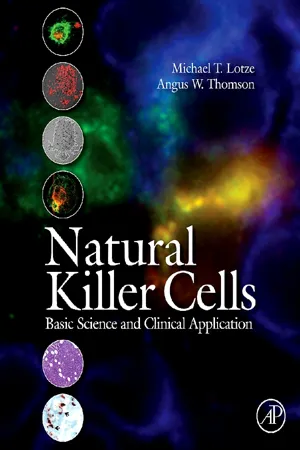
Natural Killer Cells
Basic Science and Clinical Application
- 660 pages
- English
- ePUB (mobile friendly)
- Available on iOS & Android
eBook - ePub
About this book
Natural Killer Cells explains the importance of killer cells and how they are produced. It mentions that the most likely explanation for killer cell production is that they serve as a complementary system for T cells as a primary defense against viruses. However, these cells defend against certain viruses only, such as herpes viruses and influenza viruses.
The book also explains the primary functions of killer cells, and it discusses how these cells help recognize damaged tissues, limit further damage to tissues, and regenerate damaged tissues. It discusses how these cells mature and develop, and it covers the different isolation, culture, and propagation methods of these cells. Furthermore, it focuses on the different killer cells that are present in various parts of the human body.
The book concludes by explaining that natural killer cells are utilized for clinical therapy of malignancies, and that they have led to positive outcomes in the field of biology and medicine.
- Provides a broad, detailed coverage of the biology and interactions of NK cells for students, fellows, scientists, and practitioners
- Includes figures, histologic sections, and illustrations of the ontogeny of NK cells
Information
Topic
MedicinaSubtopic
InmunologíaTable of contents
- Cover image
- Table of Contents
- Copyright
- Contributors
- Foreword
- Preface
- Chapter One. Developmental stages and pathways of NK cell maturation
- Chapter Two. Developmental origins of thymus-derived natural killer cells
- Chapter Three. Interferon-producing killer dendritic cells (IKDC)
- Chapter Four. Natural killer cells in cancer
- Chapter Five. NK cell immune recognition
- Chapter Six. NK cell KIR heterogeneity and evolution
- Chapter Seven. Signalling events in natural killer cells
- Chapter Eight. Human natural killer cell development
- Chapter Nine. Isolation, culture and propagation of natural killer cells
- Chapter Ten. The localization and migration of natural killer cells in health and disease
- Chapter Eleven. Receptors on NK cells
- Chapter Twelve. Development and testing of NK cell lines
- Chapter Thirteen. NK cell-derived cytokines and delivery
- Chapter Fourteen. NK cells as recipients of cytokine signals
- Chapter Fifteen. NK cells and chemokines
- Chapter Sixteen. Natural killer cytolytic activity
- Chapter Seventeen. Illuminating intranodal natural killer cell behaviour using two-photon microscopy
- Chapter Eighteen. Dendritic cells and NK cells
- Chapter Nineteen. NK and NKT cells
- Chapter Twenty. NK cell and endothelial cell interactions
- Chapter Twenty-One. Natural killer cell/epithelial interactions
- Chapter Twenty-Two. NK cell–T cell interactions
- Chapter Twenty-Three. NK cells and NKT cells in cutaneous disorders
- Chapter Twenty-Four. Natural killer cells in the respiratory tract
- Chapter Twenty-Five. Intestinal natural killer cells
- Chapter Twenty-Six. Natural killer cells in the liver
- Chapter Twenty-Seven. Natural killer cells in the spleen and lymph node
- Chapter Twenty-Eight. Nature killer cells in the central nervous system
- Chapter Twenty-Nine. NK cells in the eye
- Chapter Thirty. NK cells and reproduction
- Chapter Thirty-One. Identification of natural killer cells in tissues and their isolation
- Chapter Thirty-Two. Natural killer cell immune regulation
- Chapter Thirty-Three. Natural killer cells and transplantation
- Chapter Thirty-Four. Natural killer cells and autoimmunity
- Chapter Thirty-Five. Interaction of NK cells with bacteria
- Chapter Thirty-Six. Natural killer cells and human immunodeficiency virus
- Chapter Thirty-Seven. Cytomegalovirus infection and NK cells
- Chapter Thirty-Eight. Natural killer cells in allergy
- Chapter Thirty-Nine. Natural killer cells in wound healing
- Chapter Forty. Natural killer cells in atherosclerosis
- Chapter Forty-One. Natural killer cells in leukaemia
- Chapter Forty-Two. Natural killer cells and allogeneic haematopoietic cell transplantation
- Chapter Forty-Three. Clinical trials of NK cells for cancer
- Chapter Forty-Four. Natural killer cells and hepatitis C virus infection
- Chapter Forty-Five. Natural killer cells and the biology of parasitism
- Chapter Forty-Six. Lymphoproliferative disorders of natural killer cells
- Chapter Forty-Seven. Natural killer cell induction of tolerance
- Chapter Forty-Eight. Genetic engineering of natural killer cells
- Chapter Forty-Nine. NK cell-mediated target cell death
- Chapter Fifty. NK-cell tracking using non-invasive imaging modalities
- Subject Index
Trusted by 375,005 students
Access to over 1.5 million titles for a fair monthly price.
Study more efficiently using our study tools.
Frequently asked questions
Yes, you can cancel anytime from the Subscription tab in your account settings on the Perlego website. Your subscription will stay active until the end of your current billing period. Learn how to cancel your subscription
No, books cannot be downloaded as external files, such as PDFs, for use outside of Perlego. However, you can download books within the Perlego app for offline reading on mobile or tablet. Learn how to download books offline
Perlego offers two plans: Essential and Complete
- Essential is ideal for learners and professionals who enjoy exploring a wide range of subjects. Access the Essential Library with 800,000+ trusted titles and best-sellers across business, personal growth, and the humanities. Includes unlimited reading time and Standard Read Aloud voice.
- Complete: Perfect for advanced learners and researchers needing full, unrestricted access. Unlock 1.5M+ books across hundreds of subjects, including academic and specialized titles. The Complete Plan also includes advanced features like Premium Read Aloud and Research Assistant.
We are an online textbook subscription service, where you can get access to an entire online library for less than the price of a single book per month. With over 1.5 million books across 990+ topics, we’ve got you covered! Learn about our mission
Look out for the read-aloud symbol on your next book to see if you can listen to it. The read-aloud tool reads text aloud for you, highlighting the text as it is being read. You can pause it, speed it up and slow it down. Learn more about Read Aloud
Yes! You can use the Perlego app on both iOS and Android devices to read anytime, anywhere — even offline. Perfect for commutes or when you’re on the go.
Please note we cannot support devices running on iOS 13 and Android 7 or earlier. Learn more about using the app
Please note we cannot support devices running on iOS 13 and Android 7 or earlier. Learn more about using the app
Yes, you can access Natural Killer Cells by Michael T. Lotze,Angus W. Thomson in PDF and/or ePUB format, as well as other popular books in Medicina & Inmunología. We have over 1.5 million books available in our catalogue for you to explore.