- 520 pages
- English
- ePUB (mobile friendly)
- Available on iOS & Android
eBook - ePub
Principles of Soil and Plant Water Relations
About this book
Principles of Soil and Plant Water Relations combines biology and physics to show how water moves through the soil-plant-atmosphere continuum. This text explores the instrumentation and the methods used to measure the status of water in soil and plants. Principles are clearly presented with the aid of diagrams, anatomical figures, and images of instrumentation. The methods on instrumentation can be used by researchers, consultants, and the military to monitor soil degradation, including measurements of soil compaction, repellency, oxygen diffusion rate, and unsaturated hydraulic conductivity.Intended for graduate students in plant and soil science programs, this book also serves as a useful reference for agronomists, plant ecologists, and agricultural engineers.* Principles are presented in an easy-to-understand style* Heavily illustrated with more than 200 figures; diagrams are professionally drawn* Anatomical figures show root, stem, leaf, and stomata* Figures of instruments show how they work* Book is carefully referenced, giving sources for all information* Struggles and accomplishments of scientists who developed the theories are given in short biographies.
Information
Topic
Sciences biologiquesSubtopic
Botanique1
Introduction
Publisher Summary
This chapter focuses on plant growth curves. The world-population growth curve is an exponential curve. What do plant growth curves look like? Because water is the most important soil physical factor affecting plant growth, it is important to quantify plant growth to determine effects of water stress. In any experimental dealing with plant–water relations, some measure of plant growth (e.g., height, biomass) should be obtained. Plant growth curves also exemplify quantitative relationships. The chapter seeks to understand basic principles of plant–water relations. If equations can be developed to show relationships, then one can predict what is going to happen. Equations describing plant-growth curves demonstrate how one can quantify, and thus predict, plant growth. The chapter first considers the growth of the bacterium Escherichia coli. In the early nineteenth century, when plants and animals were being classified, the bacteria were arbitrarily included in the plant kingdom, and botanists first studied them. Even though bacteria are not plants or animals, we can follow their growth to understand plant growth curves.
I WHY STUDY SOIL-PLANT-WATER RELATIONS?
A Population
Of the four soil physical factors that affect plant growth (mechanical impedance, water, aeration, and temperature) (Shaw, 1952; Kirkham, 1973), water is the most important. Drought causes 40.8% of crop losses in the United States, and excess water causes 16.4%; insects and diseases amount to 7.2% of the losses (Boyer, 1982). In the United States, 25.3% of the soils are affected by drought, and 15.7% limit crop production by being too wet (Boyer, 1982).
People depend upon plants for food. Because water is the major environmental factor limiting plant growth, we need to study soil-plant-water relations to provide food for a growing population. What is our challenge?
The earth’s population is growing exponentially. The universe is now considered to be 13 billion years old (Zimmer, 2001). The earth is thought to be 4.45 billion years old (Allègre and Schneider, 1994). The earth’s oldest rock is 4.03 billion years old (Zimmer, 2001). Primitive life existed on earth 3.7 billion years ago, according to scientists studying ancient rock formations harboring living cells (Simpson, 2003). Human-like animals have existed on earth only in the last few (less than 8) million years. In Chad, Central Africa, six hominid specimens, including a nearly complete cranium and fragmentary lower jaws, have been found that are 6 to 7 million years old (Brunet et al., 2002; Wood, 2002). In 8000 B.C., at the dawn of agriculture, the world’s population was 5 million (Wilford, 1982). At the birth of Christ in 1 a.d., it was 200 million. In 1000, the population was 250 million (National Geographic, 1998a) (Fig. 1.1). By 1300, it had grown larger (Wilford, 1982). But by 1400, the population had dropped dramatically due to the Black Death, also called the bubonic plague (McEvedy, 1988), which is caused by a bacillus spread by fleas on rats. The Black Death raged in Europe between 1347 and 1351 and killed at least half of its population. It caused the depopulation or total disappearance of about 1,000 villages. Starting in coastal areas, where rats were on ships, and spreading inland, it was the greatest disaster in western European history (Renouard, 1971). People fled to the country to avoid the rampant spread of the disease in cities. The great piece of literature, The Decameron, published in Italian in 1353 and written by Giovanni Boccaccio (1313–1375), tells of 10 people who in 1348 went to a castle outside of Florence, Italy, to escape the plague. To pass time, they each told a tale a day for 10 days (Bernardo, 1982).
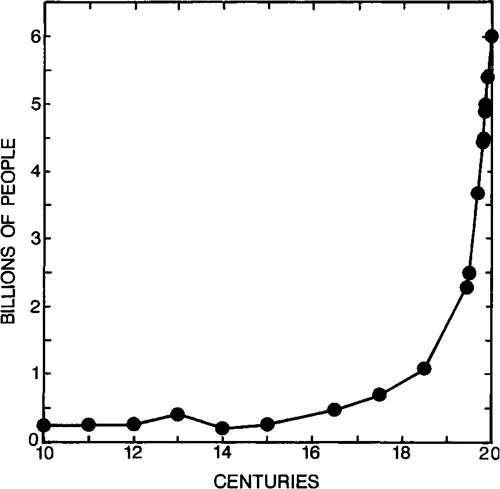
By 1500, the world’s population was about 250,000,000 again. In 1650, it was 470,000,000; in 1750, it was 694,000,000; in 1850, it was 1,091,000,000. At the beginning of the nuclear age in 1945, it was 2.3 billion. In 1950, it was 2,501,000,000; in 1970, 3,677,837,000; in 1980, 4,469,934,000. In 1985, it was 4.9...
Table of contents
- Cover image
- Title page
- Table of Contents
- Preface
- Chapter 1: Introduction
- Chapter 2: Definitions of Physical Units and the International System
- Chapter 3: Structure and Properties of Water
- Chapter 4: Tensiometers
- Chapter 5: Soil-Water Terminology and Applications
- Chapter 6: Static Water in Soil
- Chapter 7: Water Movement in Saturated Soil
- Chapter 8: Field Capacity, Wilting Point, Available Water, and the Non-Limiting Water Range
- Chapter 9: Penetrometer Measurements
- Chapter 10: Measurement of Oxygen Diffusion Rate
- Chapter 11: Infiltration
- Chapter 12: Pore Volume
- Chapter 13: Time Domain Reflectometry to Measure Volumetric Soil Water Content
- Chapter 14: Root Anatomy and Poiseuille’s Law for Water Flow in Roots
- Chapter 15: Gardner’s Equation for Water Movement to Plant Roots
- Chapter 16: Measurement of Water Potential with Thermocouple Psychrometers
- Chapter 17: Measurement of Water Potential with Pressure Chambers
- Chapter 18: Stem Anatomy and Measurement of Osmotic Potential and Turgor Potential Using Pressure-Volume Curves
- Chapter 19: The Ascent of Water in Plants
- Chapter 20: Electrical Analogues for Water Movement through the Soil-Plant-Atmosphere Continuum
- Chapter 21: Leaf Anatomy and Leaf Elasticity
- Chapter 22: Stomata and Measurement of Stomatal Resistance
- Chapter 23: Solar Radiation, Black Bodies, Heat Budget, and Radiation Balance
- Chapter 24: Measurement of Canopy Temperature with Infrared Thermometers
- Chapter 25: Stress-Degree-Day Concept and Crop-Water-Stress Index
- Chapter 26: Potential Evapotranspiration
- Chapter 27: Water and Yield
- INDEX
Trusted by 375,005 students
Access to over 1.5 million titles for a fair monthly price.
Study more efficiently using our study tools.
Frequently asked questions
Yes, you can cancel anytime from the Subscription tab in your account settings on the Perlego website. Your subscription will stay active until the end of your current billing period. Learn how to cancel your subscription
No, books cannot be downloaded as external files, such as PDFs, for use outside of Perlego. However, you can download books within the Perlego app for offline reading on mobile or tablet. Learn how to download books offline
Perlego offers two plans: Essential and Complete
- Essential is ideal for learners and professionals who enjoy exploring a wide range of subjects. Access the Essential Library with 800,000+ trusted titles and best-sellers across business, personal growth, and the humanities. Includes unlimited reading time and Standard Read Aloud voice.
- Complete: Perfect for advanced learners and researchers needing full, unrestricted access. Unlock 1.5M+ books across hundreds of subjects, including academic and specialized titles. The Complete Plan also includes advanced features like Premium Read Aloud and Research Assistant.
We are an online textbook subscription service, where you can get access to an entire online library for less than the price of a single book per month. With over 1.5 million books across 990+ topics, we’ve got you covered! Learn about our mission
Look out for the read-aloud symbol on your next book to see if you can listen to it. The read-aloud tool reads text aloud for you, highlighting the text as it is being read. You can pause it, speed it up and slow it down. Learn more about Read Aloud
Yes! You can use the Perlego app on both iOS and Android devices to read anytime, anywhere — even offline. Perfect for commutes or when you’re on the go.
Please note we cannot support devices running on iOS 13 and Android 7 or earlier. Learn more about using the app
Please note we cannot support devices running on iOS 13 and Android 7 or earlier. Learn more about using the app
Yes, you can access Principles of Soil and Plant Water Relations by M.B. Kirkham in PDF and/or ePUB format, as well as other popular books in Sciences biologiques & Botanique. We have over 1.5 million books available in our catalogue for you to explore.