- 738 pages
- English
- ePUB (mobile friendly)
- Available on iOS & Android
eBook - ePub
About this book
A multi-authored and comprehensive text, Cell Physiology Source Book enables graduate students in various biological sub-disciplines to gain a thorough understanding of cell physiology. It begins with a reviewof the physical chemistry of solutions, protein structure, and membrane structure, and ends with an Appendix featuring reviews of electricity, electrochemistry, and cable properties of cells. In between, this book is loaded with information on membrane potentials, cell metabolism, signal transduction, transport physiology and pumps, membrane excitability and ion channels, synaptic transmission, sensory transduction, muscle contraction, excitation-contraction coupling, bioluminescence, photosynthesis, andplant cell physiology.This exhaustive work provides graduate students with detailed and authoritative coverage of nearly all aspects of cell physiology. Such broad coverage of this field within a single source makes for a unique text.Chapters written in a clear, concise, and didactic style, and appropriate reviews of basic physics and chemistry are among the many distinguishing features of this monumental treatise.Comprehensive source-book of cell physiologyAuthoritative and multi-authored by leading experts in the fieldUnique features include broad coverage and review of relevant physics, chemistry, and metabolismClear, concise, and didacticIncludes reviews of physical chemistry of solutions, protein structure, membrane structure, electrochemistry, and electricityTopic covered include plant cell physiology, photosynthesis, bioluminescence, effects of pressure, cilia, and flagellaeDetailed treatise on ion channels and their regulation
Information
Topic
Scienze biologicheSubtopic
BiochimicaSECTION I
Biophysical Chemistry, Electrochemistry, Metabolism, Second Messengers, and Ultrastructure
Outline
Chapter 1: Biophysical Chemistry of Cellular Electrolytes
Chapter 2: The Physiological Structure and Function of Proteins
Chapter 3: Lateral Lipid Domains and Membrane Function
Chapter 4: Ultrastructure of Cells
Chapter 5: Diffusion and Permeability
Chapter 6: Origin of Resting Membrane Potentials
Chapter 7: Gibbs–Donnan Equilibrium Potentials
Chapter 8: Energy Production and Metabolism
Chapter 9: Signal Transduction
Chapter 10: Calcium as an Intracellular Second Messenger: Mediation by Calcium Binding Proteins
1
Biophysical Chemistry of Cellular Electrolytes
Jeffrey C. Freedman
Publisher Summary
Biophysical chemistry is defined as the application of the concepts and methods of physical chemistry to the study of biological systems. Physical chemistry includes physiologically relevant subjects, such as thermodynamics, chemical equilibria and reaction kinetics, solutions and electrochemistry, properties and kinetic theory of gases, transport processes, surface phenomena, and molecular structure and spectroscopy. This chapter discusses the basic concepts of cell physiology by describing certain physicochemical properties of electrolytes and proteins that are relevant to an understanding of the structure and function of cells. All living cells contain proteins, salts, and water enclosed in membrane-bounded compartments. These biochemical and ionic cellular constituents, together with a set of genes, enzymes, substrates, and intermediates, function to maintain cellular homeostasis and enable cells to perform chemical, osmotic, mechanical, and electrical work. Concepts of biophysical chemistry are exemplified by human red blood cells, which lack membrane-bounded intracellular organelles and are devoid of the complexities introduced by intracellular compartments.
I Introduction
Biophysical chemistry may be defined as the application of the concepts and methods of physical chemistry to the study of biological systems. Physical chemistry includes such physiologically relevant subjects as thermodynamics, chemical equilibria and reaction kinetics, solutions and electrochemistry, properties and kinetic theory of gases, transport processes, surface phenomena, and molecular structure and spectroscopy. Many cellular physiological phenomena are best understood by a rigorous and comprehensive understanding of physical chemistry. Physical chemistry texts that specifically emphasize biological applications include those by Tinoco et al. (1985) and Eisenberg and Crothers (1979). Several outstanding monographs on biophysical chemistry are also available: Edsall and Wyman (1958), Tanford (1961), Cantor and Schimmel (1980), van Holde (1985), Silver (1985), and Bergethon and Simons (1990). This chapter and the next will introduce some of the basic concepts of cell physiology by describing certain physicochemical properties of electrolytes and proteins that are relevant to an under-standing of the structure and function of cells.
All living cells contain proteins, salts, and water enclosed in membrane-bounded compartments. These biochemical and ionic cellular constituents, together with a set of genes, enzymes, substrates, and intermediates, function to maintain cellular homeostasis and to enable cells to perform chemical, osmotic, mechanical, and electrical work. Homeostasis means that certain parameters, such as the cellular volume, the intracellular pH, and the intracellular concentrations of salts are maintained relatively constant in resting cells. To understand how cellular homeostasis is achieved, the electrolyte composition and the functions of specific ions in cells will be described first followed by a consideration of some physi-cochemical aspects of water and of solutions of salts and proteins. In this chapter, some concepts of biophysical chemistry will be exemplified by human red blood cells, which lack membrane-bounded intracellular organelles and are thereby devoid of the complexities introduced by intracellular compartments.
II Cell Cations
Potassium, sodium, calcium, and magnesium are the predominant biological cations. The ionic composition of the intracellular and extracellular solutions may be de-picted on bar graphs known as Gamblegrams, named after the physiologist J. L. Gamble, who used such diagrams extensively in analyzing the electrolyte balance of the blood and body fluids (Gamble, 1964). A Gamblegram for human red blood cells is shown in Fig. 1. The most abundant ion in the intracellular solution is potassium (K +) at 143 mM, whereas sodium ion (Na+) is only 7 mM (Funder and Wieth, 1966). In the extracellular fluid, Na+ predominates at approximately 145 mM, whereas K+ is only about 5 mM. The Na, K-ATPase, a transport protein located in the plasma membrane, specifically selects K+ from the Na+-rich medium and pumps it against the K+ concentration gradient (and electrochemical gradient) into the cytoplasmic solution. The same ionic pump specifically selects Na+ from the K + -rich cytoplasmic solution and extrudes it from the cell against the Na+ concentration gradient. This coupled active transport of K+ and Na+ uses metabolic energy obtained from the hydrolysis of ATP (for reviews, see Glynn, 1985; Läuger, 1991). At the same time that K+ is actively accumulated in the cell, it is also continually leaking out of the cell through a parallel pathway down its concentration gradient. The same is true for Na+ leaking into the cell. Steady-state distributions of K+ and Na+ are achieved by a balance between active pumping and passive leakage.
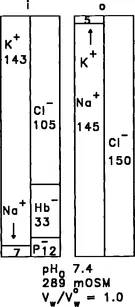
FIG. 1 Gamblegram for human red blood cells. The bar graphs illustrate the ionic composition of the intracellular and extracellular solutions, designated by i and o, respectively. Organic phosphates are represented by P−.
A quantitative model of the pump-leak theory that predicted the steady state Na+ and K+ concentrations in high-K+ and low-K+ red blood cells found in genetic variants of sheep was developed by Tosteson and Hoffman (1960).
As illustrated in Fig. 2, other transport systems that may also contribute to the steady-state intracellular ionic concentrations of red cells have since been discovered (for review, see Tosteson, 1981). These include Na/K/Cl co-transport and K/Cl cotransport (for review, see Dunham, 1990) and Na/H exchange. The pump-leak theory for red cells has been extended to include some of the effects of these additional cotransport pathways (Milanick and Hoffman, 1986).
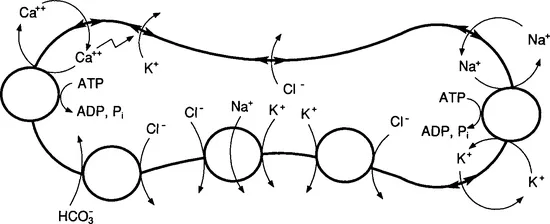
FIG. 2 The principal membrane transport systems of human red blood cells. Starting with the Na+/K+ pump and the passive leakage pathways for Na+ and K+ on the right, and proceeding clockwise around the memb...
Table of contents
- Cover image
- Title page
- Table of Contents
- Copyright
- Dedication
- Contributors
- Foreword
- Preface
- SECTION I: Biophysical Chemistry, Electrochemistry, Metabolism, Second Messengers, and Ultrastructure
- SECTION II: Transport Physiology, Pumps, and Exchangers
- SECTION III: Membrane Excitability and Ion Channels
- SECTION IV: Ion Channels as Targets for Toxins, Drugs, and Genetic Diseases
- SECTION V: Synaptic Transmission and Sensory Transduction
- SECTION VI: Muscle and Other Contractile Systems
- SECTION VII: Bioluminescence and Photosynthesis
- Appendix: Review of Electricity and Cable Properties
- Index
Trusted by 375,005 students
Access to over 1.5 million titles for a fair monthly price.
Study more efficiently using our study tools.
Frequently asked questions
Yes, you can cancel anytime from the Subscription tab in your account settings on the Perlego website. Your subscription will stay active until the end of your current billing period. Learn how to cancel your subscription
No, books cannot be downloaded as external files, such as PDFs, for use outside of Perlego. However, you can download books within the Perlego app for offline reading on mobile or tablet. Learn how to download books offline
Perlego offers two plans: Essential and Complete
- Essential is ideal for learners and professionals who enjoy exploring a wide range of subjects. Access the Essential Library with 800,000+ trusted titles and best-sellers across business, personal growth, and the humanities. Includes unlimited reading time and Standard Read Aloud voice.
- Complete: Perfect for advanced learners and researchers needing full, unrestricted access. Unlock 1.5M+ books across hundreds of subjects, including academic and specialized titles. The Complete Plan also includes advanced features like Premium Read Aloud and Research Assistant.
We are an online textbook subscription service, where you can get access to an entire online library for less than the price of a single book per month. With over 1.5 million books across 990+ topics, we’ve got you covered! Learn about our mission
Look out for the read-aloud symbol on your next book to see if you can listen to it. The read-aloud tool reads text aloud for you, highlighting the text as it is being read. You can pause it, speed it up and slow it down. Learn more about Read Aloud
Yes! You can use the Perlego app on both iOS and Android devices to read anytime, anywhere — even offline. Perfect for commutes or when you’re on the go.
Please note we cannot support devices running on iOS 13 and Android 7 or earlier. Learn more about using the app
Please note we cannot support devices running on iOS 13 and Android 7 or earlier. Learn more about using the app
Yes, you can access Cell Physiology by Nicholas Sperelakis in PDF and/or ePUB format, as well as other popular books in Scienze biologiche & Biochimica. We have over 1.5 million books available in our catalogue for you to explore.