eBook - ePub
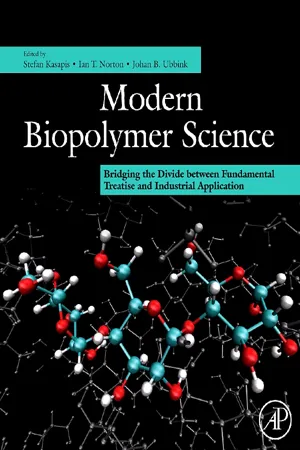
Modern Biopolymer Science
Bridging the Divide between Fundamental Treatise and Industrial Application
- 640 pages
- English
- ePUB (mobile friendly)
- Available on iOS & Android
eBook - ePub
Modern Biopolymer Science
Bridging the Divide between Fundamental Treatise and Industrial Application
About this book
Industrialists developing new food and pharmaceutical products face the challenge of innovation in an increasingly competitive market that must consider incredient cost, product added-value, expectations of a healthy life-style, improved sensory impact, controlled delivery of active compounds and last, but not lease, product stability. While much work has been done to explore, understand, and address these issues, a gap has emerged between recent advances in fundamental knowledge and its direct application to product situations with a growing need for scientific input.Modern Biopolymer Science matches science to application by first acknowledging the differing viewpoints between those working with low-solids and those working with high-solids, and then sharing the expertise of those two camps under a unified framework of materials science.
- Real-world utilisation of fundamental science to achieve breakthroughs in product development
- Includes a wide range of related aspects of low and high-solids systems for foods and pharmaceuticals
- Covers more than bio-olymer science in foods by including biopolymer interactions with bioactive compounds, issues of importance in drug delivery and medicinal chemistry
Information
Subtopic
Organic ChemistryTable of contents
- Cover image
- Table of Contents
- Copyright
- Contributors
- Preface
- CHAPTER 1. Biopolymer Network Assembly
- CHAPTER 2. Gelation
- 2.1. Introduction
- 2.2. Modeling gel networks and their rheological behavior
- 2.3. Molecular mechanisms causing aggregation/gelation
- 2.4. Gel structure type
- 2.5. Gel texture: oral processing, rheology/fracture, microstructure and sensory analysis
- 2.6. Concluding remarks and future challenges
- CHAPTER 3. Antifreeze Proteins
- CHAPTER 4. Biopolymers in Food Emulsions
- CHAPTER 5. Functional Interactions in Gelling Biopolymer Mixtures
- CHAPTER 6. Effect of Processing on Biopolymer Interactions
- CHAPTER 7. Unified Application of the Materials-Science Approach to the Structural Properties of Biopolymer Co-Gels throughout the Industrially Relevant Level of Solids
- CHAPTER 8. Mapping the Different States of Food Components Using State Diagrams
- CHAPTER 9. Structural Advances in the Understanding of Carbohydrate Glasses
- CHAPTER 10. Biopolymer Films and Composite Coatings
- CHAPTER 11. Protein + Polysaccharide Coacervates and Complexes
- CHAPTER 12. Single Molecule Techniques
- CHAPTER 13. Dietary Fiber
- CHAPTER 14. Resistant Starch in Vitro and in Vivo
- 14.1. Introduction
- 14.2. Measurement of resistant starch
- 14.3. Health benefits of RS
- 14.4. Effect of processing on resistant starch formation in foods
- 14.5. Model studies of isolated starches
- 14.6. Molecular and microstructural organization of resistant starches
- 14.7. Concluding remarks
- CHAPTER 15. Glycemic Response Reduction in Processed Food Products
- CHAPTER 16. Biopolymers in Controlled-Release Delivery Systems
- CHAPTER 17. Amyloid Fibrils – Self-Assembling Proteins
- CHAPTER 18. Hydrocolloids and Medicinal Chemistry Applications
- Index
Trusted by 375,005 students
Access to over 1.5 million titles for a fair monthly price.
Study more efficiently using our study tools.
Frequently asked questions
Yes, you can cancel anytime from the Subscription tab in your account settings on the Perlego website. Your subscription will stay active until the end of your current billing period. Learn how to cancel your subscription
No, books cannot be downloaded as external files, such as PDFs, for use outside of Perlego. However, you can download books within the Perlego app for offline reading on mobile or tablet. Learn how to download books offline
Perlego offers two plans: Essential and Complete
- Essential is ideal for learners and professionals who enjoy exploring a wide range of subjects. Access the Essential Library with 800,000+ trusted titles and best-sellers across business, personal growth, and the humanities. Includes unlimited reading time and Standard Read Aloud voice.
- Complete: Perfect for advanced learners and researchers needing full, unrestricted access. Unlock 1.5M+ books across hundreds of subjects, including academic and specialized titles. The Complete Plan also includes advanced features like Premium Read Aloud and Research Assistant.
We are an online textbook subscription service, where you can get access to an entire online library for less than the price of a single book per month. With over 1.5 million books across 990+ topics, we’ve got you covered! Learn about our mission
Look out for the read-aloud symbol on your next book to see if you can listen to it. The read-aloud tool reads text aloud for you, highlighting the text as it is being read. You can pause it, speed it up and slow it down. Learn more about Read Aloud
Yes! You can use the Perlego app on both iOS and Android devices to read anytime, anywhere — even offline. Perfect for commutes or when you’re on the go.
Please note we cannot support devices running on iOS 13 and Android 7 or earlier. Learn more about using the app
Please note we cannot support devices running on iOS 13 and Android 7 or earlier. Learn more about using the app
Yes, you can access Modern Biopolymer Science by Stefan Kasapis,Ian T. Norton,Johan B Ubbink,Johan B, Ubbink in PDF and/or ePUB format, as well as other popular books in Technology & Engineering & Organic Chemistry. We have over 1.5 million books available in our catalogue for you to explore.