- 832 pages
- English
- ePUB (mobile friendly)
- Available on iOS & Android
eBook - ePub
DNA Repair Mechanisms
About this book
DNA Repair Mechanisms is an account of the proceedings at a major international conference on DNA Repair Mechanisms held at Keystone, Colorado on February 1978. The conference discusses through plenary sessions the overall standpoint of DNA repair. The papers presented and other important documents, such as short summaries by the workshop session conveners, comprise this book. The compilation describes the opposing views, those that agree and dispute about certain topic areas. This book, divided into 15 parts, is arranged according to the proceedings in the conference. The plenary sessions are grouped with the related workshop and poster manuscripts. The first two parts generally tackle repair in terms of its identification and quantification, as well as the models, systems, and perspectives it utilizes. The following parts discuss the various types of repair including base excision, nucleotide excision repair in bacteria, excision repair in mammalian cells, inducible/error-prone repair in prokaryotes, and strand break repair in mammalian cells among others. This reference material looks into the replicative bypass mechanisms in mammalian cells, viral probes, and hereditary repair defects. It explains repair deficiency and human disease, as well as mutagenesis and carcinogenesis. The last part of this book deals with the consequences and effects of DNA repair. This volume is a helpful source of reference for students, teachers, scientists, and researchers in the different fields of genetics, radiology, biochemistry, and environmental biology.
Information
V
NUCLEOTIDE EXCISION REPAIR IN BACTERIA
ENZYMATIC PATHWAYS OF DAMAGED NUCLEOTIDE EXCISION1
Lawrence Grossman and Sheikh Riazuddin2, Department of Biochemistry, School of Hygiene & Public Health, The Johns Hopkins University
ABSTRACT
Py <> Py correndonucleases I and II from Micrococcus Luteus act exclusively on thymine-thymine, cytosine-cytosine, and thymine-cytosine cyclobutyl dimers in DNA, catalyzing incision 5′ to the damage and generating 3′-hydroxyl and 5′-phosphoryl termini. Both enzymes initiate excision of pyrimidine dimers in vitro by correxonucleases and DNA polymerase I. The respective incised DNAs, however, differ in their ability to act as substrate for phage T4 polynucleotide ligase or bacterial alkaline phosphatase, suggesting that each endonuclease is specific for a conformationally unique site. The possibility that their respective action generates termini which represent different degrees of single strandedness is suggested by the unequal protection by Escherichia coli binding protein from the hydrolytic action of exonuclease VII.
INTRODUCTION
Perhaps the best understood pathways of DNA repair; - one involving a variety of nucleases is expressed as nucleotide excision either of nucleotides as first described by Carrier and Setlow (1) and Boyce and Howard-Flanders (2) or of bases as described by Lindahl (3). The initial recognition by site-specific nucleases which act on the primary chemical or photochemical damage is the rate-limiting step in the excision process. The other pathways, involving N-glycosylic bond hydrolysis by enzymes recognizing unique kinds of chemical changes, have recently received a great deal of attention and will be discussed at some length by Drs. E. Friedberg and T. Lindahl.
General Endonucleolytic Mechanisms - Nucleotide Excision.
There have been a plethora of reports describing enzymes that act on damaged DNAs. There is a need for some distinction at this juncture between enzymes that act specifically at damaged sites and those that act as a secondary consequence of the distortion imposed upon the structure of DNA consequent to some prior modification. There have been reports in the literature, for example, that the Neurospora endonuclease (4) S1 endonuclease (5) an endonuclease from Ustilago (6) and M. luteus (7) act on DNAs that have been heavily damaged with ultraviolet light as well as single stranded DNA. Such data suggest that there are endonucleases which may be distortion rather than damage base specific. The E. coli endonuclease V is a typical example of such an endonuclease whose role in repair is suggestive. The ultimate demonstration for the biological role of such enzymes depends upon the identification of the structural gene and its relationship to a specific gene product.
Nucleotide Excision - Damage Specific Endonucleases.
Fig. 1 There are three damage-specific endonucleases which act on pyrimidine dimer-containing DNA. The T4 bacteriophage V+ gene coded enzyme (7), the enzymes controlled by the uvrA, uvrB structural genes (8) and the enzymes isolated from Micrococcus luteus (9–11) behave in a similar manner. These enzymes are specific for the damaged strand (12) resulting in phosphodiester bond hydrolysis 5’ to the damaged site generating 3′-hydroxyl and 5′-phosphoryl groups (12). Such sites are reversed with polynucleotide ligase by virtue of the juxtaposed 3’ hydroxyl and 5’ phosphoryl group (10, 13). Although polynucleotide ligase has been used diagnostically in identifying these intermediate structures it is possible this “reversibility” may play an important role in vivo; this putative step being under the control of the uvrC gene (14).
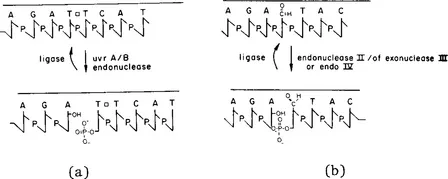
FIGURE 1 Damage Specific Endonucleases (a) pyr <> pyr correndonucleases (b) Apurinic/apyrimidinic endonucleases.
It is unclear why a controlling step is necessary at this point in repair. However, definitive binding data at such sites by competing enzymes, such as DNA polymerase I, and ligase is needed. From preliminary information concerning the competition of these two enzymes for nicked or incised sites, it can be suggested that ligase can limit polymerization or strand displacement reactions catalyzed by DNA polymerase I (15).
An endonucleolytic step is required to act specifically at sites generated by the DNA N-glycosylases (3–6). These apyrimidinic or apurinic sites act as substrates for the action of a number of ubiquitous endonucleases. In E. coli exonuclease III, its associated endonuclease activity (16) is able to act at such sites generating 5′-phosphoryl and 3′-hydroxyl termini, 5’ to the deoxyribose moiety (17). It has been suggested by Verly (18) that the role of the exonuclease III activity in repair is for removal of a few juxtaposed nucleotides thereby limiting the action of ligase and thus abortive repair. Mutants of exo III/endonuclease II, (xth− mutants) possess a unique residual endonuclease activity free of associated exonuclease which acts specifically at apurinic sites. Endonuclease IV (19) has the capacity to act at such apurinic sites, presumably acting 5’ to the damage to generate suitable sites for excision reactions.
Two enzymes have been isolated which appear to be specific for UV damage, one referred to as endonuclease III (20) and the other is the gene product of uvrA and uvrB (8). The latter enzymes are absent in excision-defective mutants whereas endonuclease III, requiring more heavily irradiated DNA is present in excision-defective mutants.
Endonuclease V recently reported by Ga...
Table of contents
- Cover image
- Title page
- Table of Contents
- Inside Front Cover
- Copyright
- Preface
- I: REPAIRABLE DAMAGE: IDENTIFICATION AND QUANTIFICATION
- II: REPAIR PATHWAYS: MODELS, SYSTEMS, AND PERSPECTIVES
- III: MECHANISM AND DIVERSITY OF ENZYMATIC PHOTOREACTIVATION
- IV: BASE EXCISION REPAIR
- V: NUCLEOTIDE EXCISION REPAIR IN BACTERIA
- VI: EXCISION REPAIR IN MAMMALIAN CELLS
- VII: INDUCIBLE/ERROR-PRONE REPAIR IN PROCARYOTES
- VIII: REPAIR IN LOWER EUCARYOTES
- IX: STRAND BREAK REPAIR IN MAMMALIAN CELLS
- X: REPLICATIVE BYPASS MECHANISMS IN MAMMALIAN CELLS
- XI: VIRAL PROBES FOR DNA REPAIR
- XII: HEREDITARY REPAIR DEFECTS IN MAN: XERODERMA PIGMENTOSUM
- XIII: REPAIR DEFICIENCY AND HUMAN DISEASE: OTHER HEREDITARY DEFECTS
- XIV: MUTAGENESIS AND CARCINOGENESIS
- XV: CONSEQUENCES OF DNA DAMAGE AND REPAIR
- Author Index
- Subject Index
Trusted by 375,005 students
Access to over 1.5 million titles for a fair monthly price.
Study more efficiently using our study tools.
Frequently asked questions
Yes, you can cancel anytime from the Subscription tab in your account settings on the Perlego website. Your subscription will stay active until the end of your current billing period. Learn how to cancel your subscription
No, books cannot be downloaded as external files, such as PDFs, for use outside of Perlego. However, you can download books within the Perlego app for offline reading on mobile or tablet. Learn how to download books offline
Perlego offers two plans: Essential and Complete
- Essential is ideal for learners and professionals who enjoy exploring a wide range of subjects. Access the Essential Library with 800,000+ trusted titles and best-sellers across business, personal growth, and the humanities. Includes unlimited reading time and Standard Read Aloud voice.
- Complete: Perfect for advanced learners and researchers needing full, unrestricted access. Unlock 1.5M+ books across hundreds of subjects, including academic and specialized titles. The Complete Plan also includes advanced features like Premium Read Aloud and Research Assistant.
We are an online textbook subscription service, where you can get access to an entire online library for less than the price of a single book per month. With over 1.5 million books across 990+ topics, we’ve got you covered! Learn about our mission
Look out for the read-aloud symbol on your next book to see if you can listen to it. The read-aloud tool reads text aloud for you, highlighting the text as it is being read. You can pause it, speed it up and slow it down. Learn more about Read Aloud
Yes! You can use the Perlego app on both iOS and Android devices to read anytime, anywhere — even offline. Perfect for commutes or when you’re on the go.
Please note we cannot support devices running on iOS 13 and Android 7 or earlier. Learn more about using the app
Please note we cannot support devices running on iOS 13 and Android 7 or earlier. Learn more about using the app
Yes, you can access DNA Repair Mechanisms by Philip Hanawalt in PDF and/or ePUB format, as well as other popular books in Biological Sciences & Biology. We have over 1.5 million books available in our catalogue for you to explore.