- 762 pages
- English
- ePUB (mobile friendly)
- Available on iOS & Android
eBook - ePub
Neurobiology of Psychiatric Disorders
About this book
This new volume in the Handbook of Clinical Neurology presents a comprehensive review of the fundamental science and clinical treatment of psychiatric disorders. Advances in neuroscience have allowed for dramatic advances in the understanding of psychiatric disorders and treatment. Brain disorders, such as depression and schizophrenia, are the leading cause of disability worldwide. It is estimated that over 25% of the adult population in North America are diagnosed yearly with at least one mental disorder and similar results hold for Europe. Now that neurology and psychiatry agree that all mental disorders are in fact, "brain diseases," this volume provides a foundational introduction to the science defining these disorders and details best practices for psychiatric treatment.
- Provides a comprehensive review of the scientific foundations of psychiatric disorders and psychiatric treatment
- Includes detailed results from genetics, molecular biology, brain imaging, and neuropathological, immunological, epidemiological, metabolic, therapeutic and historical aspects of the major psychiatric disorders
- A "must have" reference and resource for neuroscientists, neurologists, psychiatrists, and clinical psychologists as well as all research scientists investigating disorders of the brain
Information
Handbook of Clinical Neurology, Vol. 106, No. Suppl (C), 2012
ISSN: 0072-9752
doi: 10.1016/B978-0-444-52002-9.00001-2
Chapter 1 Psychiatry and neuroscience – history
Is there anything so extravagant as the imaginations of men’s brains? Where is the head that has no chimeras in it? (John Locke, 1690)
Neuroscience and the history and theory of science
The ideal of inexorable scientific progress, characterized by expanding knowledge and increased sophistication and complexity, is a defining characteristic of the modern self-image of the natural sciences and can even be objectively quantified. Rider (1944) and de Solla Price (1963), the founders of bibliometrics and scientometrics, noted many years ago that from the 17th century onward the number of scientific publications has been doubling every 10–20 years, while at the same time citations of earlier literature have fallen off markedly. This finding seems also to be confirmed by publishing developments in the fields of basic psychiatric and neurobiological research. A rough estimate based on the medical subject headings gathered in the National Library of Medicine’s Medline Database shows that in the four decades from 1966 to 2005 the number of essays on psychiatric disorders published in magazines increased from 5400 to 32 000 per year, and in the entire field of neuroscience from 35 000 to 144 000 per year.
Does this increase of approximately 4% per year actually reflect inexorable and continuous progress in neuroscience and psychiatry? Among contemporary historians and philosophers of science, this traditional image of progressive scientific development is considered to be naive. This is not to deny that research is shaped markedly by concepts and issues inherent to specific scientific fields – concepts such as “neuron” (Waldeyer-Hartz, 1891), “nerve growth factor” (Cohen and Levi-Montalcini, 1957), or “manic-depressive illness” (Kraepelin, 1899). Yet such ideas are by no means the result of simple linear growth in knowledge. Instead, scientific consensus derives from complex historical processes that involve political attitudes, prevailing scientific beliefs, or academic career trajectories, just as much as more “objective” criteria like the research methodology or the structures of decision-making processes in research groups. Furthermore, medical science does not exist simply for its own sake; instead, it is practiced in institutes and clinics that are financed by state organizations or private enterprises (Fig. 1.1). Consequently, it is shaped by political and administrative decisions and must respond to social needs. The results of a scientific inquiry are deemed “facts” only after they have been published in professional, peer-reviewed journals, presented at conferences, and accepted as worthy of discussion by the “scientific community.”
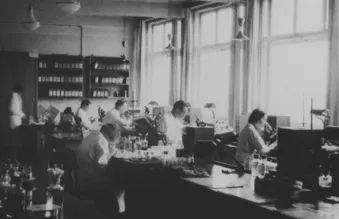
Fig. 1.1 Laboratory of the neuropathology department of the German Research Institute for Psychiatry (Deutsche Forschungsanstalt für Psychiatrie), Munich, c.1930. The laboratory is the site of contemporary neuroscience. It brings together a community of scientific objects comprising not only the researchers themselves, but also their concepts and ideas, and the technical instruments they use to produce scientific images. (Max Planck Institute of Psychiatry, historical archive: photo collection DFA.)
This “constructivist” understanding of science evolved within the history of the neurosciences. It can be traced back to the work of the Polish microbiologist Ludwik Fleck who, in 1935, after working in the laboratory of August von Wassermann, used the successful serological identification of syphilis to study the factors that influence scientific innovation and knowledge growth. Fleck spoke of “styles of thought” (Denkstile) to describe the comprehensive concepts and hypotheses that influence the questions and methodologies of any given scientific community. Subsequently, in his study on the Scientific Revolution, Thomas Kuhn (1962) coined the phrase “paradigm” to describe the underlying idea that any kind of research is affected by such antecedent styles of thought. For example, the classification of mental diseases as “psychogenic neuroses” and as “organically induced psychoses” was an important characteristic of the psychiatric style of thought in the middle of the 20th century, and until recently the “one gene – one protein” hypothesis dominated the field of molecular biology. Scientists doing research in this field know from their own experience how rapidly almost all neuroscientific disciplines deemed “safe” since the 1950s are subject to change: the growing influence of epigenetics (Allis et al., 2006) is but one typical example of such a change in the style of thought.
The medical specialties we now call “psychiatry” and “neurology” are also historical constructions (Hirschmüller, 1999). They resulted not from ineluctable scientific progress, but from the negotiations of 19th-century practitioners who managed to redefine some neuroses away from Cullen’s old class of “disorders of general sensation and movement, without idiopathic pyrexia and local lesion” (Cullen, 1803). So-called “neurological diseases” were thus constructed on the basis of two criteria: salient disorders of motor and sensory function, and the possibility of being related to a “focal” brain lesion. On the belief that a putative etiological link existed between “focal lesion” and symptoms as dictated by the clinicopathological model of disease, it was further claimed that the said motor and sensory changes were “primary” and that all other complaints, e.g., mental symptoms and cognitive deficits, were “occasional” or “secondary.” Huntington’s disease, Parkinson’s disease, and multiple sclerosis were constructed in this way (Berrios and Porter, 1995). This maneuver created two independent clinical spaces: on the one hand the brand new space of clinical neurology and on the other the obscure space of alienism that was occupied by conditions which were definable only in terms of mental symptoms or behavioral complaints and which could not be plausibly linked to a “focal brain lesion.”
Although critics have advanced many valid arguments against such constructivist models, the ensuing debates in the history and philosophy of science have insured that it is no longer possible to view science as a closed system, isolated from society, politics, and economics and governed by its own inherent rules of knowledge acquisition (Golinski, 1998). Scientists working in the field of psychiatry and neuroscience should be especially aware of this fact, because in public discourse their concepts always affect human self-interpretation in a very particular way. For example, the 20th century has been called the “psychiatric century” (Porter, 2002). Culturally and historically, it has been shaped decisively not just by psychoanalysis and “biological psychiatry” or psychopharmacology, but also by the antipsychiatry movement in the 1960s and 1970s and by psychiatric genetics in both its racist guise under National Socialism and its arguably progressive contemporary guise.
Given the abundance of knowledge at the disposal of contemporary psychiatrists and neurobiologists, they can hardly keep up with current literature in their own field, let alone with the history of their discipline. Given the international nature of biomedical research today, historical accounts that stress national traditions – as the introduction to volume one of the first edition of this handbook (Zülch, 1968) did – no longer seem relevant. Instead, to understand long-term developments in neuroscience, it now seems more appropriate to focus on several core themes that have recurred in debates throughout history. More precisely, two key questions seem worthy of consideration: first, the material localization of the psyche, and second, the significance of hereditary transmission in the etiology of mental disorders.
Theories and concepts of localization and genetics
The localization of the psyche as a function of the brain is anything but self-evident. In Greek antiquity, especially in the well-known paper on epilepsy in the Corpus Hippocraticum, disturbances in the brain were believed to cause mental illness. Yet this belief should not be taken to imply that the idea of the psyche being localized in the blood/heart system, i.e., in the body fluids, became obsolete. Although today the brain is often described using the metaphors of computer science and information technology, contemporary theories that are indebted to classical humoral pathology have played a decisive role in neuroendocrinology and research on depression (Holsboer, 2001). Not until after the Enlightenment did the brain finally became the “organ of the soul” (Sömmerring, 1796). Most of the neuroscientific studies conducted during the past two cent...
Table of contents
- Cover image
- Title page
- Series Page
- Copyright
- Handbook of Clinical Neurology 3rd Series
- Foreword
- Preface
- Contributors
- Chapter 1: Psychiatry and neuroscience – history
- Chapter 2: Receptor signaling and the cell biology of synaptic transmission
- Chapter 3: Human genetics of schizophrenia
- Chapter 4: Neurological and psychiatric aspects of emotion
- Chapter 5: Research methods
- Chapter 6: Structural imaging in psychiatric disorders
- Chapter 7: Human functional neuroimaging
- Chapter 8: Neurotransmitters and neuropeptides in depression
- Chapter 9: Animal models of psychiatric disorders
- Chapter 10: Psychiatric epidemiology
- Chapter 11: Emerging methods in the molecular biology of neuropsychiatric disorders
- Chapter 12: Clinical psychoneuroimmunology
- Chapter 13: Psychiatric rating scales
- Chapter 14: Unipolar depression
- Chapter 15: Bipolar disorder
- Chapter 16: The neurobiology and treatment of late-life depression
- Chapter 17: Seasonal affective disorder
- Chapter 18: Biological and clinical framework for posttraumatic stress disorder
- Chapter 19: Generalized anxiety disorder
- Chapter 20: Panic disorder
- Chapter 21: Obsessive-compulsive disorder
- Chapter 22: Attention-deficit/hyperactivity disorder
- Chapter 23: Autism and related disorders
- Chapter 24: Substance abuse disorders
- Chapter 25: Cognitive impairment in schizophrenia: profile, course, and neurobiological determinants
- Chapter 26: Eating disorders
- Chapter 27: Personality disorders
- Chapter 28: Psychiatric, nonmotor aspects of Parkinson’s disease
- Chapter 29: Stroke
- Chapter 30: Huntington’s disease
- Chapter 31: Sleep disorders
- Chapter 32: Depression and cardiovascular disorders
- Chapter 33: Psychiatric disorders among cancer patients
- Chapter 34: Chronic fatigue syndrome
- Chapter 35: Neurocognitive deficits in patients with human immunodeficiency virus infection
- Chapter 36: Gastrointestinal disorders
- Chapter 37: Role of psychotherapy in the management of psychiatric diseases
- Chapter 38: Pharmacology and neuroimaging of antidepressant action
- Chapter 39: Antipsychotic drugs
- Chapter 40: Anxiolytics
- Chapter 41: Brain stimulation therapies for neuropsychiatric disease
- Chapter 42: Chronotherapeutics (light and wake therapy) as a class of interventions for affective disorders
- Chapter 43: Pharmacogenetics of antidepressants and mood stabilizers
- Index
Trusted by 375,005 students
Access to over 1.5 million titles for a fair monthly price.
Study more efficiently using our study tools.
Frequently asked questions
Yes, you can cancel anytime from the Subscription tab in your account settings on the Perlego website. Your subscription will stay active until the end of your current billing period. Learn how to cancel your subscription
No, books cannot be downloaded as external files, such as PDFs, for use outside of Perlego. However, you can download books within the Perlego app for offline reading on mobile or tablet. Learn how to download books offline
Perlego offers two plans: Essential and Complete
- Essential is ideal for learners and professionals who enjoy exploring a wide range of subjects. Access the Essential Library with 800,000+ trusted titles and best-sellers across business, personal growth, and the humanities. Includes unlimited reading time and Standard Read Aloud voice.
- Complete: Perfect for advanced learners and researchers needing full, unrestricted access. Unlock 1.5M+ books across hundreds of subjects, including academic and specialized titles. The Complete Plan also includes advanced features like Premium Read Aloud and Research Assistant.
We are an online textbook subscription service, where you can get access to an entire online library for less than the price of a single book per month. With over 1.5 million books across 990+ topics, we’ve got you covered! Learn about our mission
Look out for the read-aloud symbol on your next book to see if you can listen to it. The read-aloud tool reads text aloud for you, highlighting the text as it is being read. You can pause it, speed it up and slow it down. Learn more about Read Aloud
Yes! You can use the Perlego app on both iOS and Android devices to read anytime, anywhere — even offline. Perfect for commutes or when you’re on the go.
Please note we cannot support devices running on iOS 13 and Android 7 or earlier. Learn more about using the app
Please note we cannot support devices running on iOS 13 and Android 7 or earlier. Learn more about using the app
Yes, you can access Neurobiology of Psychiatric Disorders by Thomas E Schlaepfer,Charles B. Nemeroff in PDF and/or ePUB format, as well as other popular books in Biological Sciences & Neurology. We have over 1.5 million books available in our catalogue for you to explore.