eBook - ePub
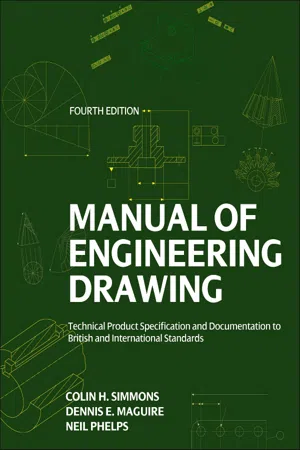
Manual of Engineering Drawing
Technical Product Specification and Documentation to British and International Standards
- 384 pages
- English
- ePUB (mobile friendly)
- Available on iOS & Android
eBook - ePub
Manual of Engineering Drawing
Technical Product Specification and Documentation to British and International Standards
About this book
Manual of Engineering Drawing is a comprehensive guide for experts and novices for producing engineering drawings and annotated 3D models that meet the recent BSI and ISO standards of technical product documentation and specifications. This fourth edition of the text has been updated in line with recent standard revisions and amendments. The book has been prepared for international use, and includes a comprehensive discussion of the fundamental differences between the ISO and ASME standards, as well as recent updates regarding legal components, such as copyright, patents, and other legal considerations. The text is applicable to CAD and manual drawing, and it covers the recent developments in 3D annotation and surface texture specifications. Its scope also covers the concepts of pictorial and orthographic projections, geometrical, dimensional and surface tolerancing, and the principle of duality. The text also presents numerous examples of hydraulic and electrical diagrams, applications, bearings, adhesives, and welding. The book can be considered an authoritative design reference for beginners and students in technical product specification courses, engineering, and product designing.
- Expert interpretation of the rules and conventions provided by authoritative authors who regularly lead and contribute to BSI and ISO committees on product standards
- Combines the latest technical information with clear, readable explanations, numerous diagrams and traditional geometrical construction techniques
- Includes new material on patents, copyrights and intellectual property, design for manufacture and end-of-life, and surface finishing considerations
Information
Subtopic
Ingegneria meccanicaChapter 1
Drawing Office Management and Organization
Every article used in our day-to-day lives will probably have been produced as a result of solutions to a sequence of operations and considerations, namely:
1. Conception
2. Design and analysis
3. Manufacture
4. Verification
5. In-service (maintenance)
6. Disposal.
The initial stage will commence when an original marketable idea is seen to have a possible course of development. The concept will probably be viewed from an artistic and a technological perspective.
The appearance and visual aspects of a product are very important in creating an acceptable good first impression.
The technologist faces the problem of producing a sound, practical, safe design, which complies with the initial specification and can be produced at an economical cost.
During every stage of development there are many progress records to be maintained and kept up to date so that reference to the complete history is available to responsible employees and regulatory bodies.
For many years various types of drawings, sketches and paintings have been used to convey ideas and information. In the last decade 3D models and rapid prototypes have also become a common way of conveying design intent. However, a good recognizable picture will often remove ambiguity when a project is being discussed and assist in overcoming a possible language barrier.
British Standards are listed in the British Standards Catalogue, and the earliest relevant Engineering Standards date back to 1903. Standards were developed to establish suitable dimensions for a range of sizes of metal bars, sheets, nuts, bolts, flanges, etc. following the Industrial Revolution and used by the Engineering Industry. The first British Standard for Engineering Drawing Office Practice published in September 1927 only contained 14 clauses, as follows:
1. Sizes of drawings and tracings, and widths of tracing cloth and paper
2. Position of drawing number, date and name
3. Indication of scale
4. Method of projection
5. Types of line and writing
6. Colour of lines
7. Dimension figures
8. Relative importance of dimensions
9. Indication of materials on drawings
10. Various degrees of finish
11. Screw threads
12. Flats and squares
13. Tapers
14. Abbreviations for drawings.
There were also five figures illustrating:
1. Method of projection
2. Types of line
3. Views and sections
4. Screw threads
5. Tapers.
First angle projection was used for the illustrations and the publication was printed on A5 sheets of paper.
During the early days of the Industrial Revolution manufacturers simply compared and copied component dimensions to match those used on the prototype. However, with the introduction of quantity production where components were required to be made at different factory sites, measurement by more precise means was essential. Individual manufacturers developed their own standard methods. Clearly, for the benefit of industry in general a National Standard was vital. Later the more comprehensive British Standard of Limits and Fits was introduced. There are two clear aspects, which are necessary to be considered in the specification of component drawings:
1. The drawing shows the dimensions for the component in three planes. Dimensions of the manufactured component need to be verified because some variation of size in each of the three planes (length, breadth, and thickness) will be unavoidable. The designer’s contribution is to provide a Characteristics Specification, which in current jargon is defined as the ‘Design Intent Measurand’.
2. The metrologist produces a ‘Characteristics Evaluation’ which is simply the Measured Value.
The drawing office is generally regarded as the heart of any manufacturing organization. Products, components, ideas, layouts, or schemes which may be presented by a designer in the form of rough freehand sketches, may be developed stage by stage into working drawings and annotated 3D models by the draughtsman. There is generally very little constructive work which can be done by other departments within the firm without an approved drawing of some form being available. The drawing is the universal means of communication.
Drawings are made to an accepted Standard, and in the United Kingdom, it is BS 8888, containing normative and informative references to international Standards. These Standards are acknowledged and accepted throughout the world.
The contents of the drawing (and annotated 3D models) are themselves, where applicable, in agreement with separate Standards relating to materials, dimensions, processes, etc. Larger organizations employ Standards engineers who ensure that products conform to British and also international Standards where necessary. Good design is often the product of teamwork where detailed consideration is given to the aesthetic, economic, ergonomic and technical aspects of a given problem. It is therefore necessary to impose the appropriate Standards at the design stage, since all manufacturing instructions originate from this point.
A perfect drawing communicates an exact requirement, or specification, which cannot be misinterpreted and which may form part of a legal contract between supplier and user.
Engineering drawings can be produced to a good professional Standard if the following points are observed:
(a) The types of lines used must be of uniform thickness and density.
(b) Eliminate fancy printing, shading and associated artistry.
(c) Include on the drawing only the information which is required to ensure accurate clear communication.
(d) Use only standard symbols and where no other method of specification exist, appropriate abbreviations.
(e) Ensure that the drawing is correctly dimensioned (adequately but not over-dimensioned) with no unnecessary details.
Remember that care and consideration given to small details make a big contribution towards perfection, but that perfection itself is no small thing. An accurate, well-delineated engineering drawing can give the draughtsman responsible considerable pride and job satisfaction.
The field of activity of the draughtsman may involve the use, or an appreciation, of the following topics.
1. Company communications Most companies have their own systems which have been developed over a period of time for the following:
(a) internal paperwork;
(b) numbering of drawings and contracts;
(c) coding of parts and assemblies;
(d) production planning for component manufacture;
(e) quality control and inspection;
(f) updating, modification, and reissuing of drawings.
2. Company standards Many drawing offices use their own standard methods which arise from satisfactory past experience of a particular product or process. Also, particular styles may be retained for easy identification; e.g., certain prestige cars can be recognized easily since some individual details, in principle, are common to all models.
3. Standards for dimensioning Interchangeability and quality are controlled by the application of practical limits, fits and geometrical tolerances.
4. Material standards Physical and chemical properties and non-destructive testing methods must be borne in mind. Note must also be taken of preferred sizes, stock sizes, and availability of rod, bar, tube, plate, sheet, nuts, bolts, rivets, etc., and other bought-out items.
5. Draughting standards and codes of practice Drawings must conform to accepted standards, but components are sometimes required which in addition must conform to certain local requirements or specific regulations, for example relating to safety when operating in certain environments or conditions. Assemblies may be required to be flameproof, gastight, waterproof, or resistant to corrosive attack, and detailed specifications from the user may be applicable.
6. Standard parts are sometimes manufactured in quantity by a company, and are used in several different assemblies. The use of standard parts reduces an unnecessary variety of materials and basically similar components.
7. Standards for costs The draughtsman is often required to compare costs where different methods of manufacture are available. A component could possibly be made by forging, by casting, or by fabricating and welding, and a decision as to which method to use must be made. The draughtsman must obviously be well aware of the manufacturing facilities and capacity offered by his own company and of the costs involved when different techniques of production are employed, and also have an idea of the likely costs when work is sub-contracted to specialist manufacturers, since this alternative often proves an economic proposition.
8. Data sheets Tables of sizes, performance graphs, and ...
Table of contents
- Title of Book
- Chapter 1. Drawing Office Management and Organization
- Chapter 2. Product Development and Computer Aided Design
- Chapter 3. Design for Manufacture to End of Life
- Chapter 4. Intellectual Property and Engineering Design
- Chapter 5. CAD Organization and Applications
- Chapter 6. Principles of First and Third Angle Orthographic Projection
- Chapter 7. Linework and Lettering
- Chapter 8. Three-dimensional Illustrations Using Isometric and Oblique Projection
- Chapter 9. Drawing Layouts and Simplified Methods
- Chapter 10. Sections and Sectional Views
- Chapter 11. Geometrical Constructions and Tangency
- Chapter 12. Loci Applications
- Chapter 13. True Lengths and Auxiliary Views
- Chapter 14. Conic Sections and Interpenetration of Solids
- Chapter 15. Development of Patterns from Sheet Materials
- Chapter 16. Dimensioning Principles
- Chapter 17. Screw Threads and Conventional Representations
- Chapter 18. Nuts, Bolts, Screws, and Washers
- Chapter 19. Keys and Key Ways
- Chapter 20. Worked Examples in Machine Drawing
- Chapter 21. Limits and Fits
- Chapter 22. Geometrical Tolerancing and Datums
- Chapter 23. Application of Geometrical Tolerances
- Chapter 24. Maximum Material and Least Material Principles
- Chapter 25. Positional Tolerancing
- Chapter 26. Surface Texture
- Chapter 27. Surface Finish and Corrosion of Metals
- Chapter 28. 3D Annotation
- Chapter 29. The Duality Principle – the Essential Link Between the Design Intent and the Verification of the End Product
- Chapter 30. Differences between American ASME Y 14.5M Geometric Dimensioning and Tolerancing (GD&T) and ISO/BS 8888 Geometrical Tolerancing Standards
- Chapter 31. Cams and Gears
- Chapter 32. Springs
- Chapter 33. Welding and Welding Symbols
- Chapter 34. Engineering Diagrams
- Chapter 35. Bearings and Applied Technology
- Chapter 36. Engineering Adhesives
- Chapter 37. Related Standards
- Chapter 38. Production Drawings
- Chapter 39. Drawing Solutions
Trusted by 375,005 students
Access to over 1.5 million titles for a fair monthly price.
Study more efficiently using our study tools.
Frequently asked questions
Yes, you can cancel anytime from the Subscription tab in your account settings on the Perlego website. Your subscription will stay active until the end of your current billing period. Learn how to cancel your subscription
No, books cannot be downloaded as external files, such as PDFs, for use outside of Perlego. However, you can download books within the Perlego app for offline reading on mobile or tablet. Learn how to download books offline
Perlego offers two plans: Essential and Complete
- Essential is ideal for learners and professionals who enjoy exploring a wide range of subjects. Access the Essential Library with 800,000+ trusted titles and best-sellers across business, personal growth, and the humanities. Includes unlimited reading time and Standard Read Aloud voice.
- Complete: Perfect for advanced learners and researchers needing full, unrestricted access. Unlock 1.5M+ books across hundreds of subjects, including academic and specialized titles. The Complete Plan also includes advanced features like Premium Read Aloud and Research Assistant.
We are an online textbook subscription service, where you can get access to an entire online library for less than the price of a single book per month. With over 1.5 million books across 990+ topics, we’ve got you covered! Learn about our mission
Look out for the read-aloud symbol on your next book to see if you can listen to it. The read-aloud tool reads text aloud for you, highlighting the text as it is being read. You can pause it, speed it up and slow it down. Learn more about Read Aloud
Yes! You can use the Perlego app on both iOS and Android devices to read anytime, anywhere — even offline. Perfect for commutes or when you’re on the go.
Please note we cannot support devices running on iOS 13 and Android 7 or earlier. Learn more about using the app
Please note we cannot support devices running on iOS 13 and Android 7 or earlier. Learn more about using the app
Yes, you can access Manual of Engineering Drawing by Colin H. Simmons,Dennis E. Maguire in PDF and/or ePUB format, as well as other popular books in Tecnologia e ingegneria & Ingegneria meccanica. We have over 1.5 million books available in our catalogue for you to explore.