- 420 pages
- English
- ePUB (mobile friendly)
- Available on iOS & Android
eBook - ePub
Mammals
About this book
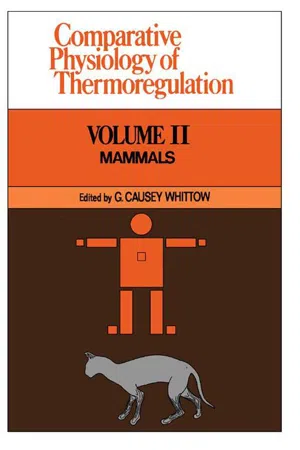
Mammals aims to present separate accounts of the means by which each of the major groups of animals regulates its body temperature, heat production, and heat loss. Readers who wish to obtain information on thermoregulatory processes in different species will welcome this as a convenient reference work. It is hoped that the treatise will have more than convenience value. This volume comprises five chapters, with the first focusing on rodents. It discusses the thermal environment of rodents, thermal behavior, and precision of homeothermy. Chapter 2 focuses on carnivores and discusses general thermal defenses, protection against hypothermia and hyperthermia, and cold acclimation. Chapter 3 deals with body temperature, behavioral thermoregulation, and food and water intake of ungulates. Chapter 4 focuses on primates and discusses normal thermoregulation in the monkey, fever and other responses to pyrogens, and neurochemical control mechanisms in the hypothalamus. Finally, Chapter 5 discusses man's energy exchanges related to temperature and work, behavioral versus physiological temperature regulation, and a mathematical model of man's thermoregulatory system. This book will be of interest to practitioners in the fields of physiology, epidemiology, biology, neuropsychology, and public health.
Information
CONTENTS OF VOLUME I
Aquatic Invertebrates
F. JOHN VERNBERG AND WINONA B. VERNBERG
Terrestrial Invertebrates
J. L. CLOUDSLEY-THOMPSON
Fish
F. E. J. FRY AND P. W. HOCHACHKA
Amphibia
BAYARD H. BRATTSTROM
Reptiles
JAMES R. TEMPLETON
Birds
WILLIAM R. DAWSON AND JACK W. HUDSON
AUTHOR INDEX–SUBJECT INDEX
Chapter 1
RODENTS*
J.S. Hart
Publisher Summary
This chapter discusses the thermal environments of rodents. The rodents as a group consist of thermally sensitive animals of small body weight, which inhabit all regions of the earth from the tropics to polar region and from sea level to high-mountain climates. In arctic and subarctic climates, small animals are insulated from extreme conditions by their behavior in seeking warm microclimates, but these climates still appear to impose considerable metabolic burden particularly during foraging where subfreezing conditions are encountered. In cold climates, it is abundantly clear that the animals are exposed to much lower temperatures than in warm climates, in spite of behavioral tendencies tending to offset environmental influences. Studies on behavioral tendencies—such as huddling, nest building, and temperature selection—have shown the effectiveness of temperature compensation by this means and the seasonal variation in these qualities. The ability to tolerate elevations in body temperature in the heat and depression of body temperature in the cold is adaptive to variable conditions of environment, particularly in hot arid regions. Variability of body temperature is a mechanism for conserving energy and water. Examination of the effect of activity on temperature regulation shows that many rodents tend to increase activity with a fall in temperature and to reduce it greatly in extreme cold.
I. Introduction
II. Thermal Environment of Rodents
A. Arctic and Subarctic Regions
B. Cool Temperate Regions
C. Desert and Warm Climates
D. Special Environments
III. Thermal Behavior
A. Huddling and Nesting
B. Temperature Selection
C. Heat Reinforcement Behavior
IV. Precision of Homeothermy
A. Periodic Variations in Body Temperature
B. Body Temperature in Relation to Ambient Temperature
C. Body Temperature and Climate
V. Temperature Regulation in Cold Environments
A. Minimal Metabolism and Body Size
B. Newton’s Law, Critical Temperature, and Critical Gradient
C. Heat Production and Loss below Thermal Neutrality
D. Influence of Diet
E. Thermal Conductance
F. Thermal Limits
VI. Temperature Regulation in Warm Environments
A. Heat Production and Body Temperature
B. Partition of Sensible and Evaporative Heat Loss
C. Components of Pulmocutaneous Loss
D. Peripheral Heat Loss and Blood Flow
E. Acclimation to Heat
F. Thermal Limits
G. Heat Death and Tissue Injury
VII. Activity and Temperature Regulation
A. Amount of Activity at Different Temperatures
B. Effect of Activity on Body Temperature
C. Effect of Activity on Oxygen Consumption
D. Activity and Cold Resistance
E. Diurnal Metabolic Rhythms
VIII. Altitude, Hypoxia, and Temperature Regulation
A. Acute Effects
B. Chronic States
IX. Sex Differences in Temperature Regulation
X. Summary and Conclusions
References
I Introduction
The study of temperature regulation has been pursued more intensively in the rodents than in any other group during the last 25 years, particularly during the last decade. This interest has stemmed partly from the convenience in methodology for study of animals of small body size (101−104 gm) but primarily from the great diversity in regulatory responses within the group. The latter aspect has attracted much attention from the comparative physiologists interested in hibernation, and in behavioral and physiological regulations during active states in relation to the great diversity of ecological and climatic conditions. These studies have shown that it has not been possible to understand the regulations in different species without knowledge of microclimatic conditions of their habitats and of the behavioral features of the species in question. While the characteristics of torpidity and hibernation will not be considered in this chapter, the microhabitat conditions and behavioral aspects of rodents will be analyzed, since these aspects are an important component of the total ability of a species to insulate itself from its environment.
While it may be concluded that the major interest of the zoological interpretation of temperature regulation has been in relation to the behavior of animals in nature, the rodents have been of primary interest to physiologists in the interpretation and understanding of the mechanisms of temperature regulation. Much of the work in this area has been on laboratory animals such as the wh...
Table of contents
- Cover image
- Title page
- Table of Contents
- CONTRIBUTORS
- Copyright
- LIST OF CONTRIBUTORS
- PREFACE
- CONTENTS OF VOLUME I
- Chapter 1: RODENTS
- Chapter 2: CARNIVORES
- Chapter 3: UNGULATES
- Chapter 4: PRIMATES
- Chapter 5: MAN
- AUTHOR INDEX
- SUBJECT INDEX
Trusted by 375,005 students
Access to over 1.5 million titles for a fair monthly price.
Study more efficiently using our study tools.
Frequently asked questions
Yes, you can cancel anytime from the Subscription tab in your account settings on the Perlego website. Your subscription will stay active until the end of your current billing period. Learn how to cancel your subscription
No, books cannot be downloaded as external files, such as PDFs, for use outside of Perlego. However, you can download books within the Perlego app for offline reading on mobile or tablet. Learn how to download books offline
Perlego offers two plans: Essential and Complete
- Essential is ideal for learners and professionals who enjoy exploring a wide range of subjects. Access the Essential Library with 800,000+ trusted titles and best-sellers across business, personal growth, and the humanities. Includes unlimited reading time and Standard Read Aloud voice.
- Complete: Perfect for advanced learners and researchers needing full, unrestricted access. Unlock 1.5M+ books across hundreds of subjects, including academic and specialized titles. The Complete Plan also includes advanced features like Premium Read Aloud and Research Assistant.
We are an online textbook subscription service, where you can get access to an entire online library for less than the price of a single book per month. With over 1.5 million books across 990+ topics, we’ve got you covered! Learn about our mission
Look out for the read-aloud symbol on your next book to see if you can listen to it. The read-aloud tool reads text aloud for you, highlighting the text as it is being read. You can pause it, speed it up and slow it down. Learn more about Read Aloud
Yes! You can use the Perlego app on both iOS and Android devices to read anytime, anywhere — even offline. Perfect for commutes or when you’re on the go.
Please note we cannot support devices running on iOS 13 and Android 7 or earlier. Learn more about using the app
Please note we cannot support devices running on iOS 13 and Android 7 or earlier. Learn more about using the app
Yes, you can access Mammals by G. Causey Whittow in PDF and/or ePUB format, as well as other popular books in Biological Sciences & Zoology. We have over 1.5 million books available in our catalogue for you to explore.