- 698 pages
- English
- ePUB (mobile friendly)
- Available on iOS & Android
eBook - ePub
About this book
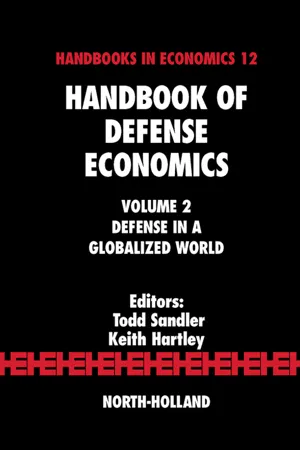
The second volume of the Handbook of Defense Economics addresses defense needs, practices, threats, and policies in the modern era of globalization. This new era concerns the enhanced cross-border flows of all kinds (e.g., capital and labor flows, revolutionary rhetoric, guerrillas, and terrorists) including the spillovers of benefits and costs associated with public goods and transnational externalities (i.e., uncompensated interdependencies affecting two or more nations). These ever-increasing flows mean that military armaments and armies are less able to keep out security threats. Thus, novel defense and security barriers are needed to protect borders that are porous to terrorists, pollutants, political upheavals, and conflicts. Even increased trade and financial flows imply novel security challenges and defenses. Globalization also underscores the importance of a new set of institutions (e.g., the European Union and global governance networks) and agents (e.g., nongovernmental organizations and partnerships).This volume addresses the security challenges in this age of globalization, where conflicts involve novel tactics, new technologies, asymmetric warfare, different venues, and frightening weapons. Volume 2 contains topics not covered in volume 1 – i.e., civil wars, peacekeeping, economic sanctions, the econometrics of arms races, conversion, peace economics, and the interface of trade, peace, and democracy. Volume 2 also revisits topics from volume 1, where there has been a significant advancement of knowledge – i.e., conflict analysis, terrorism, arms races, arms trade, military manpower, and arms industries. All of the main securities concerns of today are analyzed. Chapters are written by the leading contributors in the topic areas.*Up-to-date surveys on the pressing defense issues: theoretical, empirical and policy issues.*Coverage of theoretical and empirical studies of terrorism.*Contributions by the leading researchers in the field of defense economics.
Information
Subtopic
National SecurityTable of contents
- Cover image
- Title page
- Table of Contents
- Contents of the Handbook
- Chapter 20 Defense in a Globalized World: An Introduction
- Chapter 21 Economics of Defense in a Globalized World
- Chapter 22 Economics of Conflict: An Overview
- Chapter 23 Civil War
- Chapter 24 Political Economy of Peacekeeping
- Chapter 25 Terrorism: A Game-Theoretic Approach
- Chapter 26 Terrorism: An Empirical Analysis
- Chapter 27 The Political Economy of Economic Sanctions
- Chapter 28 The Econometrics of Military Arms Races
- Chapter 29 Arms Trade and Arms Races: A Strategic Analysis
- Chapter 30 Arms Industries, Arms Trade, and Developing Countries
- Chapter 31 Trade, Peace and Democracy: An Analysis of Dyadic Dispute
- Chapter 32 New Economics of Manpower in the Post-Cold War Era
- Chapter 33 The Arms Industry, Procurement and Industrial Policies
- Chapter 34 Success and Failure in Defense Conversion in the ‘Long Decade of Disarmament’
- Chapter 35 A Survey of Peace Economics
- Author Index of Volume 2
- Subject Index of Volume 2
Trusted by 375,005 students
Access to over 1.5 million titles for a fair monthly price.
Study more efficiently using our study tools.
Frequently asked questions
Yes, you can cancel anytime from the Subscription tab in your account settings on the Perlego website. Your subscription will stay active until the end of your current billing period. Learn how to cancel your subscription
No, books cannot be downloaded as external files, such as PDFs, for use outside of Perlego. However, you can download books within the Perlego app for offline reading on mobile or tablet. Learn how to download books offline
Perlego offers two plans: Essential and Complete
- Essential is ideal for learners and professionals who enjoy exploring a wide range of subjects. Access the Essential Library with 800,000+ trusted titles and best-sellers across business, personal growth, and the humanities. Includes unlimited reading time and Standard Read Aloud voice.
- Complete: Perfect for advanced learners and researchers needing full, unrestricted access. Unlock 1.5M+ books across hundreds of subjects, including academic and specialized titles. The Complete Plan also includes advanced features like Premium Read Aloud and Research Assistant.
We are an online textbook subscription service, where you can get access to an entire online library for less than the price of a single book per month. With over 1.5 million books across 990+ topics, we’ve got you covered! Learn about our mission
Look out for the read-aloud symbol on your next book to see if you can listen to it. The read-aloud tool reads text aloud for you, highlighting the text as it is being read. You can pause it, speed it up and slow it down. Learn more about Read Aloud
Yes! You can use the Perlego app on both iOS and Android devices to read anytime, anywhere — even offline. Perfect for commutes or when you’re on the go.
Please note we cannot support devices running on iOS 13 and Android 7 or earlier. Learn more about using the app
Please note we cannot support devices running on iOS 13 and Android 7 or earlier. Learn more about using the app
Yes, you can access Handbook of Defense Economics by Todd Sandler,Keith Hartley in PDF and/or ePUB format, as well as other popular books in Politics & International Relations & National Security. We have over 1.5 million books available in our catalogue for you to explore.