- 720 pages
- English
- ePUB (mobile friendly)
- Available on iOS & Android
eBook - ePub
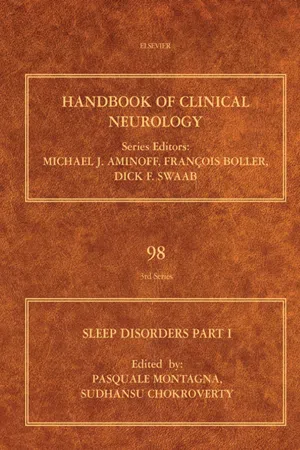
Sleep Disorders Part I
About this book
Sleep Disorders Part 1 offers a glimpse of developments that focus on diagnostic techniques in the field of neurobiology of sleep. This part discusses the models of the rapid eye movement (REM) sleep mechanism; issues regarding sleep states, stages, and memory consolidation; and advances in the understanding of the sleep-wake genes, gene products, the circadian clock, and the role of sleep duration. This book explains noninvasive neuroimaging studies, particularly positron emission tomographic and single photon emission computed tomographic scans. It further discusses advances in clinical science, including concepts about neurobiology of sleep, narcolepsy-cataplexy, therapy, and laboratory techniques. The significant advances in therapy have led to the addition of new drugs for the treatment of different sleeping disorders, as described in this book. Sleep is essential to humans. Awareness of its true importance leads to the development and acceptance of sleep medicines in the market.
- Clinical data on groundbreaking advancements in the understanding of basic sleep science
- Invaluable information on new therapies and drug protocols for sleep disorders
- A state-of-the-art reference that includes the role of genetics in sleep medicine
Handbook of Clinical Neurology, Vol. 98, No. Suppl C, 2011
ISSN: 0072-9752
doi: 10.1016/B978-0-444-52006-7.00001-0
Chapter 1History of sleep medicine
Sleep; King of all the gods and of all mortals, hearken now, prithee, to my word; and if ever before thou didst listen, obey me now, and I will ever be grateful to thee all my days (Homer, 14th book of the Iliad:Mueller, 1984).
Only a few physiological conditions have received as much attention from poets, novelists, scholars, and scientists as sleep. Writers from Aristotle and Ovid to Shakespeare and Dante have been fascinated by sleep and its impact upon our emotions, behavior, and health. Causes and reasons for sleep have been pondered by some of the world's greatest minds. Regardless of what the reason is, it is likely that sleep and dreams developed in animals because they were of some evolutionary benefit. Not only has sleep evolved through the ages but the environment for sleep has also undergone a change. From communal sleeping rooms with beds of twigs, straw, or skins, the bedroom has changed in the 21st century into a private place with electronic equipment, including remote-controlled television, DVD players, internet access, and even exercise equipment. The size of bedrooms has enlarged over the years.
A rudimentary understanding of insomnia and sleepiness was known in ancient times, but specific sleep disorders, such as narcolepsy, began to be recognized only in the late 19th century. Differentiation between causes of sleepiness and insomnia has reached a peak within the last 50 years since the development of sophisticated technology for the investigation of sleep.
Although most sleep disorders have probably been present since humans evolved, modern society has inadvertently produced several new disorders. The electric light bulb, developed by Thomas Edison, has allowed the light of day to be extended into night so that shift work can now occur around the clock, but at the expense of circadian rhythm disruption and sleep disturbance. Similarly, international jet travel has enabled the rapid crossing of time zones, which also can lead to a disruption of circadian rhythms and to sleep disturbance. Scientific investigation has produced more information on the physiology and pathophysiology of sleep in recent years than ever before. This rapid advance in sleep research and the development of sleep disorders medicine are producing answers to questions that date from antiquity.
Sleep in Prehistoric and Ancient Times
Sleep's the only medicine that gives ease (Sophocles, Philoctetes: Lloyd Jones, 1994).
The sleep patterns and sleep disorders of prehistoric humans are unknown, and therefore we must speculate from the comparative physiology of animals and from evidence of other behaviors and illnesses. Theories on the phylogenetic development of sleep stages in mammals have been developed from information available on the mammal-like reptiles. The earliest form of life developed about 600 million years ago in the pre-Cambrian period, and mammal-like reptiles evolved approximately 250 million years ago. The monotremes (egg-laying mammals) evolved as a separate line from the therian (live-bearing) mammals about 180 million years ago. It is about this time when it is believed that slow-wave sleep appeared; rapid eye movement (REM) sleep (paradoxical sleep) appeared about 50 million years later. Recent sleep research on one of the three surviving monotremes, the Australian short-nosed echidna and platypus, has provided some of the evidence for the evolution of sleep stages. The monotremes have high-voltage REM sleep, which suggests that REM sleep may have had its origin in reptilian ancestors (Karmanova, 1982; Siegel et al., 1998).
The pattern of sleep and waking behavior in prehistoric humans can be deduced from studies of animal groups phylogenetically closest to humans, namely nonhuman primates, such as apes and Old World monkeys. Sleep–wake patterns in nonhuman primates consist mainly of polyphasic episodes of rest and activity with frequent (up to 12) cycles of wakeful activity throughout the 24-hour day. Humans have the most developed monophasic pattern, with one episode of consolidated sleep and one main episode of wakefulness. Some animals, e.g., the chimpanzee, have a biphasic sleep–wake pattern, with a nap taken during the daytime. The chimpanzee has a rather prolonged sleep episode from dusk to dawn of approximately 10 hours; however, during this time there are frequent, brief awakenings. The daytime is characterized by two long episodes of wakefulness and an approximately 5-hour midday nap, which also includes frequent, brief wakefulness episodes. This type of sleep pattern may have the advantage of providing some security from predators.
Extrapolating from nonhuman primate studies, it seems likely that a similar polyphasic sleep pattern was likely to have been present in earliest humans (prior to the Neolithic period), particularly if they also attempted to sleep between dusk and dawn. There would have been frequent awakenings during the major sleep episode, as a single sleep episode of more than 10 hours appears unlikely. The monophasic sleep–wake pattern probably began in the latter part of the Neolithic period (since 10 000 BC). Neanderthal humans (70 000–40 000 BC) may well have been in a transitional stage between a polyphasic sleep pattern and the monophasic pattern seen today.
Prehistoric humans may have attempted to treat sleep disturbances, but how early they would have done this is unknown. Therapy probably resembled that utilized by sick animals, such as the removal of infective agents, eating various plants to induce emesis, and possibly even bloodletting. Bloodletting became an increasingly frequent therapeutic means for treating disease, including sleep disorders, in more advanced ancient civilizations. Primitive societies, even today, consider many illnesses and diseases to be caused by gods, magic, and spirits, and therefore various forms of divination, such as the casting of bones, moving of beads, charms, fetishes, chanting or the use of elaborate ceremonies, are invoked for therapeutic reasons. For disturbances of sleep and wakefulness, prehistoric humans probably applied similar forms of treatment.
Ancient Egypt
Most of our current knowledge of ancient Egyptian medicine derives from the ancient medical papyruses of Egypt (Ebbell, 1937). The Chester Beatty papyrus, which was written around 1350 BC, contains information on the interpretation of dreams. Dreams were regarded as being contrary predictions; for example, a dream of death meant a long life. However, an extensive text on a variety of medical subjects, including treatment, the Georg Ebers papyrus (1600 BC), has not been reported to contain any information on sleep disturbances. Ancient Egyptian medical practice consisted largely of praying to the gods and invoking the help of these divine healers. Thoth, who was a physician to the gods, and Imhotep were both important gods of healing at that time. The ancient Egyptians were known for their attention to hygiene and cleanliness, and it is likely that such attention was also paid to sleeping habits.
Medical opinion at the time held that the body was made up of a system of channels (Metu), which conveyed air to all parts of the body. Because they believed that bodily fluids could enter this system of channels, the ancient Egyptians were particularly concerned about feces entering the Metu. Hence, purging and enemas were the treatment modalities of many illnesses of that time, which included infective illnesses, such as malaria, parasitic infections, smallpox, and leprosy. Wine and other mildly alcoholic drinks (as compared to distilled alcoholic products) were consumed in large amounts and were probably the earliest treatments for insomnia but also may have been important in its d...
Table of contents
- Cover
- Table of Contents
- Series editors
- Copyright
- Handbook of Clinical Neurology 3rd Series
- Foreword
- Preface
- Acknowledgments
- List of contributors
- Chapter 1: History of sleep medicine
- Chapter 2: Normal sleep-recording and scoring techniques
- Chapter 3: Assessment of daytime sleepiness
- Chapter 4: Actigraphic monitoring of sleep and circadian rhythms
- Chapter 5: Video recordings and video polysomnography
- Chapter 6: Functional neuroimaging in sleep, sleep deprivation, and sleep disorders
- Chapter 7: The phylogeny of sleep
- Chapter 8: Ontogeny of EEG sleep from neonatal through infancy periods
- Chapter 9: Neurobiology of waking and sleeping
- Chapter 10: Neurobiology of REM sleep
- Chapter 11: Neurochemistry of sleep
- Chapter 12: Molecular neurobiology of sleep
- Chapter 13: Manifestations and functional implications of sleep homeostasis
- Chapter 14: Thermoregulation in wakefulness and sleep in humans
- Chapter 15: Cytokines in immune function and sleep regulation
- Chapter 16: Endocrine and metabolic changes during sleep
- Chapter 17: Sleep, memory, and molecular neurobiology
- Chapter 18: Epidemiology of sleep disorders
- Chapter 19: Cardiovascular and cerebrovascular physiology in sleep
- Chapter 20: Cardiovascular diseases and sleep apnea
- Chapter 21: Alterations in gastrointestinal functioning during sleep
- Chapter 22: Sleep and genitourinary systems: physiology and disorders
- Chapter 23: Sleep enuresis
- Chapter 24: Respiratory physiology in sleep and wakefulness
- Chapter 25: Obstructive sleep apnea: diagnosis, risk factors, and pathophysiology
- Chapter 26: Upper-airway resistance syndrome
- Chapter 27: Central sleep apnea
- Chapter 28: Positive-pressure treatment of obstructive sleep apnea syndrome
- Chapter 29: Medical and surgical treatment of obstructive sleep apnea syndrome, including dental appliances
- Chapter 30: Noninvasive positive ventilation in the treatment of sleep-related breathing disorders
- Chapter 31: Sleep and pulmonary diseases
- Chapter 32: Sleep-associated respiratory disorders and their psychobehavioral consequences in children
- Chapter 33: Sudden death in infants during sleep
- Chapter 34: Neurobiology and the neurological basis of dreaming
- Chapter 35: Abnormal dreams and nightmare disorders
- Chapter 36: Sleep and psychiatric diseases
- Chapter 37: Sleep-related eating disorder
- Chapter 38: Alcohol, toxins, and medications as a cause of sleep dysfunction
- Chapter 39: Sleep, pain, fibromyalgia, and chronic fatigue syndrome
- Chapter 40: Women and sleep
- Chapter 41: Normal and abnormal sleep in the elderly
- Subject Index
Trusted by 375,005 students
Access to over 1.5 million titles for a fair monthly price.
Study more efficiently using our study tools.
Frequently asked questions
Yes, you can cancel anytime from the Subscription tab in your account settings on the Perlego website. Your subscription will stay active until the end of your current billing period. Learn how to cancel your subscription
No, books cannot be downloaded as external files, such as PDFs, for use outside of Perlego. However, you can download books within the Perlego app for offline reading on mobile or tablet. Learn how to download books offline
Perlego offers two plans: Essential and Complete
- Essential is ideal for learners and professionals who enjoy exploring a wide range of subjects. Access the Essential Library with 800,000+ trusted titles and best-sellers across business, personal growth, and the humanities. Includes unlimited reading time and Standard Read Aloud voice.
- Complete: Perfect for advanced learners and researchers needing full, unrestricted access. Unlock 1.5M+ books across hundreds of subjects, including academic and specialized titles. The Complete Plan also includes advanced features like Premium Read Aloud and Research Assistant.
We are an online textbook subscription service, where you can get access to an entire online library for less than the price of a single book per month. With over 1.5 million books across 990+ topics, we’ve got you covered! Learn about our mission
Look out for the read-aloud symbol on your next book to see if you can listen to it. The read-aloud tool reads text aloud for you, highlighting the text as it is being read. You can pause it, speed it up and slow it down. Learn more about Read Aloud
Yes! You can use the Perlego app on both iOS and Android devices to read anytime, anywhere — even offline. Perfect for commutes or when you’re on the go.
Please note we cannot support devices running on iOS 13 and Android 7 or earlier. Learn more about using the app
Please note we cannot support devices running on iOS 13 and Android 7 or earlier. Learn more about using the app
Yes, you can access Sleep Disorders Part I by Pasquale Montagna,Sudhansu Chokroverty in PDF and/or ePUB format, as well as other popular books in Medicine & Neurology. We have over 1.5 million books available in our catalogue for you to explore.