- 589 pages
- English
- ePUB (mobile friendly)
- Available on iOS & Android
eBook - ePub
Starch: Chemistry and Technology
About this book
Starch: Chemistry and Technology, Second Edition focuses on the chemistry, processes, methodologies, applications, and technologies involved in the processing of starch. The selection first elaborates on the history and future expectation of starch use, economics and future of the starch industry, and the genetics and physiology of starch development. Discussions focus on polysaccharide biosynthesis, nonmutant starch granule polysaccharide composition, cellular developmental gradients, projected future volumes of corn likely to be used by the wet-milling industry, and organization of the corn wet-milling industry. The manuscript also tackles enzymes in the hydrolysis and synthesis of starch, starch oligosaccharides, and molecular structure of starch.
The publication examines the organization of starch granules, fractionation of starch, and gelatinization of starch and mechanical properties of starch pastes. Topics include methods for determining starch gelatinization, solution properties of amylopectin, conformation of amylose in dilute solution, and biological and biochemical facets of starch granule structure. The text also takes a look at photomicrographs of starches, industrial microscopy of starches, and starch and dextrins in prepared adhesives. The selection is a vital reference for researchers interested in the processing of starch.
Information
CHAPTER I
HISTORY AND FUTURE EXPECTATION OF STARCH USE
ROY L. WHISTLER, Department of Biochemistry, Purdue University, West Lafayette, Indiana
Publisher Summary
Starch is the lowest priced and most abundant worldwide commodity. It is produced in most countries and is available at low cost in all countries. Its level price over many years is impressive and makes it especially attractive as an industrial raw material. Its production by the wet-milling industry has continued to increase and may increase at a faster rate because starch takes more of the sweetener market and as governments subsidize ethanol production. The birth of enzyme engineering made possible the low cost conversion of starch to D-glucose and on to an equilibrium mixture of D-glucose and D-fructose equivalent in sweetness to invert sugar from cane or beet. With the development of more sophisticated methods of enzyme chemistry, it will become possible to transform starch into novel molecules possessing new properties suitable for new applications.
I INTRODUCTION
Although the past is usually prologue to the future, industrial usage of starch will be greater than normal methods of economic projection would indicate. Even though starch usage has shown a steady, rapid rate of growth over an extended period of time, new events are increasing demand for starch in an ever upward direction.
The birth of enzyme engineering made possible low cost conversion of starch to d-glucose and on to an equilibrium mixture of d-glucose and d-fructose equivalent in sweetness to invert sugar from cane or beet. This process alone made possible an immediate seizure of 30% of the sucrose market in the United States and doubled the amount of starch produced by the wet milling industry. With development of even more sophisticated methods of enzyme chemistry, it will become possible to transform starch into novel molecules possessing new properties suitable for entirely new applications.
A second event that makes projections for starch use difficult, but still suggests an upward demand, is the increased price of energy. This places new usage requirements on low cost starch to serve as a source of alcohol, components for plastics, special absorbents, paper extenders, oil well drilling muds, and as an additive of tertiary oil recovery systems, the potential requirement for the latter being enormous.
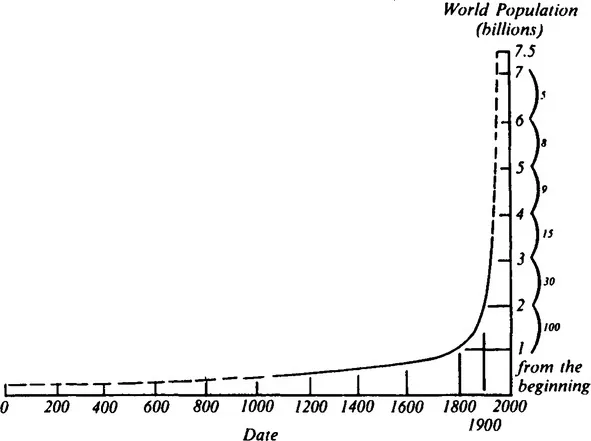
A third, large area of starch usage, more accurately predictable, is as a basic food to supply nutritional requirements of the growing world population (Fig. 1). Traditionally, carbohydrates supply 80% of the calories consumed by the human population with two-thirds of these calories coming from starch. Now that starch can be economically converted to sweeteners, it will supply a greater proportion of nutritional calories. Then too, as meat costs rise, the amount of carbohydrates consumed in the diet of populations in developed countries may increase over present levels.
Each of these considerations indicates a firm place for starch as a future industrial raw material.
II EARLY HISTORY
Starchy foods have always been an item in the diet of man. It is natural, therefore, that the practical use of starch products, and later of starch itself, should have developed in an early period. Some developments are cloaked in the predawn twilight of the unrecorded past. Strips of Egyptian papyrus, cemented together with a starchy adhesive and dated to the predynastic period of 3500–4000 b.c., give evidence of the early use of starch. However, a description of starch and its application is not found until much more recent times. The historian and philosopher, Caius Plinius Secundus (Pliny the Elder, 23–74 a.d.), described documents of 130 b.c. made by sizing papyrus with modified wheat starch to produce a smooth surface. The adhesive was made from fine ground wheat flour, boiled with a dilute solution of vinegar. The paste was spread over strips of papyrus; the strips beaten with a mallet and further strips lapped over the edges to give a broader sheet. Pliny stated that the 200-year-old sheets which he observed were still in good condition. Pliny also described the use of starch to whiten cloth and to powder hair. Chinese paper documents of about 312 a.d. are reported to contain starch size (1). Later, Chinese documents were first coated with a high-fluidity starch to provide resistance to ink penetration and then covered with powdered starch to provide weight and thickness. Starches from rice, wheat, and barley were commonly used at that time.
A procedure for starch production was given in some detail in a Roman treatise by Cato in about 184 b.c. (2). Grain was steeped in water for 10 days, pressed and mixed with fresh water, then filtered on a linen cloth, after which the starch in the filtrate was allowed to settle, washed with water, and finally dried in the sun.
Modified starches used for adhesives or to provide a sweet molasses developed at an early period. Hydrolysis was a common method of modification, and vinegar as well as amylolytic enzymes were used. Abu Mansur (3), an Arabian teacher and pharmacologist, was acquainted with the use of saliva on starch for producing an “artificial honey” used for treating wounds.
Starch was introduced into Northern Europe to stiffen linen, possibly early in the fourteenth century. Colored and uncolored starches were used as cosmetics. Uncolored starch was used principally as a hair powder. Blue starch was employed by the Puritans until its use was banned by Queen Elizabeth in 1596. Yellow starch was quite fashionable until a notorious woman prisoner wearing a bright yellow-starched ruffle was publicly executed. Red starch cosmetics remained in fashion for many years.
Leeuwenhoek (4), the inventor of ...
Table of contents
- Cover image
- Title page
- Table of Contents
- CONTRIBUTORS
- Copyright
- LIST OF CONTRIBUTORS
- PREFACE
- CONTENTS OF PREVIOUS VOLUMES
- CHAPTER I: HISTORY AND FUTURE EXPECTATION OF STARCH USE
- CHAPTER II: ECONOMICS AND FUTURE OF THE STARCH INDUSTRY
- CHAPTER III: GENETICS AND PHYSIOLOGY OF STARCH DEVELOPMENT
- CHAPTER IV: ENZYMES IN THE HYDROLYSIS AND SYNTHESIS OF STARCH
- CHAPTER V: STARCH OLIGOSACCHARIDES: LINEAR, BRANCHED, AND CYCLIC
- CHAPTER VI: MOLECULAR STRUCTURE OF STARCH
- CHAPTER VII: ORGANIZATION OF STARCH GRANULES
- CHAPTER VIII: FRACTIONATION OF STARCH
- CHAPTER IX: GELATINIZATION OF STARCH AND MECHANICAL PROPERTIES OF STARCH PASTES
- CHAPTER X: STARCH DERIVATIVES: PRODUCTION AND USES
- CHAPTER XI: CHEMICALS FROM STARCH
- CHAPTER XII: CORN AND SORGHUM STARCHES: PRODUCTION
- CHAPTER XIII: TAPIOCA, ARROWROOT, AND SAGO STARCHES: PRODUCTION
- CHAPTER XIV: POTATO STARCH: PRODUCTION AND USES
- CHAPTER XV: WHEAT STARCH: PRODUCTION, MODIFICATION, AND USES
- CHAPTER XVI: RICE STARCH: PRODUCTION, PROPERTIES, AND USES
- CHAPTER XVII: ACID-MODIFIED STARCH: PRODUCTION AND USES
- CHAPTER XVIII: STARCH IN THE PAPER INDUSTRY
- CHAPTER XIX: APPLICATIONS OF STARCHES IN FOODS
- CHAPTER XX: STARCH AND DEXTRINS IN PREPARED ADHESIVES
- CHAPTER XXI: GLUCOSE- AND FRUCTOSE-CONTAINING SWEETNERS FROM STARCH
- CHAPTER XXII: INDUSTRIAL MICROSCOPY OF STARCHES
- CHAPTER XXIII: PHOTOMICROGRAPHS OF STARCHES
- INDEX
Trusted by 375,005 students
Access to over 1.5 million titles for a fair monthly price.
Study more efficiently using our study tools.
Frequently asked questions
Yes, you can cancel anytime from the Subscription tab in your account settings on the Perlego website. Your subscription will stay active until the end of your current billing period. Learn how to cancel your subscription
No, books cannot be downloaded as external files, such as PDFs, for use outside of Perlego. However, you can download books within the Perlego app for offline reading on mobile or tablet. Learn how to download books offline
Perlego offers two plans: Essential and Complete
- Essential is ideal for learners and professionals who enjoy exploring a wide range of subjects. Access the Essential Library with 800,000+ trusted titles and best-sellers across business, personal growth, and the humanities. Includes unlimited reading time and Standard Read Aloud voice.
- Complete: Perfect for advanced learners and researchers needing full, unrestricted access. Unlock 1.5M+ books across hundreds of subjects, including academic and specialized titles. The Complete Plan also includes advanced features like Premium Read Aloud and Research Assistant.
We are an online textbook subscription service, where you can get access to an entire online library for less than the price of a single book per month. With over 1.5 million books across 990+ topics, we’ve got you covered! Learn about our mission
Look out for the read-aloud symbol on your next book to see if you can listen to it. The read-aloud tool reads text aloud for you, highlighting the text as it is being read. You can pause it, speed it up and slow it down. Learn more about Read Aloud
Yes! You can use the Perlego app on both iOS and Android devices to read anytime, anywhere — even offline. Perfect for commutes or when you’re on the go.
Please note we cannot support devices running on iOS 13 and Android 7 or earlier. Learn more about using the app
Please note we cannot support devices running on iOS 13 and Android 7 or earlier. Learn more about using the app
Yes, you can access Starch: Chemistry and Technology by Roy L. Whistler,James N. BeMiller,Eugene F. Paschall in PDF and/or ePUB format, as well as other popular books in Technology & Engineering & Biology. We have over 1.5 million books available in our catalogue for you to explore.