- 634 pages
- English
- ePUB (mobile friendly)
- Available on iOS & Android
eBook - ePub
Synthesis of Essential Drugs
About this book
Synthesis of Essential Drugs describes methods of synthesis, activity and implementation of diversity of all drug types and classes. With over 2300 references, mainly patent, for the methods of synthesis for over 700 drugs, along with the most widespread synonyms for these drugs, this book fills the gap that exists in the literature of drug synthesis. It provides the kind of information that will be of interest to those who work, or plan to begin work, in the areas of biologically active compounds and the synthesis of medicinal drugs.
This book presents the synthesis of various groups of drugs in an order similar to that traditionally presented in a pharmacology curriculum. This was done with a very specific goal in mind – to harmonize the chemical aspects with the pharmacology curriculum in a manner useful to chemists. Practically every chapter begins with an accepted brief definition and description of a particular group of drugs, proposes their classification, and briefly explains the present model of their action. This is followed by a detailed discussion of methods for their synthesis. Of the thousands of drugs existing on the pharmaceutical market, the book mainly covers generic drugs that are included in the WHO's Essential List of Drugs. For practically all of the 700+ drugs described in the book, references (around 2350) to the methods of their synthesis are given along with the most widespread synonyms.
Synthesis of Essential Drugs is an excellent handbook for chemists, biochemists, medicinal chemists, pharmacists, pharmacologists, scientists, professionals, students, university libraries, researchers, medical doctors and students, and professionals working in medicinal chemistry.
* Provides a brief description of methods of synthesis, activity and implementation of all drug types* Includes synonyms* Includes over 2300 references
Information
Topic
MedicineSubtopic
Pharmacology1
General Anesthetics
Publisher Summary
In surgical practice, the term general anesthesia (narcosis) presently refers to the condition of an organism with a reversible loss of consciousness at a controlled level of nervous system suppression. It includes components such as analgesia (absence of pain), amnesia (absence of memory), and suppression of reflexes such as bradycardia, laryngospasm, and loss of skeletal muscle tonicity. In modern medical practice, general anesthesia is a complex procedure involving preanesthetic assessment, administration of general anesthetic drugs, cardiorespiratory monitoring, analgesia, airway management, and fluid management. General anesthetics are divided into two types such as inhalation anesthetics that include halothane, enflurane, isoflurane, methoxyflurane, and nitrous oxide, and noninhalation, intravenous such as barbiturates, ketamine, and etomidate. The objective of inhalation anesthetics is to obtain a concentration (partial pressure) of the drug in the brain sufficient to reach the desired level of anesthesia. In order to do this, anesthetic molecules must pass through the lungs into the brain through various biological phases. During noninhalation anesthesia, control and regulation during the procedure is significantly harder to accomplish than that with inhalation anesthesia.
In surgical practice, the term general anesthesia (narcosis) presently refers to the condition of an organism with a reversible loss of consciousness at a controlled level of nervous system suppression. It includes the following components: analgesia (absence of pain), amnesia (absence of memory), suppression of reflexes such as bradycardia, laryngospasm, and loss of skeletal muscle tonicity.
In modern medical practice, general anesthesia is a complex procedure involving preanesthetic assessment, administration of general anesthetic drugs, cardiorespiratory monitoring, analgesia, airway management, and fluid management.
Accordingly, general anesthetics are drugs that provide relief of pain, weaken the reflex and muscle activity, and ultimately result in loss of consciousness. The ideal anesthetic must include the aforementioned characteristics, as well as to have a wide range of therapeutic index and to have no significant side effects. Drugs used in anesthesiology, block or suppress neurological impulses mediated by the central nervous system, and permit surgical, obstetric, and diagnostic procedures to be completed painlessly. General anesthetics are divided into two types—inhalation (halothane, enflurane, isoflurane, methoxyflurane, and nitrous oxide), and noninhalation, intravenous (barbiturates, ketamine, and etomidate).
1.1 INHALATION ANESTHETICS
The object of inhalation anesthetics is to obtain a concentration (partial pressure) of the drug in the brain sufficient to reach the desired level of anesthesia. In order to do this, anesthetic molecules must pass through the lungs into the brain through various biological phases. Therefore, inhalation anesthetics must be soluble in blood and interstitial tissue.
The wide variation in structure, ranging from complex steroids to the inert monatomic gas xenon, led to several theories of anesthetic action. The mechanism by which inhalation anesthetics manifest their effect is not exactly known. Since they do not belong to one chemical class of compounds, the correlations between structure and activity are also not known. Inhalation anesthetics are nonspecific and therefore there are not specific antagonists. Interaction of inhalation anesthetics with cellular structures can only be described as van der Waals interactions. There are a number of hypotheses that have been advanced to explain the action of inhalation anesthetics; however, none of them can adequately describe the entire spectrum of effects caused by inhalation anesthetics.
The action of general anesthetics can be explained as a blockage of ion channels, or as specific changes in mechanisms of the release of neurotransmitters. Three of the proposed mechanisms are mentioned below.
1. Hydrate hypothesis: Anesthetic molecules can form hydrates with structured water, which can stop brain function in corresponding areas. However, the correlation between the ability to form hydrates and the activity of inhalation anesthetics is not known.
2. Ion channel hypothesis: Anesthetics block ion channels by interacting with cellular membranes and reducing the flow of Na+ ions and increasing the flow of K+ ions into the cell, which leads to the development of anesthesia.
3. Fluid membrane hypothesis: Anesthetics stabilize, or rather immobilize the cell membrane, hampering membrane fluidity, which produces changes in the ion channel action.
Selection of a specific anesthetic or combination of anesthetics is made depending on the type of medical intervention. For a long time, ether, chloroform, tricholoroethylene, ethyl chloride or chloretane, and also cyclopropane were widely used as inhalation anesthetics. Today, the following anesthetics are used most regularly in medicine: halothane, enflurane, isoflurane, metoxyflurane, and nitrous oxide. Researchers are also actively exploring the use of xenon as an anesthetic.
Halothane
Halothane, 2-bromo-2-chloro-1,1,1-trifluorethane (1.1.2), is made by the addition of hydrogen fluoride to tricholoroethylene and simultaneous substitution of chlorine atoms in the presence of antimony(III) chloride at 130 °C. The resulting 2-chloro-1,1,1-trifluorethane (1.1.1) undergoes further bromination at 450 °C to form halothane [1–3].

Halothane is a modern and widely used inhalation anesthetic. It begins to act very quickly, which is pleasing to patients, and it is very safe. The only drawback to using it is its hepatotoxicity. It is used in both short and long-lasting surgical operations. The most common synonym of halothane is fluothane.
Enflurane
Enflurane, 2-chloro-1,1,2-trifluoroethyldifluoromethyl ether (1.1.4), is synthesized by chlorinating in light 2-chloro-1,1,2-trifluoroethylmethyl ether to give 2-chloro-1,1,2-trifluoroethyldichloromethyl ether (1.1.3), followed by substitution of chlorine atoms by fluorine on the dichloromethyl group using hydrogen fluoride in the presence of antimony(III) chloride, or by using antimony(III) fluoride with antimony(V) chloride [4,5].

Enflurane has practically all the same characteristics as halothane and is used in the same situations. It is poorly absorbed. It is also prescribed under the name ethrane.
Isoflurane
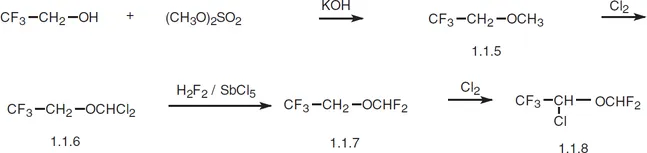
Isoflurane, 2-chloro-2-(difluoromethoxy)-1,1,1-trifluorethane (1.1.8), is synthesized from 2,2,2-trifluoroethanol. 2,2,2-Trifluoroethanol is first methylated by dimethylsulfate. The resulting methyl ether (1.1.5) undergoes chlorination by molecular chlorine to give 2-(dichloromethoxy)-1,1,1-trifluoroethane (1.1.6). In the subsequent interaction (1.1.6) with hydrogen fluoride in the presence of antimony(V) chloride, chlorine atoms are ultimately replaced by fluorine atoms. The resulting ether (1.1.7) again undergoes chlorination by molecular chlorine to give isoflurane [6,7].
In terms of action, isoflurane is analogous to enflurane; howe...
Table of contents
- Cover image
- Title page
- Table of Contents
- Preface
- Chapter 1: General Anesthetics
- Chapter 2: Local Anesthetics
- Chapter 3: Analgesics
- Chapter 4: Soporific Agents (Hypnotics and Sedative Drugs)
- Chapter 5: Anxiolytics (Tranquilizers)
- Chapter 6: Antipsychotics (Neuroleptics)
- Chapter 7: Antidepressants
- Chapter 8: Central Nervous System Stimulants
- Chapter 9: Antiepileptic Drugs
- Chapter 10: Antiparkinsonian Drugs
- Chapter 11: Adrenergic (Sympathomimetic) Drugs
- Chapter 12: Adrenoblocking Drugs
- Chapter 13: Cholinomimetics
- Chapter 14: Anticholinergic Drugs
- Chapter 15: Muscle Relaxants
- Chapter 16: Antihistamine Drugs
- Chapter 17: Cardiotonic Drugs
- Chapter 18: Antiarrhythmic Drugs
- Chapter 19: Antianginal Drugs
- Chapter 20: Hypolipidemic Agents
- Chapter 21: Diuretics
- Chapter 22: Antihypertensive Drugs
- Chapter 23: Drugs for Treating Respiratory System Illnesses
- Chapter 24: Anticoagulants, Antiaggregants, Thrombolytics, and Hemostatics
- Chapter 25: Thyroid Hormone and Antithyroid Drugs
- Chapter 26: Insulin and Synthetic Hypoglycemic Agents
- Chapter 27: Corticosteroids
- Chapter 28: Female Sex Hormones
- Chapter 29: Male Sex Hormones and Anabolic Steroids
- Chapter 30: Antineoplastics
- Chapter 31: Immunopharmacological Drugs
- Chapter 32: Antibiotics
- Chapter 33: Antimicrobial Drugs
- Chapter 34: Antimycobacterial Drugs
- Chapter 35: Antifungal Drugs
- Chapter 36: Antiviral Drugs
- Chapter 37: Drugs for Treating Protozoan Infections
- Chapter 38: Antihelmintic Drugs
- Index
Trusted by 375,005 students
Access to over 1.5 million titles for a fair monthly price.
Study more efficiently using our study tools.
Frequently asked questions
Yes, you can cancel anytime from the Subscription tab in your account settings on the Perlego website. Your subscription will stay active until the end of your current billing period. Learn how to cancel your subscription
No, books cannot be downloaded as external files, such as PDFs, for use outside of Perlego. However, you can download books within the Perlego app for offline reading on mobile or tablet. Learn how to download books offline
Perlego offers two plans: Essential and Complete
- Essential is ideal for learners and professionals who enjoy exploring a wide range of subjects. Access the Essential Library with 800,000+ trusted titles and best-sellers across business, personal growth, and the humanities. Includes unlimited reading time and Standard Read Aloud voice.
- Complete: Perfect for advanced learners and researchers needing full, unrestricted access. Unlock 1.5M+ books across hundreds of subjects, including academic and specialized titles. The Complete Plan also includes advanced features like Premium Read Aloud and Research Assistant.
We are an online textbook subscription service, where you can get access to an entire online library for less than the price of a single book per month. With over 1.5 million books across 990+ topics, we’ve got you covered! Learn about our mission
Look out for the read-aloud symbol on your next book to see if you can listen to it. The read-aloud tool reads text aloud for you, highlighting the text as it is being read. You can pause it, speed it up and slow it down. Learn more about Read Aloud
Yes! You can use the Perlego app on both iOS and Android devices to read anytime, anywhere — even offline. Perfect for commutes or when you’re on the go.
Please note we cannot support devices running on iOS 13 and Android 7 or earlier. Learn more about using the app
Please note we cannot support devices running on iOS 13 and Android 7 or earlier. Learn more about using the app
Yes, you can access Synthesis of Essential Drugs by Ruben Vardanyan,Victor Hruby in PDF and/or ePUB format, as well as other popular books in Medicine & Pharmacology. We have over 1.5 million books available in our catalogue for you to explore.