- 766 pages
- English
- ePUB (mobile friendly)
- Available on iOS & Android
eBook - ePub
Agriculture and Energy
About this book
Agriculture and Energy consists of the proceedings of a conference held at Washington University, St. Louis, Missouri, on June 17-19, 1976. The conference aims to bring together a broad spectrum of researchers concerned with obtaining a better understanding of the energy consumption by agriculture. These researchers are also concerned with developing ways to help food production adapt to occurring and anticipated resource availability problems. This book is organized into nine parts, separating the papers of the conference as chapters. It describes the quantity of energy consumed in particular production processes or in production at various levels of aggregation in the field of agriculture. It also dwells into the economic impacts of energy problems on agricultural production. It looks into the comparative economic and energy costs of the various methods for producing a specific product. Furthermore, this reference material discusses unconventional production methods that can reduce the need for fossil energy inputs by using renewable energy sources or recycling materials. Lastly, the implications of the energy situation for agricultural policy, both in the U.S. and in developing countries, are shown.
Information
Subtopic
AgribusinessIRRIGATION
IRRIGATION ENERGY REQUIREMENTS IN THE 17 WESTERN STATES
Dan Dvoskin, Ken Nicol and Earl O. Heady
ABSTRACT
Data are presented on the quantity of fuel of various types used to pump irrigation water in each producing area of the 17 Western states. These data were computed on the basis of pumping lift, mix of distribution systems, mix of power units, and average pump and power plant efficiencies. An average of 863 thousand kcal is required per A-ft of water, supplied mainly by natural gas and electricity.
INTRODUCTION
Agriculture relies heavily on fossil fuels for producing, processing, and distributing food products in the U.S. Substitution of machine power, a fossil energy-intensive technology, for labor started early in this century and still continues. The extensive use of fertilizers, herbicides, and pesticides also has increased and they require large amounts of energy during production. Irrigation is one of the major users of energy in agricultural production but the amount of energy required per A-ft of water applied varies widely across the nation as a function of the water source and the irrigation methods.
Since 1935, the amount of irrigated cropland in the U.S. has more than tripled. By 1975 more than 54 million acres were irrigated in the U.S. [5]. However, irrigated acreage is not expected to change much after 1980 because of the completion of most of the surface storage irrigation development projects underway and the rapid depletion of ground water in many areas.
Two primary sources of water are used for irrigation, surface water (streams and lakes) and ground water obtained from wells. The differences among states with respect to the source of water are marked. In Texas, Oklahoma, Kansas and Nebraska, ground water provides from 75% to 94% of the irrigation water used by farmers [8]. Ground water provides from 39% to 69% of the water requirements for irrigation on farms in the three Southwest states (California, Arizona and New Mexico). In contrast, ground water supplies less than 6% of the water for irrigation in Montana and Wyoming, and between 12% and 17% in Oregon, Washington, Utah and North Dakota.
A total of 48 million acres was irrigated in the 17 Western states in 1975 of which 23% was sprinkler irrigated [5]. Sprinkler irrigation, because of the relative high pressure required, has a markedly different energy demand than other irrigation water application methods.
The importance of irrigation to crop production varies substantially from area to area. Examination of state data suggests that it is practically impossible for some states to produce crops without irrigation while others require little or no irrigation for crop production. In general, irrigation is very important in the 17 Western states. In 1975, irrigated cropland in the 17 Western states represented more than 88% of the nation’s irrigated cropland [5].
The main objective of this study is to estimate regional energy requirements to apply an A-ft of water in the 17 Western states.
METHOD AND RESULTS
This study utilizes the 105 producing areas (Figure 1) which are the basic regional units for the programming model used in the national study just completed on energy use in agricultural production at the Center for Agricultural and Rural Development [3]. (The shaded areas in Fig. 1 are those in which a water supply is defined.) These regions are derived from the 99 Aggregated Subareas (ASA) defined by the Water Resources Council [10] with six ASA’s being subdivided to give more regional detail for agricultural variables in the Western United States.
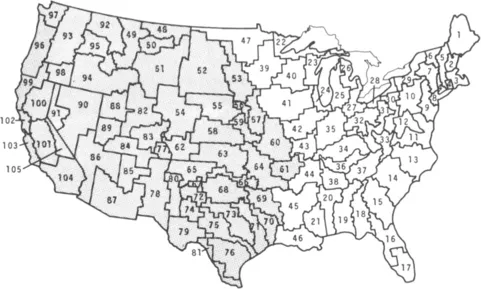
Fig. 1 The producing areas with irrigated lands in the Western states.
The basic relationship used in this study assumes that energy requirements for irrigation in each of the irrigated regions can be expressed by the following function:
IEi = f(PDi, PE, MEj, SHi, RLi, WPij, WSi, IBi, GWi) Eq. 1
i = 48, …, 105 for the producing areas including irrigation alternatives in the Western states (Fig. 1); and
j = 1, …, 5 for the five major types of power units: electric, gasoline, diesel, LPG, and natural gas.
where:
IEi is the energy required to obtain and apply one A-ft of water in producing area i;
PDi is the average pumping depth of ground water in producing area i;
PE is the average water pump efficiency;
MEj is the efficiency of power unit j in converting fuel energy to mechanical energy;
SHi is the weighted average head required for sprinkler irrigation in producing area i including friction losses;
WPij is the proportion of the total energy used for irrigation by the power unit j in producing area i;
WSi is the proportion of the irrigated acres having the water applied by sprinklers in producing area i;
IBi is the energy required to supply one A-ft of water from surface sources in producing area i; and
GWi is the proportion of total water used for irrigation obtained from ground water in producing area i.
Many variables, such as rate of pumping, size of power units, variations in pumping depth between seasons, etc., are omitted from Eq. 1. However, with the current data, complete accounting for all such factors, while important, cannot be done successfully. The following sections detail the derivation, assumptions, constant parameters, sources, and use of the data required to quantify Eq. 1.
PUMPING DEPTH
For the purpose of this study, pumping depth is defined as the yearly average depth (in feet), relative to the ground surface, from which water is pumped for irrigation. The regional variations in pumping depths within the 17 Western states were obtained by collecting water level and well depth information on more than 10,000 wells. For the 17 Western states, the average pumping depth is 196 feet. The deepest pumping depth is in region 78 (New Mexico and Northwest Texas) where water for irrigation is pumped from 357 feet (Fig. 2).
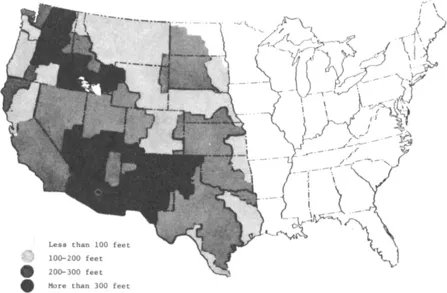
Fig. 2 Pumping depths in the 17 Western states.
WATER PUMPING EFFICIENCY
Pump efficiencies vary greatly as a function of the pump type, rate of pumping, and the pump age. While a good pump can have efficiency as high as 75%, most pumps can be expected to have a much lower efficiency rate. Pump efficiency is assumed to be a constant equal to 60% and is applied uniformly across the Western states [6].
TYPE OF POWER UNITS AND THEIR ENERGY EFFICIENCY
Major losses of energy normally occur in the conversion of fuel energy to mechanical energy, such as powering engines and turning generators in the production of electricity. In the case of electricity, losses occur both in the conversion of fossil fuel to electricity and of electricity to mechanical energy. We used the figure of 10,560 BTU for the fossil fuel energy required to produce one kwh of electricity (the value projected for 1975 in Ref. 2). This gives an output/input ratio for energy conversion in the electric generating industry of 32.287%. Thus, on the average, two-thirds of the energy consumed by the electric industry is lost in conversion of fossil fuel to electricity.
No data are available on regional differences in power unit efficiencies. Therefore, we assume that the following efficiency rates (Table 1) apply uniformly to all power units.
TABLE 1
Power Unit Energy Efficiencies for Common Motor Use in Water Pumping (a).
| Power unit | Efficiency (%) |
| Diesel engine | 26.8 |
| Gasoline ... |
Table of contents
- Cover image
- Title page
- Table of Contents
- Copyright
- Foreword
- Acknowledgments
- ENERGY USE IN AGRICULTURE: STATEWIDE AND NATIONAL ANALYSES
- CROP PRODUCTION
- IRRIGATION
- TILLAGE
- FERTILIZERS AND PLANT NUTRIENTS
- LIVESTOCK PRODUCTION
- NON-DEPLETABLE ENERGY SOURCES
- AGRICULTURE IN DEVELOPING COUNTRIES
- IMPLICATIONS OF ENERGY PROBLEMS FOR U.S. AGRICULTURAL POLICY
- Index
Trusted by 375,005 students
Access to over 1.5 million titles for a fair monthly price.
Study more efficiently using our study tools.
Frequently asked questions
Yes, you can cancel anytime from the Subscription tab in your account settings on the Perlego website. Your subscription will stay active until the end of your current billing period. Learn how to cancel your subscription
No, books cannot be downloaded as external files, such as PDFs, for use outside of Perlego. However, you can download books within the Perlego app for offline reading on mobile or tablet. Learn how to download books offline
Perlego offers two plans: Essential and Complete
- Essential is ideal for learners and professionals who enjoy exploring a wide range of subjects. Access the Essential Library with 800,000+ trusted titles and best-sellers across business, personal growth, and the humanities. Includes unlimited reading time and Standard Read Aloud voice.
- Complete: Perfect for advanced learners and researchers needing full, unrestricted access. Unlock 1.5M+ books across hundreds of subjects, including academic and specialized titles. The Complete Plan also includes advanced features like Premium Read Aloud and Research Assistant.
We are an online textbook subscription service, where you can get access to an entire online library for less than the price of a single book per month. With over 1.5 million books across 990+ topics, we’ve got you covered! Learn about our mission
Look out for the read-aloud symbol on your next book to see if you can listen to it. The read-aloud tool reads text aloud for you, highlighting the text as it is being read. You can pause it, speed it up and slow it down. Learn more about Read Aloud
Yes! You can use the Perlego app on both iOS and Android devices to read anytime, anywhere — even offline. Perfect for commutes or when you’re on the go.
Please note we cannot support devices running on iOS 13 and Android 7 or earlier. Learn more about using the app
Please note we cannot support devices running on iOS 13 and Android 7 or earlier. Learn more about using the app
Yes, you can access Agriculture and Energy by William Lockeretz in PDF and/or ePUB format, as well as other popular books in Technik & Maschinenbau & Agribusiness. We have over 1.5 million books available in our catalogue for you to explore.