eBook - ePub
Environmental and Pollution Science
- 552 pages
- English
- ePUB (mobile friendly)
- Available on iOS & Android
eBook - ePub
Environmental and Pollution Science
About this book
Environmental and Pollution Science, Second Edition, provides the latest information on the environmental influence of a significant number of subjects, and discusses their impact on a new generation of students.
This updated edition of Pollution Science has been renamed to reflect a wider view of the environmental consequences we pay as a price for a modern economy. The authors have compiled the latest information to help students assess environmental quality using a framework of principles that can be applied to any environmental problem.
The book covers key topics such as the fate and transport of contaminants, monitoring and remediation of pollution, sources and characteristics of pollution, and risk assessment and management. It contains more than 400 color photographs and diagrams, numerous questions and problems, case studies, and highlighted keywords.
This book is ideally suited for professionals and students studying the environment, especially as it relates to pollution as well as government workers and conservationists/ecologists.
- Emphasizes conceptual understanding of environmental impact, integrating the disciplines of biology, chemistry, and mathematics
- Topics cover the fate and transport of contaminants; monitoring and remediation of pollution; sources and characteristics of pollution; and risk assessment and management
- Includes color photos and diagrams, chapter questions and problems, and highlighted key words
Information
PART 1
PROCESSES AFFECTING FATE AND TRANSPORT OF CONTAMINANTS
CHAPTER 1 THE EXTENT OF GLOBAL POLLUTION

Pollution is ubiquitous, and can even cause beautiful sunsets.
Photo courtesy Ian Pepper.
1.1 SCIENCE AND POLLUTION
Pollution is ubiquitous and takes many forms and shapes. For example, the beautiful sunsets that we may see in the evening are often due to the interaction of light and atmospheric contaminants, as illustrated above.
Pollution can be defined as the accumulation and adverse affects of contaminants or pollutants on human health and welfare, and/or the environment. But in order to truly understand pollution, we must define the identity and nature of potential contaminants. Contaminants can result from waste materials produced from the activity of living organisms, especially humans. However, contamination can also occur from natural processes such as arsenic dissolution from bedrock into groundwater, or air pollution from smoke that results from natural fires. Pollutants are also ubiquitous in that they can be in the solid, liquid, or gaseous state. Information Box 1.1 presents the major categories of pollutants and their predominant routes of human exposure. Clearly, many of the agents identified in Information Box 1.1 occur directly through activities such as mining or agriculture. But in addition, pollution is also produced as an indirect result of human activity. For example, fossil fuel burning increases atmospheric carbon dioxide levels and increases global warming. Other classes of pollutants can occur due to poor waste management or disposal, which can lead to the presence of pathogenic microorganisms in water. Some examples of microbial pathogens and associated diseases are shown in Table 1.1. Another example of pollution due to human activity is accidental spillage of organics that can be toxic, such as chlorinated solvents or petroleum hydrocarbons that contaminate groundwater. Some common contaminants that find their way into the environment, with the potential to adversely affect human health and welfare, are shown in Table 1.2.
INFORMATION BOX 1.1
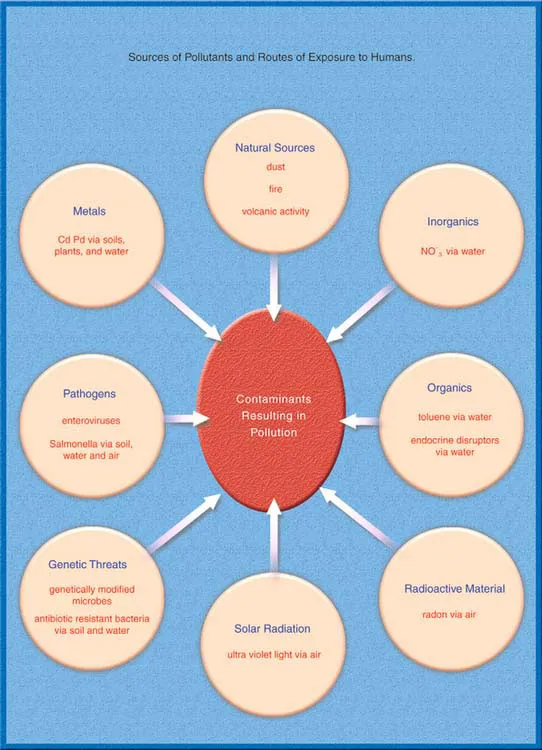
TABLE 1.1 Recently discovered microbes that have had a significant impact on human health.
| AGENT | MODE OF TRANSMISSION | DISEASE / SYMPTOMS |
|---|---|---|
| Rotavirus | Waterborne | Diarrhea |
| Legionella | Waterborne | Legionnaire’s disease |
| Escherichia coli O157:H7 | Foodborne Waterborne | Enterohemorrhagic fever, kidney failure |
| Hepatitis E virus | Waterborne | Hepatitis |
| Cryptosporidium | Waterborne | Diarrhea |
| Foodborne | ||
| Calicivirus | Waterborne | Diarrhea |
| Foodborne | ||
| Helicobacter pylori | Foodborne | Stomach ulcers |
| Waterborne | ||
| Cyclospora | Foodborne | Diarrhea |
| Waterborne |
TABLE 1.2 Common organic and inorganic contaminants found in the environment.
| CHEMICAL CLASS | FREQUENCY OF OCCURRENCE |
|---|---|
| Gasoline, fuel oil | Very frequent |
| Polycyclic aromatic hydrocarbons | Common |
| Creosote | Infrequent |
| Alcohols, ketones, esters | Common |
| Ethers | Common |
| Chlorinated organics | Very frequent |
| Polybrominated diphenyl ethers (PBDEs) | |
| Polychlorinated biphenyls (PCBs) | Infrequent |
| Nitroaromatics (TNT) | Common |
| Metals (Cd, Cr, Cu, Hg, Ni, Pb, Zn) | Common |
| Nitrate | Common |
From Environmental Microbiology © 2000, Academic Press, San Diego, CA.
In this textbook, we will discuss these major sources of pollution in a science-based context, hence the name: Environmental and Pollution Science (Information Box 1.2).
INFORMATION BOX 1.2
Environmental and Pollution Science is the study of the physical, chemical, and biological processes fundamental to the transport, fate, and mitigation of contaminants that arise from human activities as well as natural processes.
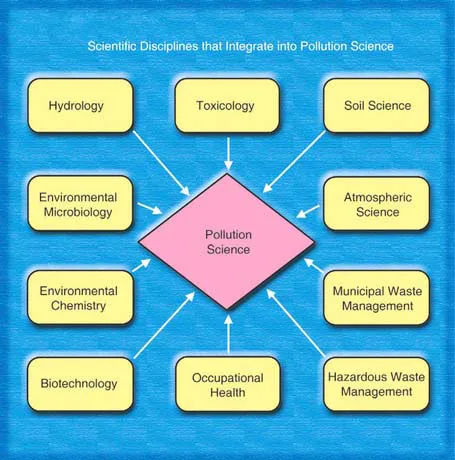
The focus of the text will be to identify the basic scientific processes that control the transport and fate of pollutants in the environment. We will also try to define the potential for adverse effects to human health and welfare, and the environment using a risk-based approach. Finally, we will present real world “case studies.” The diverse nature of the scientific disciplines needed to study pollution science are shown in Information Box 1.3. It is the holistic integration of these diverse and complex entities that presents the major challenge to understanding both “Environmental and Pollution Science.”
INFORMATION BOX 1.3
1.2 GLOBAL PERSPECTIVE OF THE ENVIRONMENT
The environment plays a key role in the ultimate fate of pollutants. The environment consists of land, water, and the atmosphere. All sources of pollution are initially released or dumped into one of these phases of the environment. As pollutants interact with the environment, they undergo physical and chemical changes, and are ultimately incorporated into the environment. The environment thus acts as a continuum into which all waste materials are placed. The pollutants, in turn, obey the second law of thermodynamics: matter cannot be destroyed; it is merely converted from one form to another. Thus, taken together, the way in which substances are added to the environment, the rate at which these wastes are added, and the subsequent changes that occur determine the impact of the waste on the environment. It is important to recognize the concept of the environment as a continuum, because many physical, chemical, and biological processes occur not within one of these phases, such as the air alone, but rather at the interface between two phases such as the soil/water interface.
The concept of the continuum relies on the premise that resources are utilized at a rate at which they can be replaced or renewed, and that wastes are added to the environment at a rate at which they can be assimilated without disturbing the environment. Historically, natural wastes were generated that could easily be broken down or transformed into beneficial, or at least benign, compounds. However, post-industrial contamination has resulted in the formation of xenobiotic waste—compounds that are foreign to natural ecosystems and that are less subject to degradation. In some cas...
Table of contents
- Cover image
- Title page
- Table of Contents
- Copyright
- DEDICATION
- PREFACE
- THE EDITORS
- CONTRIBUTING AUTHORS
- PART 1: PROCESSES AFFECTING FATE AND TRANSPORT OF CONTAMINANTS
- PART 2: MONITORING, ASSESSMENT, AND REGULATION OF ENVIRONMENTAL POLLUTION
- PART 3: LAND AND WATER POLLUTION MITIGATION
- PART 4: ATMOSPHERIC POLLUTION
- PART 5: WASTE AND WATER TREATMENT AND MANAGEMENT
- PART 6: EMERGING ISSUES IN POLLUTION SCIENCE
- INDEX
Trusted by 375,005 students
Access to over 1.5 million titles for a fair monthly price.
Study more efficiently using our study tools.
Frequently asked questions
Yes, you can cancel anytime from the Subscription tab in your account settings on the Perlego website. Your subscription will stay active until the end of your current billing period. Learn how to cancel your subscription
No, books cannot be downloaded as external files, such as PDFs, for use outside of Perlego. However, you can download books within the Perlego app for offline reading on mobile or tablet. Learn how to download books offline
Perlego offers two plans: Essential and Complete
- Essential is ideal for learners and professionals who enjoy exploring a wide range of subjects. Access the Essential Library with 800,000+ trusted titles and best-sellers across business, personal growth, and the humanities. Includes unlimited reading time and Standard Read Aloud voice.
- Complete: Perfect for advanced learners and researchers needing full, unrestricted access. Unlock 1.5M+ books across hundreds of subjects, including academic and specialized titles. The Complete Plan also includes advanced features like Premium Read Aloud and Research Assistant.
We are an online textbook subscription service, where you can get access to an entire online library for less than the price of a single book per month. With over 1.5 million books across 990+ topics, we’ve got you covered! Learn about our mission
Look out for the read-aloud symbol on your next book to see if you can listen to it. The read-aloud tool reads text aloud for you, highlighting the text as it is being read. You can pause it, speed it up and slow it down. Learn more about Read Aloud
Yes! You can use the Perlego app on both iOS and Android devices to read anytime, anywhere — even offline. Perfect for commutes or when you’re on the go.
Please note we cannot support devices running on iOS 13 and Android 7 or earlier. Learn more about using the app
Please note we cannot support devices running on iOS 13 and Android 7 or earlier. Learn more about using the app
Yes, you can access Environmental and Pollution Science by Ian Pepper,Charles P. Gerba,Mark L. Brusseau,Ian L. Pepper in PDF and/or ePUB format, as well as other popular books in Biological Sciences & Environmental Law. We have over 1.5 million books available in our catalogue for you to explore.