eBook - ePub
Social Anxiety
Clinical, Developmental, and Social Perspectives
- 632 pages
- English
- ePUB (mobile friendly)
- Available on iOS & Android
eBook - ePub
Social Anxiety
Clinical, Developmental, and Social Perspectives
About this book
Social Anxiety Clinical, Developmental, and Social Perspectives, Second Edition, provides an interdisciplinary approach to understanding social anxiety disorder (SAD) by bringing together research across several disciplines, including social psychology, developmental psychology, behavior genetics, and clinical psychology. The book explains the different aspects of social anxiety and social phobia in adults and children, including the evolution of terminology and constructs, assessment procedures, relationship to personality disorders, and psychopathology. It considers most prominent theoretical perspectives on social anxiety and SAD discussed by social psychologists, developmental psychologists, behavior geneticists, clinical psychologists, and psychiatrists. These theoretical perspectives emphasize different factors that can contribute to the etiology and/or maintenance of social anxiety/SAD. Treatment approaches are also discussed, such as cognitive behavioral therapy, exposure intervention, social skills training. The contents of this volume represent some of the best views and thoughts in the field. It is hoped that the breadth of perspectives offered will help foster continued interdisciplinary dialogue and efforts toward cross-fertilization to advance the understanding, conceptualization, and treatment of chronic and debilitating social anxiety.
- The most comprehensive source of up-to-date data, with review articles covering a thorough deliniation of social anxiety, theoretical perspectives, and treatment approaches
- Consolidates broadly distributed literature into single source, saving researchers and clinicians time in obtaining and translating information and improving the level of further research and care they can provide
- Each chapter is written by an expert in the topic area
- Provides more fully vetted expert knowledge than any existing work
- Integrates findings from various disciplines - clinical, social and developmental psychology, psychiatry, neuroscience, - rather than focusing on only one conceptual perspective
- Provides the reader with more complete understanding of a complex phenomena, giving researchers and clinicians alike a better set of tool for furthering what we know
- Offers coverage of essential topics on which competing books fail to focus, such as: related disorders of adult and childhood; the relationship to social competence, assertiveness and perfectionism; social skills deficit hypothesis; comparison between pharmacological and psychosocial treatments; and potential mediators of change in the treatment of social anxiety disorder population
Information
Chapter 1 Evolution of Terminology and Constructs in Social Anxiety and its Disorders
Introduction
Unpleasant emotional states and nonadaptive behaviors associated with social situations have historically been known as significant, life-affecting problems for many people. Given the social nature of human beings, and the functional nature of social relationships (e.g., social support), discomfort associated with interacting with others is particularly difficult, as socialization cannot be easily avoided, unlike other anxiety problems such as some phobias. Social anxieties and fears were described by Hippocrates and began to be systematically delineated with other phobias in the 1870s (Marks, 1970, 1985). In the recent past, the social psychological focus on shyness (e.g., Zimbardo, 1977), the work of Marks and others in the 1960s and 1970s, and the identification of social phobia (SP) as a distinct disorder in the Diagnostic and statistical manual of mental disorders (DSM)–III (e.g., American Psychiatric Association, 1980) and subsequent revisions, heralded a massive growth in the related scientific and self-help literatures.
This general arena of problems likely includes several somewhat overlapping constructs; the scientific language has many different terms that apply or relate, including shyness, social anxiety, social withdrawal, SP, social anxiety disorder (SAD), behavioral inhibition (BI), communication apprehension, and introversion. In both everyday and scientific language, these states have been described in a myriad of ways. Leitenberg (1990, p.2), in introducing his book on the area, states:
Social anxiety has been studied in various guises. Shyness, performance anxiety, social phobia, avoidant personality disorder, social withdrawal, social isolation, public speaking anxiety, speech anxiety, communication apprehension, fear of interpersonal rejection, dating anxiety, separation anxiety, stage fright, fear of strangers, shame, embarrassment, social inhibition, social timidity – all of these and more fall under the umbrella of social anxiety.
Other anxiety-related syndromes, such as test anxiety and selective mutism, also likely have a strong social component, and may be instantiations of SAD (Bögels et al., 2010). Body dysmorphic disorder (BDD), highly comorbid with SAD, similarly is socially determined, at least in part, in that the perception of others regarding (imagined) defects may be an underlying feature.
There also are a variety of terms that suggest, at least in part, deficient social skills, such as “nerd,” “geek,” and “wallflower.” Masia and Morris (1998) identify terms related to social distress in children across areas of psychology: developmental (i.e., peer neglect, social withdrawal), personality (i.e., shyness), and clinical (i.e., SP, avoidant personality disorder (APD)). Stranger anxiety and separation anxiety likely are related constructs as well (Thompson & Limber, 1990). Masia and Morris note that this varying “psychological language” (p. 212) creates problems in investigating phenomena (e.g., parental behavior and its relation to child social anxiety) that spans across subdisciplines in psychology, and presumably across related disciplines (e.g., psychiatry).
It should be noted that comparative psychology has contributions to this area as well. Social anxieties are not solely human phenomena; such social/emotional problems are shared by other primates (Mineka & Zinbarg, 1995; Suomi, 1997) and lower animals. Social dominance and submissiveness hierarchies have been suggested as important as determinants of socially anxious behavior across species of primates, including humans (Schneier & Welkowitz, 1996; Trower & Gilbert, 1989). Facial expressions, for example, provide important social interactional cues in both humans and other primates, including both aggression and appeasement related to anxiety (Öhman, 1986).
One of the issues that is an albatross for the field concerns the everyday language basis of the most frequently used terms: shyness, stage fright, and social anxiety. Some years ago, Harris (1984) detailed a number of problems inherent in using the lay language of “shyness” in scientific discourse, problems that still exist today. Clinically oriented scientists may try to “distance” SAD from shyness, perhaps to emphasize that individuals who meet criteria for the disorder suffer with impairment in social and occupational functioning that can be quite terrible, leading to chronic misery. Adding further complexity, some degree of social anxiety can be adaptive (Schneier & Welkowitz, 1996). Moreover, the social consequences of some socially anxious behaviors are quite positive. One example is a “bashful” child who hides his face by planting it directly in some part of one of his parents’ bodies, resulting in adult laughter and encouragement to socialize. A further example is a distant, detached person who is regarded as “coy,” “interesting,” or even “mysterious” (or conversely, as “stuck up”) as a result of their lack of social initiation or response.
This chapter provides a perspective on conceptual, definitional, and diagnostic nosology issues for the field. It is proposed that social anxieties and fears, like other phobic disorders, exist along a continuum across the general population, as explicated later in this chapter and as shown in Figure 1.1. The range of social anxieties/fears along this continuum is from no anxiety/fear to “normal” levels to psychopathological extremes. The debate (e.g., Campbell-Sills & Stein, 2005; Wakefield, Horowitz, & Schmitz, 2005a; Wakefield, Horowitz, & Schmitz, 2005b) on “overpathologizing” socially anxious people then may be somewhat addressed by a conceptualization that acknowledges both “normal” social anxieties that are mildly to moderately intense, or transient, and also their potential connectedness to SAD, depending on potentially contributing environmental and individual factors.
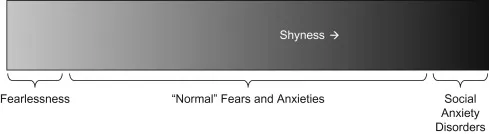
Figure 1.1 Model of the continuum of social anxieties and fears across the general population.
This chapter also reviews the evolution of constructs important to the area. Finally, it re-emphasizes the need for a multidisciplinary approach to studying and understanding distress and dysfunction related to social situations. This chapter, similarly to other work (Masia & Morris, 1998), uses the term “social anxiety” in an attempt to broadly encompass the various constructs emanating from the various disciplines and subdisciplines. Given the recognized differences between anxiety and fear states generally (Bouton, Mineka, & Barlow, 2001; McNeil, Turk, & Ries, 1994), the term “social fear” is incorporated into this lexicon and will be further elaborated in this chapter. Consistently with the evolving literature (Bögels et al., 2010), the term “social anxiety disorder” (SAD) (and, more properly, in the plural to emphasize the heterogeneity of problems in this area) is used to describe psychopathological levels of such anxieties or fears, although “SP” is used when describing historical designations.
Overlapping and Contrasting Emotional States
Anxiety and fear are not “lumps” (Lang, 1968) and are not, in and of themselves, disease states. Rather, they exist along continua across the population. At the extreme, high levels of social fears and anxiety are psychopathological, and can be classified as clinical syndromes such as SAD. Depending on the type of anxiety or fear, as well as other factors such as gender (Craske, 2003), the distributions vary.
Figure 1.2 illustrates the distributions of general social anxiety based on Social Avoidance and Distress Scale (SADS; Watson & Friend, 1969) scores of 477 male (n=214) and female (n=263) university undergraduates. The mean age of the sample was 19.9 (SD=3.1). Score distributions also are provided for specific public speaking fear using the Personal Report of Confidence as a Speaker scale (PRCS; Paul, 1966) for these same individuals. The SADS distribution is positively skewed toward lower scores, which are associated with less anxiety, but kurtosis was unremarkable (skewness and kurtosis coefficients are 0.79 and −0.39, respectively). In contrast, the PRCS is more normally distributed, but has a rectangular distribution in which each score has the same frequency of occurrence (skewness and kurtosis coefficients are −0.04 and −1.1, respectively).
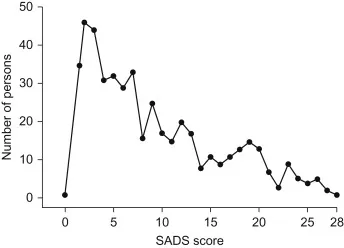
Figure 1.2 Number of individuals having each total score, reflecting general social anxiety using the Social Avoidance and Distress Scale (SADS; Watson & Friend, 1969; top panel), and public speaking fear based on the Personal Report of Confidence as a Speaker scale (PRCS; Paul, 1966; bottom panel). The possible range of scores is 0–28 for the SADS and 0–30 for the PRCS. Higher scores for both instruments are indicative of greater anxiety. The total sample consists of 477 male and female undergraduates.
Self-reported social fears and anxieties are unique in that females and males typically differ less (or not at all), unlike many other types of anxiety and fear, in which females report higher scores and males report lower ones (Craske, 2003). In fact, it has been suggested that there may be a higher incidence of a social skill deficit type of SP in males, while other types of the syndrome may be displayed equally between the sexes (Marks, 1985), although the literature is equivocal in this regard. Given the size of the present sample, substantively small differences (i.e., less than 2 points on 28- and 30-item scales) were statistically significant. The varying directionality of the sex differences, however, is interesting. For general social anxiety measured by the SADS, males (M=9.9, SD=7.3) had higher scores, indicating more anxiety, than females (M=8.4, SD=6.3), t(475)=2.40, p<0.05. Conversely, for specific public speaking fear on the PRCS, females (M=16.2, SD=7.7) indicated more anxiety than males (M=14.8, SD=7.6), t(475)=1.97, p<0.05. These differences provide suggestive evidence of the differences between general social anxieties and specific public speaking fears. While there may be differences in SADS and PRCS total scores between the sexes, the shape of the distributions were relatively consistent, except for kurtosis on the SADS, as evidenced by coefficients for skewness (SADS: males=0.60 and females=0.95; PRCS: males=−0.02 and females=−0.06) and kurtosis (SADS: males=−0.79 and females=0.06; PRCS: males=−1.1 and fema...
Table of contents
- Cover
- Title Page
- Copyright
- Table of Contents
- Contributors
- Introduction: Toward an Understanding of Social Anxiety Disorder
- Chapter 1: Evolution of Terminology and Constructs in Social Anxiety and its Disorders
- Chapter 2: Assessment of Social Anxiety and Social Phobia
- Chapter 3: Shyness, Social Anxiety, and Social Anxiety Disorder
- Chapter 4: Are Embarrassment and Social Anxiety Disorder Merely Distant Cousins, or Are They Closer Kin?
- Chapter 5: Social Anxiety Disorder and Its Relationship to Perfectionism
- Chapter 6: Social Phobia as a Deficit in Social Skills
- Chapter 7: Relation to Clinical Syndromes in Adulthood
- Chapter 8: Avoidant Personality Disorder and Its Relationship to Social Phobia
- Chapter 9: Social Anxiety in Children and Adolescents
- Chapter 10: Neuroendocrinology and Neuroimaging Studies of Social Anxiety Disorder
- Chapter 11: Genetic Basis of Social Anxiety Disorder
- Chapter 12: Temperamental Contributions to the Development of Psychological Profiles
- Chapter 13: Basic Behavioral Mechanisms and Processes in Social Anxieties and Social Anxiety Disorders
- Chapter 14: Cognitive Biases in Social Anxiety Disorder
- Chapter 15: A Cognitive Behavioral Model of Social Anxiety Disorder
- Chapter 16: Social Anxiety, Social Anxiety Disorder, and the Self
- Chapter 17: Social Anxiety, Positive Experiences, and Positive Events
- Chapter 18: Social Anxiety as an Early Warning System
- Chapter 19: Psychopharmacology for Social Anxiety Disorder
- Chapter 20: Treatment of Social Anxiety Disorder
- Chapter 21: Comparison between Psychosocial and Pharmacological Treatments
- Chapter 22: Mechanisms of Action in the Treatment of Social Anxiety Disorder
- Index
Trusted by 375,005 students
Access to over 1.5 million titles for a fair monthly price.
Study more efficiently using our study tools.
Frequently asked questions
Yes, you can cancel anytime from the Subscription tab in your account settings on the Perlego website. Your subscription will stay active until the end of your current billing period. Learn how to cancel your subscription
No, books cannot be downloaded as external files, such as PDFs, for use outside of Perlego. However, you can download books within the Perlego app for offline reading on mobile or tablet. Learn how to download books offline
Perlego offers two plans: Essential and Complete
- Essential is ideal for learners and professionals who enjoy exploring a wide range of subjects. Access the Essential Library with 800,000+ trusted titles and best-sellers across business, personal growth, and the humanities. Includes unlimited reading time and Standard Read Aloud voice.
- Complete: Perfect for advanced learners and researchers needing full, unrestricted access. Unlock 1.5M+ books across hundreds of subjects, including academic and specialized titles. The Complete Plan also includes advanced features like Premium Read Aloud and Research Assistant.
We are an online textbook subscription service, where you can get access to an entire online library for less than the price of a single book per month. With over 1.5 million books across 990+ topics, we’ve got you covered! Learn about our mission
Look out for the read-aloud symbol on your next book to see if you can listen to it. The read-aloud tool reads text aloud for you, highlighting the text as it is being read. You can pause it, speed it up and slow it down. Learn more about Read Aloud
Yes! You can use the Perlego app on both iOS and Android devices to read anytime, anywhere — even offline. Perfect for commutes or when you’re on the go.
Please note we cannot support devices running on iOS 13 and Android 7 or earlier. Learn more about using the app
Please note we cannot support devices running on iOS 13 and Android 7 or earlier. Learn more about using the app
Yes, you can access Social Anxiety by Patricia M. DiBartolo,Stefan G. Hofmann in PDF and/or ePUB format, as well as other popular books in Psicologia & Psicologia clinica. We have over 1.5 million books available in our catalogue for you to explore.