eBook - ePub
Postharvest Handling
A Systems Approach
- 640 pages
- English
- ePUB (mobile friendly)
- Available on iOS & Android
eBook - ePub
Postharvest Handling
A Systems Approach
About this book
Consideration of the interactions between decisions made at one point in the supply chain and its effects on the subsequent stages is the core concept of a systems approach. Postharvest Handling is unique in its application of this systems approach to the handling of fruits and vegetables, exploring multiple aspects of this important process through chapters written by experts from a variety of backgrounds.Newly updated and revised, this second edition includes coverage of the logistics of fresh produce from multiple perspectives, postharvest handing under varying weather conditions, quality control, changes in consumer eating habits and other factors key to successful postharvest handling.The ideal book for understanding the economic as well as physical impacts of postharvest handling decisions.
- Features contributions from leading experts providing a variety of perspectives
- Updated with 12 new chapters
- Focuses on application-based information for practical implementation
- System approach is unique in the handling of fruits and vegetables
Information
Chapter 1. Postharvest Handling - A Discipline that Connects Commercial, Social, Natural and Scientific Systems
I. Perceptions, needs and roles
Talk to any consumer and you’ll soon understand the rationale for the technologies, science and systems described in this book. You’ll learn that they are seeking certainty (Owen et al., 2000; Batt, 2006; van der Vorst et al., 2007):
- certainty that the visual appearance of their purchases will be matched by a rewarding sensory experience at the time of consumption;
- certainty that their produce purchases are safe, healthy and nutritious for themselves and their families;
- certainty that their purchases are supporting a sustainable and ethically sound production system.
The information they seek is largely invisible at the time the produce is bought; their purchases are made mostly on the basis of trust. This book is about the systems that measure, monitor and manage the invisible things that consumers most value.
Talk to any grower and they will stress the central importance of postharvest systems to their livelihoods and lifestyles (Bijman, 2002). Through these systems, they secure:
- information that enables them to grow and harvest intrinsically valuable crops;
- access to, and information about, consumers who will value the quality of the crop they have grown, often distant in terms of time and space from sites of production;
- ways to be able to characterize their crop that generate trust in buyers and consumers.
The technologies you will read about in this book are tools with which value is created in the grower’s crop.
Talk to any fresh produce marketer about how they create value for both consumers and growers and they will tell you that they need to be able to design a high-value proposition and to realize that value in the marketplace (Hughes, 2005). They will also tell you that they are managing three interconnected opportunities and avoiding their associated risks:
- achieving “managed scarcity” by avoiding the oversupply that is disastrous for prices;
- matching differentiated product to appropriate market niches to avoid the high opportunity cost of sending superior product to low-value markets and inferior product to demanding, high-value markets;
- growing, segregating and delivering consistently superior quality to avoid the negative impact of variable quality.
This book synthesizes knowledge about the disciplines that underpin the capacity of a marketer, and the managers they work with, to address these opportunities.
The systems view of postharvest handling pioneered by the team at Georgia (Prussia et al., 1986; Prussia and Mosqueda, 2006) that lies behind this book provides insight into ways to manage risks and uncertainties in produce supply and information systems (“supply chains”), and how to turn each of them into an opportunity for developing valuable points of difference. The systems approach (Senge, 1990; Capra, 2002; Senge et al., 2005) provides rich, hierarchical and interactive perspectives of all aspects of existence. Here, focused on postharvest handling, you will augment your own tools for understanding, managing and innovating in fresh produce supply chains.
II. Effects are causes
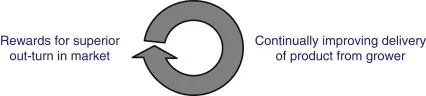
The systems view makes it clear that the outcomes of making changes in a system are themselves influential in further evolution of that system. The classic case of this that benefits both consumers and growers, and is sought by marketers, is the “virtuous cycle” (Senge, 1990). In a virtuous cycle, the valuable consequences of a change become reinforcers of that same change (Figure 1.1). Fresh produce supply chains can enter a virtuous cycle of change when the positive effects of consumers having superior experiences are fed right back through the chain, encouraging all participants to support initiatives that will deliver superior product. This concept has been the guiding principle for ZESPRI’s “Taste ZESPRI” program, aimed at consistently providing superior tasting fruit to its most discerning markets (Banks, 2003). Here, the capacity of the market to respond to good quality with a positive signal (high volume at high price) augments the capacity and willingness of growers to invest in delivering superior quality. Implementation of the Taste ZESPRI strategy has been paralleled by a 75% increase in volume of the company’s kiwifruit sales in key, high-return markets since its introduction in 2001 (Jager, 2008).
Figure 1.1. Virtuous cycle in delivery of superior product to market.
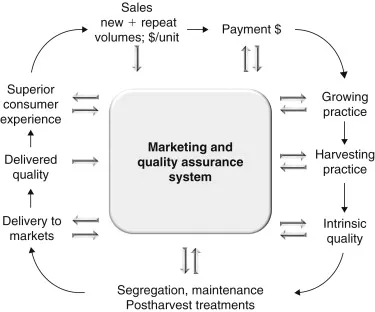
Development of a virtuous cycle by such participants requires a common language that they all understand. At its core, this involves a number of measures of success that make it clear what each participant must do for the supply chain to excel. These measures of success include a metric for describing and segregating product on the basis of its intrinsic quality, a description of financial rewards that result from increased consumer demand, and a payment mechanism that appropriately links these two to incentivize delivery of superior product. When all of this is formalized, it becomes part of an overall marketing and quality assurance system (Carriquiry and Babcock, 2007), providing clarity on the value proposition for all participants in the supply chain – a common feature of successful produce supply chains (Figure 1.2).
Figure 1.2. Flows of resources (product, physical, financial: outer flows) and information (inner flow) in a fresh produce supply chain that create responsiveness to the needs of its participants and the capacity for learning.
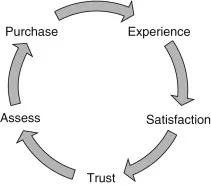
Trust among participants is a key ingredient for promoting effective communication in successful supply chains (Cadilhon et al., 2007; van der Vorst et al., 2007). Reputations of individual participants are often influential to the willingness of others to collaborate with them in forming or maintaining a supply chain; their ability to support outstanding performance by others in the system is central to establishing a virtuous cycle and driving success for the system as a whole. The hurdle of initial uncertainty associated with unfamiliarity with new parties that exists in traditional modes of business can now be overcome in electronic commerce through independent ratings from users, or from widely known and trusted third parties (Fritz et al., 2007). Brands provide a complementary mode of generating trust. Acting as shorthand for perceived aspects of value for the best part of a century in fruit markets around the world (Swan, 2000); brands support rapid decision-making by consumers facing a plethora of complex information as they make fresh fruit purchases (Figure 1.3). By acting as vehicles for integrating what is valued throughout marketing and production systems, they build reputation throughout the supply chain (Florkowski, 2000).
Figure 1.3. Learning with a brand: with each cycle of purchase and consumption, the consumer’s level of trust in the brand promise is modified according to experience. Simplified from: Andani and MacFie (2000).
III. Creating extraordinary value
Over the past few decades, there have been many examples of horticultural investors pursuing opportunities to capture the lucrative returns of growing and marketing exclusive, protected cultivars with highly desirable characteristics. By managing the volume of production in relation to demand, investors can capture the benefits of “managed scarcity,” and avoid the collapse in prices that follows from oversupply. The success stories illustrate the new marketing space that can be created with well-designed, branded new cultivars (e.g. Pink LadyTM apple, Chiquita MiniTM banana, Dole Tropical GoldTM and Del Monte Gold super-sweet pineapples, Driscoll’sTM strawberries, Sun-WorldTM peaches, ZESPRI GOLDTM kiwifruit). However, owning the protected plants in the ground is just the first of many hurdles to be overcome in securing high returns. In addition to the marketing costs of creating awareness of a new offering in international markets and discovering the strongest m...
Table of contents
- Brief Table of Contents
- Table of Contents
- Preface
- List of Contributors
- Chapter 1. Postharvest Handling
- BibliographyBibliography
- Chapter 2. Challenges in Handling Fresh Fruits and Vegetables
- BibliographyBibliography
- Chapter 3. Consumer Eating Habits and Perceptions of Fresh Produce Quality
- BibliographyBibliography
- Chapter 4. Testing and Measuring Consumer Acceptance
- BibliographyBibliography
- Chapter 5. Nutritional Quality of Fruits and Vegetables
- BibliographyBibliography
- Chapter 6. Value Chain Management and Postharvest Handling
- BibliographyBibliography
- Chapter 7. A Functional Evaluation of Business Models in Fresh Produce in the United States
- BibliographyBibliography
- Chapter 8. Quality Management
- BibliographyReferences
- Chapter 9. Postharvest Regulation and Quality Standards on Fresh Produce
- BibliographyReferences
- Chapter 10. Fresh-cut Produce Quality
- BibliographyBibliography
- Chapter 11. Logistics and Postharvest Handling of Locally Grown Produce
- BibliographyReferences
- Chapter 12. Traceability in Postharvest Systems
- BibliographyBibliography
- Chapter 13. Microbial Quality and Safety of Fresh Produce
- BibliographyBibliography
- Chapter 14. Sorting for Defects and Visual Quality Attributes
- BibliographyBibliography
- Chapter 15. Non-destructive Evaluation
- BibliographyBibliography
- Chapter 16. Stress Physiology and Latent Damage
- BibliographyBibliography
- Chapter 17. Measuring Quality and Maturity
- BibliographyBibliography
- Chapter 18. Modeling Quality Attributes and Quality Related Product Properties
- BibliographyBibliography
- Chapter 19. Refrigeration of Fresh Produce from Field to Home
- BibliographyReferences
- Chapter 20. Postharvest Handling under Extreme Weather Conditions
- BibliographyBibliography
- Chapter 21. Advanced Technologies and Integrated Approaches to Investigate the Molecular Basis of Fresh Produce Quality
- BibliographyReferences
- Chapter 22. Challenges in Postharvest Handling
- BibliographyBibliography
- Glossary
- Appendix Food Science and Technology
Trusted by 375,005 students
Access to over 1.5 million titles for a fair monthly price.
Study more efficiently using our study tools.
Frequently asked questions
Yes, you can cancel anytime from the Subscription tab in your account settings on the Perlego website. Your subscription will stay active until the end of your current billing period. Learn how to cancel your subscription
No, books cannot be downloaded as external files, such as PDFs, for use outside of Perlego. However, you can download books within the Perlego app for offline reading on mobile or tablet. Learn how to download books offline
Perlego offers two plans: Essential and Complete
- Essential is ideal for learners and professionals who enjoy exploring a wide range of subjects. Access the Essential Library with 800,000+ trusted titles and best-sellers across business, personal growth, and the humanities. Includes unlimited reading time and Standard Read Aloud voice.
- Complete: Perfect for advanced learners and researchers needing full, unrestricted access. Unlock 1.5M+ books across hundreds of subjects, including academic and specialized titles. The Complete Plan also includes advanced features like Premium Read Aloud and Research Assistant.
We are an online textbook subscription service, where you can get access to an entire online library for less than the price of a single book per month. With over 1.5 million books across 990+ topics, we’ve got you covered! Learn about our mission
Look out for the read-aloud symbol on your next book to see if you can listen to it. The read-aloud tool reads text aloud for you, highlighting the text as it is being read. You can pause it, speed it up and slow it down. Learn more about Read Aloud
Yes! You can use the Perlego app on both iOS and Android devices to read anytime, anywhere — even offline. Perfect for commutes or when you’re on the go.
Please note we cannot support devices running on iOS 13 and Android 7 or earlier. Learn more about using the app
Please note we cannot support devices running on iOS 13 and Android 7 or earlier. Learn more about using the app
Yes, you can access Postharvest Handling by Nigel H. Banks,Wojciech J. Florkowski,Stanley E. Prussia,Robert L. Shewfelt,Bernhard Brueckner,Nigel Banks in PDF and/or ePUB format, as well as other popular books in Tecnología e ingeniería & Agronegocios. We have over 1.5 million books available in our catalogue for you to explore.