- 488 pages
- English
- ePUB (mobile friendly)
- Available on iOS & Android
eBook - ePub
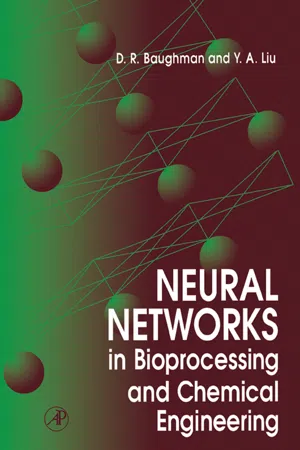
Neural Networks in Bioprocessing and Chemical Engineering
About this book
Neural networks have received a great deal of attention among scientists and engineers. In chemical engineering, neural computing has moved from pioneering projects toward mainstream industrial applications. This book introduces the fundamental principles of neural computing, and is the first to focus on its practical applications in bioprocessing and chemical engineering. Examples, problems, and 10 detailed case studies demonstrate how to develop, train, and apply neural networks. A disk containing input data files for all illustrative examples, case studies, and practice problems provides the opportunity for hands-on experience. An important goal of the book is to help the student or practitioner learn and implement neural networks quickly and inexpensively using commercially available, PC-based software tools. Detailed network specifications and training procedures are included for all neural network examples discussed in the book.Each chapter contains an introduction, chapter summary, references to further reading, practice problems, and a section on nomenclatureIncludes a PC-compatible disk containing input data files for examples, case studies, and practice problemsPresents 10 detailed case studiesContains an extensive glossary, explaining terminology used in neural network applications in science and engineeringProvides examples, problems, and ten detailed case studies of neural computing applications, including:Process fault-diagnosis of a chemical reactorLeonardKramer fault-classification problemProcess fault-diagnosis for an unsteady-state continuous stirred-tank reactor systemClassification of protein secondary-structure categoriesQuantitative prediction and regression analysis of complex chemical kineticsSoftware-based sensors for quantitative predictions of product compositions from flourescent spectra in bioprocessingQuality control and optimization of an autoclave curing process for manufacturing composite materialsPredictive modeling of an experimental batch fermentation processSupervisory control of the Tennessee Eastman plantwide control problemPredictive modeling and optimal design of extractive bioseparation in aqueous two-phase systems
Information
Table of contents
- Cover image
- Title page
- Table of Contents
- Copyright
- Preface
- Software Selection and References
- Acknowledgments
- About the Authors
- Chapter 1: Introduction to Neural Networks
- Chapter 2: Fundamental and Practical Aspects of Neural Computing
- Chapter 3: Classification: Fault Diagnosis and Feature Categorization
- Chapter 4: Prediction and Optimization
- Chapter 5: Process Forecasting, Modeling, and Control of Time-Dependent Systems
- Chapter 6: Development of Expert Networks: A Hybrid System of Expert Systems and Neural Networks
- Connections between Neural Networks and Multivariate Statistical Methods: An Overview
- Glossary
- Data Files
- Index
Trusted by 375,005 students
Access to over 1.5 million titles for a fair monthly price.
Study more efficiently using our study tools.
Frequently asked questions
Yes, you can cancel anytime from the Subscription tab in your account settings on the Perlego website. Your subscription will stay active until the end of your current billing period. Learn how to cancel your subscription
No, books cannot be downloaded as external files, such as PDFs, for use outside of Perlego. However, you can download books within the Perlego app for offline reading on mobile or tablet. Learn how to download books offline
Perlego offers two plans: Essential and Complete
- Essential is ideal for learners and professionals who enjoy exploring a wide range of subjects. Access the Essential Library with 800,000+ trusted titles and best-sellers across business, personal growth, and the humanities. Includes unlimited reading time and Standard Read Aloud voice.
- Complete: Perfect for advanced learners and researchers needing full, unrestricted access. Unlock 1.5M+ books across hundreds of subjects, including academic and specialized titles. The Complete Plan also includes advanced features like Premium Read Aloud and Research Assistant.
We are an online textbook subscription service, where you can get access to an entire online library for less than the price of a single book per month. With over 1.5 million books across 990+ topics, we’ve got you covered! Learn about our mission
Look out for the read-aloud symbol on your next book to see if you can listen to it. The read-aloud tool reads text aloud for you, highlighting the text as it is being read. You can pause it, speed it up and slow it down. Learn more about Read Aloud
Yes! You can use the Perlego app on both iOS and Android devices to read anytime, anywhere — even offline. Perfect for commutes or when you’re on the go.
Please note we cannot support devices running on iOS 13 and Android 7 or earlier. Learn more about using the app
Please note we cannot support devices running on iOS 13 and Android 7 or earlier. Learn more about using the app
Yes, you can access Neural Networks in Bioprocessing and Chemical Engineering by D. R. Baughman,Y. A. Liu in PDF and/or ePUB format, as well as other popular books in Biological Sciences & Biotechnology. We have over 1.5 million books available in our catalogue for you to explore.