eBook - ePub
The Smallest Biomolecules: Diatomics and their Interactions with Heme Proteins
- 614 pages
- English
- ePUB (mobile friendly)
- Available on iOS & Android
eBook - ePub
The Smallest Biomolecules: Diatomics and their Interactions with Heme Proteins
About this book
This is not a book on NO biology, nor about hemoglobin, nor about heme-based sensors per se. Of course, it covers all these topics and more, but above all, it aims at providing a truly multidisciplinary perspective of heme-diatomic interactions. The overarching goal is to build bridges among disciplines, to bring about a meeting of minds.
The contributors to this book hail from diverse university departments and disciplines – chemistry, biochemistry, molecular biology, microbiology, zoology, physics, medicine and surgery, bringing with them very different views of heme-diatomic interactions. The hope is that the juxtaposition of this diversity will lead to increased exchanges of ideas, approaches, and techniques across traditional disciplinary boundaries.
The authors represent a veritable Who's Who of heme protein research and include John Olson, Tom Spiro, Walter Zumft, F. Ann Walker, Teizo Kitagawa, W. Robert Scheidt, Pat Farmer, Marie-Alda Gilles-Gonzalez, and many other equally distinguished scientists.
- Extremely distinguished list of authors
- Multidisciplinary character – equally suitable for chemists and biochemists
- Covers the hottest topics in heme protein research: sensors, NO biology, new roles of hemoglobin, etc.
Information
Topic
Scienze biologicheSubtopic
BiochimicaPART I
INTRODUCTORY OVERVIEWS
Chapter 1 Mammalian Myoglobin as a Model for Understanding Ligand Affinities and Discrimination in Heme Proteins
1. INTRODUCTION
The binding of the diatomic gases O2, CO, and NO to the iron atom in heme proteins is involved in a wide variety of crucial physiological functions, including respiration, O2 transport and storage, vasoregulation, neuronal function, transcriptional control, and heme degradation, all of which are discussed in the chapters of this book. Each system has its own unique structural and physiological features; however, there are certain fundamental principles associated with ligand binding to heme iron that can be generalized into a useful mechanistic framework. Recombinant mammalian myoglobin has served as a convenient model system for exploring these general features [1–5], and the purpose of this initial chapter is to describe the currently accepted mechanism for O2, CO, and NO binding to myoglobin as a basis for interpreting ligand binding to the wide variety of heme proteins discussed in the rest of this book.
Many of the chapters in this book are devoted to the reactions of NO, including both reversible binding to ferric and ferrous forms and the dioxygenation of NO by bound O2. Thus, for the most part, our focus is on O2 and CO binding, but the resultant ideas and mechanisms are applicable for understanding NO binding and NO dioxygenation. Both of these latter processes are key secondary in vivo functions of mammalian Mbs and Hbs and have been reviewed extensively by us and others over the past 10 years [6–8].
Most substrates have complex shapes and charge distributions that are complemented by binding sites on protein surfaces, which lead to high affinity and specificity. Proofreading to obtain the right binding partner occurs during the association process, and poor substrates are rejected because they do not fit or have the right electrostatic complementarities. In the case of the simple diatomic gases, ligand discrimination only occurs during and after coordination with the iron atom. As explained below, steric hindrance plays only a small role in this discrimination, in part because the differences between the bent Fe–O–O and Fe–N–O geometries and the mostly linear Fe–C–O complexes are small and because angular deformation of these complexes is not as unfavorable as once thought. The key factor causing ligand discrimination is differential electrostatic stabilization of the partial charges on the bound ligand atoms, which are small in the case of bound CO, moderate in the case of NO, and large in the case of O2 [2,9–15]. At the same time, protein regulation of distal iron accessibility or proximal coordination geometry can affect the absolute affinities of all three ligands over 10,000-fold ranges compared to simple, unhindered hexacoordinate complexes with the same proximal base [2,16–21].
2. LIGAND CONFORMATION AND DISCRIMINATION
Our understanding of ligand stereochemistry and deformability in heme proteins and their importance in ligand discrimination has increased enormously over the last 10–15 years [9,22]. The textbook explanation, based on early MbCO crystal structures, is that the protein forces the heme-bound CO into a high-energy bent conformation, whereas such a conformation is natural for bound O2. On the basis of high-resolution recombinant MbCO crystal structures [23,24], structures for native MbCO that take into account heme disorder [25], and IR absorption and photoselection studies [26,27], this picture changed dramatically in the 1990s. These studies indicated a stiff, upright FeCO unit with an Fe–C–O angle ≥160°. Thus, the high FeCO bending frequency, ∼550 cm−1, of carbonylhemes (which is higher than the Fe—C stretching frequency of ∼480–510 cm−1) suggested an essentially nondeformable FeCO unit. However, this picture also turned out to be flawed.
In the mid-1990s, using DFT calculations, Ghosh and Bocian showed that FeCO units are in fact extremely flexible with respect to cooperative tilting and bending of the MXO unit but remarkably stiff when tilting and bending occur in opposite directions, the tilting and bending angles being defined in Fig. 1 [28,29]. This idea was soon confirmed by Spiro and coworkers [30], while Nakamoto and coworkers [31] provided a molecular orbital explanation for this effect. Although cooperative tilting and bending hardly disrupts M–X–O π-bonding, out-of-phase tilting and bending does. In light of the cooperative tilting and bending potential energy surface (for which a mathematical expression was given by Ghosh and Bocian [28]), the 550 cm−1 FeCO vibration could be assigned to the high-energy out-of-phase tilting and bending mode.
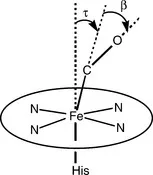
Fig. 1. Definition of the tilting (τ) and bending (β) angles, relative to the heme normal.
More recently, the concept of ...
Table of contents
- Cover image
- Title page
- Table of Contents
- Copyright
- Preface
- PART I: INTRODUCTORY OVERVIEWS
- PART II: ELECTRONIC STRUCTURE AND SPECTROSCOPY
- PART III: ASPECTS OF HEMOGLOBINS (EXCEPT HEME–NOx INTERACTIONS)
- PART IV: HEME–NOx INTERACTIONS
- PART V: SELECTED ENZYMES AND SENSORS
- Index
Trusted by 375,005 students
Access to over 1.5 million titles for a fair monthly price.
Study more efficiently using our study tools.
Frequently asked questions
Yes, you can cancel anytime from the Subscription tab in your account settings on the Perlego website. Your subscription will stay active until the end of your current billing period. Learn how to cancel your subscription
No, books cannot be downloaded as external files, such as PDFs, for use outside of Perlego. However, you can download books within the Perlego app for offline reading on mobile or tablet. Learn how to download books offline
Perlego offers two plans: Essential and Complete
- Essential is ideal for learners and professionals who enjoy exploring a wide range of subjects. Access the Essential Library with 800,000+ trusted titles and best-sellers across business, personal growth, and the humanities. Includes unlimited reading time and Standard Read Aloud voice.
- Complete: Perfect for advanced learners and researchers needing full, unrestricted access. Unlock 1.5M+ books across hundreds of subjects, including academic and specialized titles. The Complete Plan also includes advanced features like Premium Read Aloud and Research Assistant.
We are an online textbook subscription service, where you can get access to an entire online library for less than the price of a single book per month. With over 1.5 million books across 990+ topics, we’ve got you covered! Learn about our mission
Look out for the read-aloud symbol on your next book to see if you can listen to it. The read-aloud tool reads text aloud for you, highlighting the text as it is being read. You can pause it, speed it up and slow it down. Learn more about Read Aloud
Yes! You can use the Perlego app on both iOS and Android devices to read anytime, anywhere — even offline. Perfect for commutes or when you’re on the go.
Please note we cannot support devices running on iOS 13 and Android 7 or earlier. Learn more about using the app
Please note we cannot support devices running on iOS 13 and Android 7 or earlier. Learn more about using the app
Yes, you can access The Smallest Biomolecules: Diatomics and their Interactions with Heme Proteins by Abhik Ghosh in PDF and/or ePUB format, as well as other popular books in Scienze biologiche & Biochimica. We have over 1.5 million books available in our catalogue for you to explore.