- 156 pages
- English
- ePUB (mobile friendly)
- Available on iOS & Android
eBook - ePub
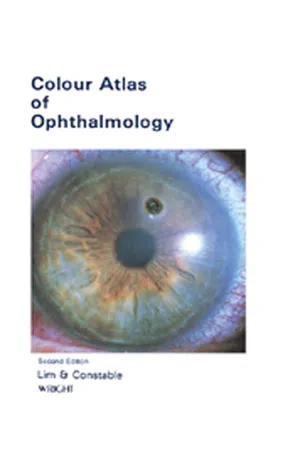
Colour Atlas of Ophthalmology
About this book
Colour Atlas of Ophthalmology, Second Edition provides information pertinent to the fundamental aspects of ophthalmology. This book provides the correct diagnosis and treatment of many ocular disorders. Organized into 11 chapters, this edition begins with an overview of the process of assessment of a patient with eye disease, which includes taking a good history, examining the eyes with adequate illumination, and testing the visual function. This text then describes exophthalmos, which is the most common condition of the orbit and indicates the possibility of thyroid disease or a space-occupying lesion. Other chapters consider the common causes of ocular injuries, including injury from flying particles, sharp instruments, chemicals, and ocular injury associated with head injury. The final chapter deals with the common, therapeutic, and diagnostic ocular drugs. This book is a valuable resource for ophthalmologists, physicians, nurses, students, and all those paramedical personnel who have to deal with common eye disease.
Information
1
EXAMINATION
Publisher Summary
The cause for a sudden loss of vision could be vascular in nature such as retinal vein occlusion, retinal artery occlusion, or vitreous hemorrhage. It could also be due to acute glaucoma, retinal detachment, or inflammatory conditions such as acute uveitis and optic neuritis. A gradual loss of vision is usually due to a refractive error, such as myopia or presbyopia, or degenerative conditions of which cataract is the most common. Flashes are momentary flashes of light due to the stimulation of the retina and are seen in retinal tears and detachments and also in vitreous detachment. Eye pain and headaches may be due to either ophthalmic or nonophthalmic causes. Binocular diplopia is usually due to extraocular muscle paralysis. Monocular diplopia is caused by disease in the eyeball, such as early cataract, lens dislocation, or corneal opacity. The assessment of distant and near visual acuity is important as it reflects the state of the macular function (central vision). The response of light directed at one pupil in a darkened room is known as the direct pupillary response. The extraocular muscles are examined by observing the position of the eyeballs with the patient looking straight ahead. The ophthalmoscope is used to observe abnormality in the ocular media, the optic disc, the retinal vessels, the fundal background, and the macula.
INTRODUCTION
In the assessment of a patient with eye disease, it is important to take a good history, examine the eyes with adequate illumination and test the visual function.
Recently, retinal and macular diseases have become more common as causes of severe visual loss. In these cases, a fundal examination with dilatation of the pupils in a darkened room is necessary.
HISTORY
A careful history of the patient’s ocular symptoms is essential. His past history and general illnesses, such as diabetes and hypertension, frequently provide useful clues.
Myopia, squint, open-angle glaucoma and dystrophic conditions have a hereditary tendency which is revealed by an inquiry into the patient’s family history. It is also useful to take note of allergies and of the medical therapy the patient is undergoing.
OCULAR SYMPTOMS
The more important symptoms include decreased visual acuity, floaters, ocular pain, headaches, itching, flashes, watering and double vision (diplopia).
Decreased visual acuity
Decreased visual acuity must always be investigated and the cause found. The cause for a sudden loss of vision could be vascular in nature such as retinal vein occlusion, retinal artery occlusion or vitreous haemorrhage. It could also be due to acute glaucoma, retinal detachment or inflammatory conditions such as acute uveitis and optic neuritis.
Gradual loss of vision is usually due to a refractive error such as myopia or presbyopia, or to degenerative conditions of which cataract is the most common. It could also be due to macular degeneration or chronic glaucoma.
Floaters
Another common ocular symptom which calls for further investigation is the appearance of floaters usually described by the patient as small, semi-translucent particles of varying shapes moving across the visual field with the movement of the eye. Single or double floaters of many months or years are common and usually harmless. But a sudden increase in floaters, especially when associated with lightning flashes and visual loss in patients with high myopia or in the elderly, suggests retinal disease, particularly retinal detachment.
Flashes
Flashes are momentary flashes of light due to stimulation of the retina and are seen in retinal tears and detachments and also in vitreous detachment. Other sensations of light may arise from m...
Table of contents
- Cover image
- Title page
- Table of Contents
- Copyright
- THE AUTHORS
- PREFACE
- PREFACE TO SECOND EDITION
- ACKNOWLEDGEMENT
- Chapter 1: EXAMINATION
- Chapter 2: LID, LACRIMAL APPARATUS AND ORBIT
- Chapter 3: CONJUNCTIVA SCLERA AND CORNEA
- Chapter 4: LENS AND GLAUCOMA
- Chapter 5: UVEAL TRACT, RETINA AND VITREOUS
- Chapter 6: OCULAR MANIFESTATIONS OF SYSTEMIC DISEASES
- Chapter 7: NEURO-OPHTHALMOLOGY
- Chapter 8: EYE DISEASES IN CHILDREN
- Chapter 9: OCULAR INJURIES
- Chapter 10: REFRACTIVE ERRORS
- Chapter 11: OPHTHALMIC DRUGS
- INDEX
Trusted by 375,005 students
Access to over 1.5 million titles for a fair monthly price.
Study more efficiently using our study tools.
Frequently asked questions
Yes, you can cancel anytime from the Subscription tab in your account settings on the Perlego website. Your subscription will stay active until the end of your current billing period. Learn how to cancel your subscription
No, books cannot be downloaded as external files, such as PDFs, for use outside of Perlego. However, you can download books within the Perlego app for offline reading on mobile or tablet. Learn how to download books offline
Perlego offers two plans: Essential and Complete
- Essential is ideal for learners and professionals who enjoy exploring a wide range of subjects. Access the Essential Library with 800,000+ trusted titles and best-sellers across business, personal growth, and the humanities. Includes unlimited reading time and Standard Read Aloud voice.
- Complete: Perfect for advanced learners and researchers needing full, unrestricted access. Unlock 1.5M+ books across hundreds of subjects, including academic and specialized titles. The Complete Plan also includes advanced features like Premium Read Aloud and Research Assistant.
We are an online textbook subscription service, where you can get access to an entire online library for less than the price of a single book per month. With over 1.5 million books across 990+ topics, we’ve got you covered! Learn about our mission
Look out for the read-aloud symbol on your next book to see if you can listen to it. The read-aloud tool reads text aloud for you, highlighting the text as it is being read. You can pause it, speed it up and slow it down. Learn more about Read Aloud
Yes! You can use the Perlego app on both iOS and Android devices to read anytime, anywhere — even offline. Perfect for commutes or when you’re on the go.
Please note we cannot support devices running on iOS 13 and Android 7 or earlier. Learn more about using the app
Please note we cannot support devices running on iOS 13 and Android 7 or earlier. Learn more about using the app
Yes, you can access Colour Atlas of Ophthalmology by Arthur Lim Siew Ming,Ian J Constable in PDF and/or ePUB format, as well as other popular books in Medicine & Neurology. We have over 1.5 million books available in our catalogue for you to explore.