- 877 pages
- English
- ePUB (mobile friendly)
- Available on iOS & Android
eBook - ePub
About this book
ICSAS '99 - The Fourth International Conference on Steel and Aluminium Structures was a sequel to ICSAS '87 held in Cardiff, UK, to ICSAS '91 held in Singapore and to ICSAS '95 held in Istanbul, Turkey. The objective of the conference was to provide a forum for the discussion of recent findings and developments in the design and construction of various types of steel and aluminium structures.The conference was concerned with the analysis, modelling and design of light-weight or slender structures in which the primary material is structural steel, stainless or aluminium. The structural analysis papers presented at the conference cover both static and dynamic behaviour, instability behaviour and long-term behaviour under hygrothermal effects. The results of the latest research and development of some new structural products were also presented at the conference. A total of 76 papers and 30 posters were presented at the conference by participants from 36 countries in all 6 continents.
Information
Session B2
ALUMINIUM AND STAINLESS STEEL STRUCTURES
COLUMN CURVES FOR STAINLESS STEEL ALLOYS
K.J.R. Rasmussen1 and J. Rondal2, 1Department of Civil Engineering, University of Sydney, Sydney, NSW 2006, Australia; 2MSM Institute of Civil Engineering, University of Liege, Quai Banning 6, 4000 Liege, Belgium
ABSTRACT
The paper describes a column curve formulation capable of producing strength curves for cold-formed stainless steel columns. The formulation uses a nonlinear expression for the imperfection parameter but is otherwise identical to the Perry-Robertson equation used in Eurocode3, Parts 1.1, 1.3 and 1.4. It is shown that several column curves are necessary for accurately describing the strength of austenitic and austenitic-ferritic stainless steel alloy columns and two curves are proposed. One of these is close to the curve for cold-formed sections currently used in the draft Eurocode3, Part 1.4. A new column curve is also proposed for ferritic alloys and 12% Chromium weldable structural steels.
KEYWORDS
Stainless steel
Columns
Flexural buckling
Design
Multiple column curves
Eurocode 3 Part 1.4
INTRODUCTION
The draft European Standard for stainless steel structures, Eurocode3, Part 1.4, (Eurocode3 1996a) was developed in the early 1990s largely by the British Steel Construction Institute (SCI). Initially the recommendations were published as the Euro Inox Design Manual (EURO INOX, 1994) featuring design recommendations, a commentary and worked examples. The current draft of Eurocode3, Part 1.4, hereon referred to as “EC3, 1.4,” was published in 1996 (Eurocode3, 1996a) following the initial draft in 1992 and a revision in 1994. The Euro Inox Design Manual was based on the test data available in the early 1990s. Most tests had been conducted on structural members cold-formed from annealed austenitic alloys. For this reason, the draft standard only applies to austenitic and austeniticferritic (duplex) alloys and not to ferritic alloys. The latter alloys can, however, be designed using the informative Annex D of EC3, 1.4, but as will be shown in this paper, the design approach described in Annex D of EC3, 1.4, is very conservative for compression members.
The draft EC3, 1.4, specifies two strength curves for columns failing by flexural buckling and uses a Perry-Robertson curve with a linear imperfection parameter,
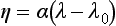
For cold-formed open and rolled tubular sections, the imperfection parameter is defined by α = 0.49 and λ0 = 0.4. For welded sections, the values of α = 0.76 and λ0 = 0.2 apply. In specifying these values, no regard is made to the fact that the mechanical properties of the alloys covered by EC3, 1.4, are different and consequently, the corresponding strength curves are different. The differences arise partly because the chemical compositions are different and partly because different degrees of cold-working may be used in the forming process. The effects of chemical compositions and cold-working are recognised by use of strength classes (S220, S240, S290, S350, S480) and cold-worked strength grades (C700, C850, etc) respectively. The numerals refer to the 0.2% proof stress and tensile strength for the Sxxx and Cxxx strength classes/grades respectively. However, despite the differences in 0.2% proof stress of the alloys pertaining to these strength classes and cold-worked grades, a single column curve is specified in the current draft of EC3, 1.4, for cold-formed open and rolled tubular sections. It will be shown in this paper that there are significant differences in the strength curves of the various strength classes and cold-worked grades, and that several column curves therefore should be used.
The column design provisions of the ASCE/ANSI Standard for Stainless Steel Cold-formed Members (ASCE 1991) uses a tangent modulus approach and thus specifies different column curves for alloys with different mechanical properties. While this approach is more general and accurate, it is implicit and requires iteration. The EC3, 1.4, approach is explicit but lacks accuracy. It also lacks a strength curve for ferritic alloys. While the simplicity of the EC3, 1.4, approach makes it preferable from the designer’s viewpoint, additional strength curves to the curve presently used in EC3, 1.4, for cold-formed sections are required.
The objective of this paper is to present an accurate column curve formulation capable of taking into account the different mechanical properties applicable to the stainless steel alloys covered by EC3, 1.4. The formulation is the same as that specified in EC3, 1.4, except that the imperfection parameter takes the form,

rather than the linear form of Eqn. 1. The formulation can produce accurate strength curves for austenitic and austenitic-ferritic (duplex) alloys, as well as ferritic alloys and 12% Chromium weldable structural steels. Using the formulation, two column curves are proposed in place of the current strength curve of EC3, 1.4, and a new column curve is proposed for ferritic alloys and 12% Chromium weldable structural steels. The scope of the paper is limited to cold-formed sections failing by flexural buckling.
THE IMPERFECTION PARAMETER
The column curve formulation employed in this paper is described in detail in Rasmussen & Rondal (1997). It is generally applicable to metallic columns with non-linear stress-strain curves such as stainless steel and aluminium columns. In developing the method, advanced finite element analyses were carried out on columns with different slenderness for a wide range of mechanical properties, represented by the Ramberg-Osgood parameters E0, σ0.2 and n. (E0 is the initial Young’s modulus, σ0.2 the 0.2% proof stress and n...
Table of contents
- Cover image
- Title page
- Table of Contents
- Inside Front Cover
- Copyright
- LOCAL ORGANIZING COMMITTEE
- PREFACE
- Session A1: STRUCTURAL MODELLING AND ANALYSIS
- Poster Session P1: STRUCTURAL MODELLING AND ANALYSIS
- Session A2: BUCKLING BEHAVIOUR
- Session A3: BEAM-COLUMNS
- Poster Session P2: SANDWICH STRUCTURES AND DYNAMIC BEHAVIOUR
- Session A4: ANALYSIS OF SHELLS AND FRAMES
- Session A5: NEW STRUCTURAL PRODUCTS
- Poster Session P3: NEW STRUCTURAL PRODUCTS
- Session A6: DEVELOPMENTS IN DESIGN
- Session B1: ALUMINIUM STRUCTURES
- Session A7: ALUMINIUM AND STAINLESS STEEL STRUCTURES
- Poster Session P4: STRUCTURES AT AMBIENT AND ELEVATED TEMPERATURES
- Session A8: CONNECTIONS
- Session B2: ALUMINIUM AND STAINLESS STEEL STRUCTURES
- Session A9: DESIGN FOR HYGROTHERMAL, VIBRATION AND FIRE EFFECTS
- Poster Session P5: COMPOSITE STRUCTURES
- Session A10: SPECIAL FEATURES IN MODELLING AND DESIGN
- Session B3: RESPONSE TO DYNAMIC AND ALTERNATING LOADS
- KEYWORD INDEX
- AUTHOR INDEX
Trusted by 375,005 students
Access to over 1.5 million titles for a fair monthly price.
Study more efficiently using our study tools.
Frequently asked questions
Yes, you can cancel anytime from the Subscription tab in your account settings on the Perlego website. Your subscription will stay active until the end of your current billing period. Learn how to cancel your subscription
No, books cannot be downloaded as external files, such as PDFs, for use outside of Perlego. However, you can download books within the Perlego app for offline reading on mobile or tablet. Learn how to download books offline
Perlego offers two plans: Essential and Complete
- Essential is ideal for learners and professionals who enjoy exploring a wide range of subjects. Access the Essential Library with 800,000+ trusted titles and best-sellers across business, personal growth, and the humanities. Includes unlimited reading time and Standard Read Aloud voice.
- Complete: Perfect for advanced learners and researchers needing full, unrestricted access. Unlock 1.5M+ books across hundreds of subjects, including academic and specialized titles. The Complete Plan also includes advanced features like Premium Read Aloud and Research Assistant.
We are an online textbook subscription service, where you can get access to an entire online library for less than the price of a single book per month. With over 1.5 million books across 990+ topics, we’ve got you covered! Learn about our mission
Look out for the read-aloud symbol on your next book to see if you can listen to it. The read-aloud tool reads text aloud for you, highlighting the text as it is being read. You can pause it, speed it up and slow it down. Learn more about Read Aloud
Yes! You can use the Perlego app on both iOS and Android devices to read anytime, anywhere — even offline. Perfect for commutes or when you’re on the go.
Please note we cannot support devices running on iOS 13 and Android 7 or earlier. Learn more about using the app
Please note we cannot support devices running on iOS 13 and Android 7 or earlier. Learn more about using the app
Yes, you can access Light-Weight Steel and Aluminium Structures by P. Mäkeläinen,P. Hassinen in PDF and/or ePUB format, as well as other popular books in Technology & Engineering & Civil Engineering. We have over 1.5 million books available in our catalogue for you to explore.