eBook - ePub
Environmental Geochemistry: Site Characterization, Data Analysis and Case Histories
- 350 pages
- English
- ePUB (mobile friendly)
- Available on iOS & Android
eBook - ePub
Environmental Geochemistry: Site Characterization, Data Analysis and Case Histories
About this book
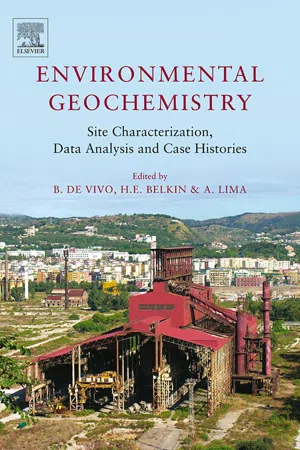
This volume contains chapters spanning from the role of geochemistry in the environment in general to specific investigations on site characterization (sampling strategy, analytical procedures and problems). Specific articles deal with health problems related to environment pollution, waste disposal, data base management, and provide illustrations of specific case histories of site characterization and remediation of brownfield sites.
- Comprehensive analysis providing background information ranging from geochemistry in general to specific investigations
- Provides practical insight through case study material
- Informs and updates students and practitioners on hot topics, latest trends and developments
Information
Topic
Scienze fisicheSubtopic
Geologia e scienze della terraCHAPTER ONE FIELD METHODS IN REGIONAL GEOCHEMICAL SURVEYS
Abstract
This chapter summarizes experiences from a number of recently completed regional-scale geochemical surveys. The aim is to briefly show the most essential issues to be taken into account in planning and carrying out geochemical surveys in the field. Whether the aim of a geochemical survey is prospecting, environmental assessment, or something else, the main principles in the fieldwork are always the same.
Contents
1. Introduction
2. Sampling Media
3. Sampling Density
4. Sampling Networks
5. Quality Assurance in Sampling
6. Sampling Procedures
6.1. General aspects of the fieldwork
6.2. Stream waters
6.3. Sediments
6.4. Soils
7. Documentation of Field Data
8. Photography
9. Sample Archive
References
1. INTRODUCTION
Geochemical studies vary enormously in an area. At one extreme, they cover continent-wide areas (Gustavsson et al., 2001; Salminen et al., 2005), based on information from not more than a thousand sites, while at the other, detailed maps, based on several thousands of samples, are produced from a small prospecting target (e.g., Kauranne, 1976; McClenaghan et al., 2001).
Studies at different scales differ considerably in the way they are carried out. Not only sampling density, but sampling material, sampling depth, analytical methods, and data processing also essentially depend on the aim of the study, the size of the area to be studied, the objects to be recognized, and the contrast between the anomaly and the surrounding area. The sources of the anomalies detected by different sampling densities are also totally different in nature.
2. SAMPLING MEDIA
Minerogenic stream sediments are the traditional medium in small-scale, regional geochemical mapping, particularly if the aim is ore prospecting. In areas of residual overburden, minerogenic stream sediments have proven to be very useful, providing data from a wide drainage area where the stream has been in contact with the bedrock (Hale and Plant, 1994). The most suitable conditions prevail in areas of temperate climate where the rivers are draining in situ weathered bedrock, and mountainous areas where the bedrock is widely exposed.
In glaciated areas, the stream is usually disconnected from the bedrock by till and the stream sediments may thus only reflect the variation of element contents in till. The interpretation of results for prospecting purposes becomes complicated. However, in till-covered mountainous areas such as Scotland (Plant et al., 1984) and Norway (Wennervirta et al., 1971), useful results were obtained by stream sediment geochemistry.
Till has conventionally been exploited as a sampling material only on local-scale prospecting studies. However, results from Scandinavia and adjacent areas (Bølviken et al., 1986; Koljonen, 1992; Reimann et al., 1998; Salminen et al., 1995) have shown beyond doubt that highly informative and easily interpreted results can be obtained from till geochemistry practiced on a regional or reconnaissance scale.
In the 1990s and earlier, environmental applications became important in geochemical mapping. New sampling media such as surface water and terrestrial mosses were tested and became more commonly used in geochemical surveys (Lahermo et al., 1990, 1996; Reimann et al., 1998; Rühling 1994; Salminen et al., 2005; Salminen, 2004; Steinnes et al., 1992). This development also brought some new variation not only in the sample media but also in sampling, analysis, and data management methodologies. In principle, most geochemical mapping data can also be used in environmental geochemical studies.
In exploration geochemistry, the concept of a geochemical background value is used to differentiate anomalies caused by mineralized occurrences from the geogenic anomalies caused by normal nonmineralized bedrock. In environmental geochemistry, a new concept of the geochemical baseline was needed to differentiate contamination derived from a point source from that derived from the general background, which includes both natural geogenic element concentration and diffuse anthropogenic pollution (Salminen and Gregorauskiene, 2000). Environmental geochemical studies have concentrated increasingly on defining baselines rather than on detecting high anomaly points; methods to separate local and regional components (anomaly and baseline) have been developed (e.g., De Vivo et al., 2006).
In an attempt to establish a global, common understanding of continuously varying methodologies in regional geochemical surveys, the sampling media were discussed very thoroughly in the 1980s and 1990s as part of the IGCP 259 (International Geoscience Programme) (International Geochemical Mapping) and IGCP 360 (Global Geochemical Baselines) projects. Furthermore, this discussion has continued in the framework of the IUGS/IAGC (International Union of Geological Sciences/International Association of Geochemistry) Working Group on Global Geochemical Baselines. Darnley et al. (1995) concluded the earlier discussions with recommendations that were globally accepted. These recommended media, described below, are considered to be the most representative of the Earth’s surface environment, and are the most commonly used in past and current environmental geochemical investigations.
• Stream water (filtered and unfiltered)
• Stream sediment: mineral sediment (<0.15 mm)
• Residual soil: upper 0–25 cm horizon/topsoil without the top organic layer (<2 mm)
• Residual soil: lower (C) horizon/subsoil; a 25-cm layer within a depth range of 50–200 cm (<2 mm)
• Organic soil layer (humus)
• Overbank sediment: upper 0–25 cm horizon (<0.15 mm)
• Overbank sediment: bottom layer (<0.15 mm)
• Floodplain sediment: upper 0–25 cm horizon (<2 mm) and
• Floodplain sediment: bottom layer (<2 mm)
Stream, overbank, and floodplain sediment samples generally reflect the average geogenic composition of a catchment basin for most elements, although they are somewhat sensitive to pollution. Stream sediment is the most widely used sample material in regional geochemical surveys throughout the world.
Stream waters reflect the interplay between geosphere/hydrosphere and pollution. At the same time, they have a huge economic value, often being a major source of drinking water in some countries.
Soil samples reflect variations in the geogenic composition of the uppermost layers of the Earth’s crust. As a result, it is important in regional surveys to avoid soil sampling at locations that have visible or known contamination. Priority for site selection of soil samples should be given to
• foreste...
Table of contents
- Cover image
- Title page
- Table of Contents
- Copyright
- CONTRIBUTORS
- PREFACE
- Chapter 1: FIELD METHODS IN REGIONAL GEOCHEMICAL SURVEYS
- Chapter 2: SAMPLING METHODS FOR SITE CHARACTERIZATION
- Chapter 3: CONTAMINATED GROUNDWATER SAMPLING AND QUALITY CONTROL OF WATER ANALYSES
- Chapter 4: THE COLLECTION OF DRAINAGE SAMPLES FOR ENVIRONMENTAL ANALYSES FROM ACTIVE STREAM CHANNELS
- Chapter 5: DATA CONDITIONING OF ENVIRONMENTAL GEOCHEMICAL DATA: QUALITY CONTROL PROCEDURES USED IN THE BRITISH GEOLOGICAL SURVEY’S REGIONAL GEOCHEMICAL MAPPING PROJECT
- Chapter 6: GAS CHROMATOGRAPHIC METHODS OF CHEMICAL ANALYSIS OF ORGANICS AND THEIR QUALITY CONTROL
- Chapter 7: EVALUATION OF GEOCHEMICAL BACKGROUND AT REGIONAL AND LOCAL SCALES BY FRACTAL FILTERING TECHNIQUE: CASE STUDIES IN SELECTED ITALIAN AREAS
- Chapter 8: URBAN GEOCHEMICAL MAPPING
- Chapter 9: CHEMICAL SPECIATION TO ASSESS POTENTIALLY TOXIC METALS’ (PTMs’) BIOAVAILABILITY AND GEOCHEMICAL FORMS IN POLLUTED SOILS
- Chapter 10: OVERVIEW OF SELECTED SOIL PORE WATER EXTRACTION METHODS FOR THE DETERMINATION OF POTENTIALLY TOXIC ELEMENTS IN CONTAMINATED SOILS: OPERATIONAL AND TECHNICAL ASPECTS
- Chapter 11: SEWAGE SLUDGE IN EUROPE AND IN THE UK: ENVIRONMENTAL IMPACT AND IMPROVED STANDARDS FOR RECYCLING AND RECOVERY TO LAND
- Chapter 12: LEAD ISOTOPES AS MONITORS OF ANTHROPOGENIC AND NATURAL SOURCES AFFECTING THE SURFICIAL ENVIRONMENT
- Chapter 13: ENVIRONMENTAL IMPACT OF THE DISPOSAL OF SOLID BY-PRODUCTS FROM MUNICIPAL SOLID WASTE INCINERATION PROCESSES
- Chapter 14: INNOVATIVE RESPONSES TO CHALLENGES: REDEVELOPMENT OF COS COB BROWNFIELDS SITE, CONNECTICUT, USA
- Chapter 15: CHARACTERIZATION AND REMEDIATION OF A BROWNFIELD SITE: THE BAGNOLI CASE IN ITALY
- Chapter 16: RELATIONSHIPS BETWEEN HEAVY METAL DISTRIBUTION AND CANCER MORTALITY RATES IN THE CAMPANIA REGION, ITALY
- Chapter 17: CHRONIC ARSENIC POISONING FROM DOMESTIC COMBUSTION OF COAL IN RURAL CHINA: A CASE STUDY OF THE RELATIONSHIP BETWEEN EARTH MATERIALS AND HUMAN HEALTH
- Index
Trusted by 375,005 students
Access to over 1.5 million titles for a fair monthly price.
Study more efficiently using our study tools.
Frequently asked questions
Yes, you can cancel anytime from the Subscription tab in your account settings on the Perlego website. Your subscription will stay active until the end of your current billing period. Learn how to cancel your subscription
No, books cannot be downloaded as external files, such as PDFs, for use outside of Perlego. However, you can download books within the Perlego app for offline reading on mobile or tablet. Learn how to download books offline
Perlego offers two plans: Essential and Complete
- Essential is ideal for learners and professionals who enjoy exploring a wide range of subjects. Access the Essential Library with 800,000+ trusted titles and best-sellers across business, personal growth, and the humanities. Includes unlimited reading time and Standard Read Aloud voice.
- Complete: Perfect for advanced learners and researchers needing full, unrestricted access. Unlock 1.5M+ books across hundreds of subjects, including academic and specialized titles. The Complete Plan also includes advanced features like Premium Read Aloud and Research Assistant.
We are an online textbook subscription service, where you can get access to an entire online library for less than the price of a single book per month. With over 1.5 million books across 990+ topics, we’ve got you covered! Learn about our mission
Look out for the read-aloud symbol on your next book to see if you can listen to it. The read-aloud tool reads text aloud for you, highlighting the text as it is being read. You can pause it, speed it up and slow it down. Learn more about Read Aloud
Yes! You can use the Perlego app on both iOS and Android devices to read anytime, anywhere — even offline. Perfect for commutes or when you’re on the go.
Please note we cannot support devices running on iOS 13 and Android 7 or earlier. Learn more about using the app
Please note we cannot support devices running on iOS 13 and Android 7 or earlier. Learn more about using the app
Yes, you can access Environmental Geochemistry: Site Characterization, Data Analysis and Case Histories by Benedetto DeVivo,Harvey Belkin,Harvey Belkin,Annamaria Lima in PDF and/or ePUB format, as well as other popular books in Scienze fisiche & Geologia e scienze della terra. We have over 1.5 million books available in our catalogue for you to explore.