Solar Energy Conversion II presents the proceedings of the 1980 International Symposium on Solar Energy Utilization, held in Ontario, Canada on August 10-24, 1980. This book provides information on the utilization of solar energy and on the difficulties encountered in its implementation. Organized into 42 chapters, this compilation of papers begins with an overview of the important parameter in solar radiation measurement. This text then examines the use of solar radiation measurement, the solar radiation scales, the solar radiation units, and the types of solar radiation. Other chapters consider the general problems linked with building up data banks of observed solar radiation data. This book discusses as well the fundamental modes of heat transfer. The final chapter deals with the necessity to incorporate energy education into other disciplines like space geometry. This book is a valuable resource for politicians, government officials, engineers, scientists, and research workers. Technologists working on solar energy will also find this book useful.
A.A.M. Sayigh, College of Engineering, University of Riyadh, Riyadh, Saudi Arabia
ABSTRACT
The paper describes the basic modes of heat transfer, then shows their application to flat plate solar collectors used for liquid heating. The paper then examines the factors affecting the performance of a flat plate solar collector and the para meters that are used to describe performance.
KEYWORDS
Conduction
convection
radiation
heat losses from flat plate collectors
collector performance
efficiency
collector efficiency factor
heat removal factor
flow factor
HEAT TRANSFER BY CONDUCTION
This mode of heat transfer takes place mostly in a solid material and occurs due to temperature difference between different parts of the material. Conduction also takes place in liquids and gases, but it is associated with convection. Conduction in solids is a transfer of internal energy which is the energy due to molecular collisions of the material and leads to energy transfer to regions of lower kinetic energy. Under steady state a molecule will pass on the same amount of energy that it receives. In unsteady conditions the flow of energy is governed by the changing energy levels.
The theory of conduction heat transfer was established by Joseph Fourier and published in Paris in 1822, but earlier work was carried out by J.B. Biot in 1804 and 1816.
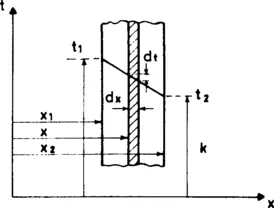
The Fourier equation is
(1)
QX = rate of heat transfer
A = cross sectional area of the slab
k = thermal conductivity
t = temperature
x = thickness of the slab
as shown in Fig. 1.
Fig. 1 Conduction in a plane slab.
The negative sign results from the convention of defining a positive heat flow in the direction of a negative temperature gradient
There are three and two-dimensional conduction, but for the sake of simplicity, only one-dimensional steady state conduction will be discussed here.
Using a rectangular coordinate system, the differential equation of conduction in the x-direction only is
(2)
HEAT CONVECTION
It is the gross motion of the fluid itself, so that fresh fluid is continually available for heating or cooling. This is subdivided into two different kinds, natural and forced. Heat transfer by natural convection occurs between a solid and a fluid undisturbed by other effects when there is a temperature difference between the two, as in a kettle of water. It is not often that a fluid can be regarded as entirely at rest, so frequently there is a small amount of forced convection as well. Forced convection requires a major applied motion of the fluid in relation to the source or sink of heat, so that natural convection is negligible. Within both modes, there are subdivisions of laminar and turbulent flow convection. In forced convection there are special cases where flow may be separated from solid surface, as in flow across the outside of a pipe, and also convection with phase change occurring in the fluid. This is, of course, encountered in a steam raising and condensing plant. Therefore, many factors are involved in heat convection.
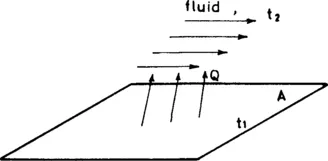
Newton, in 1701, proposed a general equation to describe convection heat transfer, as shown in Fig. 2.
Fig. 2 Heat convection.
(3)
where h is the film coefficient expressed in J/m2.s.°C or Btu/ft2. hr.°F
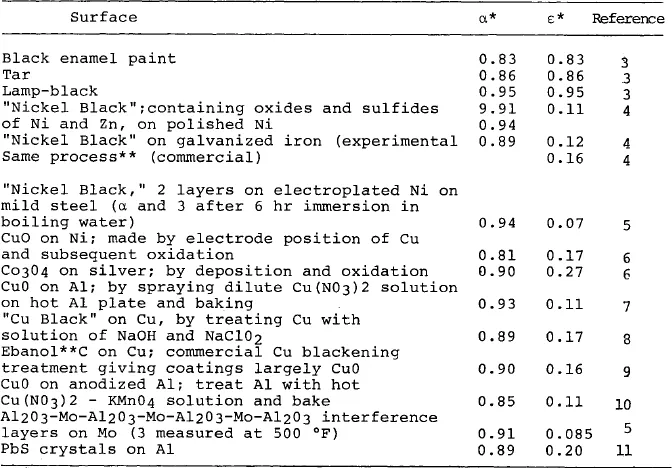
Typical values are given in Table 1.
TABLE 1
Properties Of Some Surface Coating Used In Flat Plate Collectors.
*α = absorptance for solar energy; ε = emittance for long-wave radiation at at temperatures typical of flat plate solar collectors.
**Commercial processes.
TABLE 1
Convection System
Range of h, J/m2,°C
Natural convection
3.5 − 50
Forced convection (air)
10 − 550
Forced convection (liquids)
100 − 5500
Boiling heat transfer (water)
1000 − 110,000
Condensation (steam, filmwise)
550 − 25,000
Forced convection (liquid metals)
3000 − 110,000
Dimensional analysis of natural convection provides a correlation for the film coefficient, h, in the Nusselt number, Nu, where Nu = hd/k as a function of Grashof and Prandtl numbers as follows:
(4)
where a and b are constants, and the Grashof and Prandtl numbers can be expressed as the Rayleigh number:
(5)
Varying Gr at some fixed Pr, laminar and turbulent flow regions have been observed in natural convection, and transition generally occurs in the range
Mc Adams recommends for vertical surfaces
Fishenden and Saunders recommend for square or rectangular horizontal surfaces up to a mean length of side of 2 ft.
RADIATION
Energy absorbed by any surface due to radiation behaves according to:
where
For thick or opaque bodies τ = 0,
In engineering applications of radiation, there will generally be a gas separating solid bodies; often this gas is air which can be a...
Table of contents
Cover image
Title page
Table of Contents
Pergamon Books of Related Interest
Copyright
FREQUENTLY USED CONVERSION CONSTANTS
PREFACE
ACKNOWLEDGEMENTS
INTERNATIONAL ORGANIZING COMMITTEE
SPEAKERS
PANELISTS
PARTICIPANTS
SOLAR RADIATION
ACTIVE SYSTEMS AND STORAGE
ARCHITECTURE AND COMMUNITY PLANNING
DIRECT AND BIO-CONVERSION
CONTROL SYSTEMS
GENERAL TOPICS
SOLAR ECONOMICS AND COMMERCIALIZATION
SOLAR ENERGY AND SOCIETY
INDEX
Trusted by 375,005 students
Access to over 1.5 million titles for a fair monthly price.
Study more efficiently using our study tools.
Frequently asked questions
Yes, you can cancel anytime from the Subscription tab in your account settings on the Perlego website. Your subscription will stay active until the end of your current billing period. Learn how to cancel your subscription
No, books cannot be downloaded as external files, such as PDFs, for use outside of Perlego. However, you can download books within the Perlego app for offline reading on mobile or tablet. Learn how to download books offline
Perlego offers two plans: Essential and Complete
Essential is ideal for learners and professionals who enjoy exploring a wide range of subjects. Access the Essential Library with 800,000+ trusted titles and best-sellers across business, personal growth, and the humanities. Includes unlimited reading time and Standard Read Aloud voice.
Complete: Perfect for advanced learners and researchers needing full, unrestricted access. Unlock 1.5M+ books across hundreds of subjects, including academic and specialized titles. The Complete Plan also includes advanced features like Premium Read Aloud and Research Assistant.
Both plans are available with monthly, semester, or annual billing cycles.
We are an online textbook subscription service, where you can get access to an entire online library for less than the price of a single book per month. With over 1.5 million books across 990+ topics, we’ve got you covered! Learn about our mission
Look out for the read-aloud symbol on your next book to see if you can listen to it. The read-aloud tool reads text aloud for you, highlighting the text as it is being read. You can pause it, speed it up and slow it down. Learn more about Read Aloud
Yes! You can use the Perlego app on both iOS and Android devices to read anytime, anywhere — even offline. Perfect for commutes or when you’re on the go. Please note we cannot support devices running on iOS 13 and Android 7 or earlier. Learn more about using the app
Yes, you can access Solar Energy Conversion II by A. F. Janzen, R. K. Swartman, A. F. Janzen,R. K. Swartman in PDF and/or ePUB format, as well as other popular books in Technology & Engineering & Physics. We have over 1.5 million books available in our catalogue for you to explore.