eBook - ePub
Sustainable Water for the Future
Water Recycling versus Desalination
- 444 pages
- English
- ePUB (mobile friendly)
- Available on iOS & Android
eBook - ePub
Sustainable Water for the Future
Water Recycling versus Desalination
About this book
This book is part of a series on sustainability. Specifically, it deals with the issue of sustainable water use. Fresh sources of potable water are being depleted across the world. Pure water is the goal of water utilities as well as several industries. Well past the experimental stage, membrane processes are now a proven and reliable method of providing high-quality, cost-effective water. Membrane technologies have immediate applications to treatment of fresh, brackish and sea waters, as well as wastewater reclamation. With innovative module design and engineering, micro- and ultra-filtrations have become effective and economical for drinking water production, particularly for removal of microorganisms. Membrane bioreactors are being developed for municipal and industrial water recycling. Various membrane processes are also used to remove contaminants from industrial wastewaters.This book covers the fundamental and practical concepts and issues regarding the application of membrane technologies for sustainable water treatment. It describes and compares the effectiveness of desalination versus water recycling for long-term sustainable water use.
- Describes the global water situation with respect to sustainability
- Emphasizes the role of membrane technologies
- Compares the strategies of water recycling and desalination
Information
Chapter 1 An Overview of the Global Water Situation
Isabel C. Escobar* (email: [email protected])
Chemical and Environmental Engineering Department, The University of Toledo, 2801 West Bancroft Street, MS 305, Toledo, OH 43606-3390, USA
*Corresponding Author.
According to the International Water Management Institute (IWMI), one in three people globally endures some form of water scarcity, one-quarter of the world's population lives in areas where water is physically scarce, and over one billion people live where water is economically scarce, or places where “water is available in rivers and aquifers, but the infrastructure is lacking to make this water available to people.”Fig. 1 shows a United Nations history of global water scarcity since 1950, and a projection to 2025. The World Water Institute states that water scarcity is not a factor of absolute quantity; rather, it is a relative concept comparing the availability of water to actual use. In the United States and Europe, the average individual uses between 200 and 600liters of water per day (UN – Coping with Water Scarcity, 2007 World Water Day, http://www.unwater.org/wwd07), compared to the 20liters deemed to be the minimum daily requirement for drinking, washing, cooking, and sanitation. A significant cause of water scarcity is agriculture since crop production requires up to 70 times more water than is used in drinking and other domestic purposes. IWMI approximates that each calorie consumed as food requires about 1liter of water to produce. Such unsustainable consumption levels have led to localized areas of water scarcity and significantly altered freshwater ecosystems.
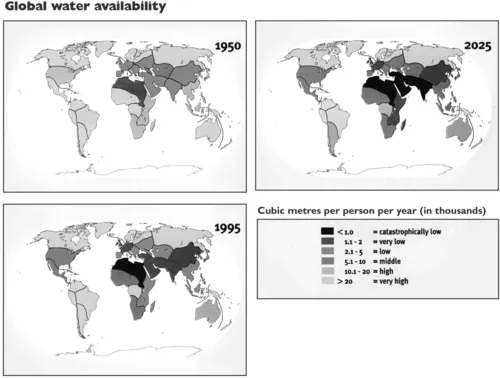 |
| Figure 1 A history of global water scarcity since 1950, and a projection to 2025. Sources:http://www.un.org and http://www.un.org/events/water/images/WaterYearGraph.webp |
Existing water supplies may be limited in quantity or quality for meeting the increasing demands from population growth and industry expansion. In many arid and semi-arid areas, providing the large volume of water required for industrial, agricultural, recreational, and potable applications is especially difficult. So, searching for “new” water sources is a task for researchers in the water works field. Municipal wastewater, which comprises between 75% and 80% of consumed water in most cities, is one of the most reliable sources of water, since its volume varies little throughout the year. Through suitable treatment, reclaimed wastewater can meet various water quality requirements for potential wastewater reuse/recycle [1]. Recycled water can be used in numerous applications to satisfy many water demands such as agricultural and landscape irrigation, industrial processes, toilet flushing, or replenishing a groundwater basin, depending on the level of treatment. Usually, treatment includes four stages: primary, secondary, tertiary or advanced, and disinfection. Among the many available treatment alternatives, membrane filtration technologies are attractive treatment options since they can meet stringent regulation standards.
Membrane processes are now a proven and reliable method of providing high-quality, cost-effective water. Membrane technologies have immediate applications to treatment of fresh, brackish, and seawaters, as well as wastewater reclamation. With innovative module design and engineering, micro- and ultrafiltrations have become effective and economical for drinking water production, particularly for removal of microorganisms. Membrane bioreactors are being developed for municipal and industrial water recycling. Various membrane processes are also used to remove contaminants from industrial wastewaters. The use of membrane technologies for aqueous separations has become very popular over the past 20 years. Successful use of membranes was first seen with desalination of brackish water and seawater. However, improvements in materials and manufacturing technology, mechanical configuration, and cleaning have expanded membrane technology to the treatment of waters of varying quality. Communities are searching for alternatives to conventional treatment for the production of high-quality effluents, and membrane technologies are emerging as treatment of choice for communities, as such technologies become better understood and widely available [2].
The United Nations declared 2005–2015 the “Water for Life” Decade because water is crucial for sustainable development. The goals of the “Water for Life” Decade are to reduce by half the proportion of people without access to safe drinking water, to stop unsustainable exploitation of water resources, to aim to develop integrated water resource management and water efficiency plans, and to halve the proportion of people who do not have access to basic sanitation. Providing safe, clean water in a sustainable fashion is the focus of this book as it covers the fundamental and practical concepts and issues dealing with the application of different technologies for sustainable water treatment. It describes and compares the effectiveness of desalination versus water recycling for long-term sustainable water use.
References
[1] I.C. Escobar, Membrane developed systems for water and wastewater treatment, Environmental Progress 24
(4)
(2005) 355–357.
[2] I.C. Escobar, S. Ritchie, Foreword: Selected water/wastewater membrane-related presentations from the North American, Environmental Progress 27
(2)
(2008) 169–172.
Chapter 2 Global Desalination Situation
Sabine Lattemann1,* (email: [email protected]), Maria D. Kennedy2, Jan C. Schippers2 and Gary Amy2
1Institute for Chemistry and Biology of the Marine Environment (ICBM), University of Oldenburg, Oldenburg, Germany
2UNESCO – IHE Institute for Water Education, Delft, The Netherlands
*Corresponding author:
Abstract
This chapter gives an overview on the worldwide installed desalination capacity by different source water types, technologies, and end uses. It furthermore discusses the historical development of the main desalination technologies, regional and future trends. About 63% of the present desalination capacity of 44.1 million cubic meters per day is produced from seawater, 19% from brackish water, and 5% from waste water sources. Much of the expected growth of the desalination market will take place in the seawater sector, although brackish water and wastewater desalination will presumably become more important in the future. The figures show that desalination is developing into a coastal-based industry in some sea regions such as the Arabian Gulf, the Red Sea, or the Mediterranean Sea, with potential to harm the marine environmental resources it depends on. The key environmental concerns are briefly outlined, covering the intakes and discharges, and energy demand of the main processes, followed by an outlook on impact mitigation measures.
1. Introduction
Seawater and brackish groundwater have become the most important sources of drinking water in a few arid countries of the Middle East, such as Kuwait or the United Arab Emirates, which depend heavily on desalination. Many industrialized and developing regions, however, have recently also started to use desalination as a way to supplement and diversify their water supply options. Until a few years ago, desalination plants were limited to the water-scarce but oil-rich countries of the Middle East and North Africa, and to some tropical and subtropical islands. Today, desalinated water has become a commodity for many countries in order to satisfy their growing demand for water.
For the “pioneering” countries, the driving factors were often a lack of surface and groundwater resources, coupled with sufficient natural or financial resources to engage in energy-intensive and costly desalination projects. For the newly emerging desalination markets, driving factors are more diverse, including economic and demographic growth, prolonged droughts, climate change, or declining conventional water resources in terms of quality and quantity due to overuse, pollution, or salinization. Moreover, as conventional water production costs have been rising in many parts of the world and the costs of desalination – particularly seawater desalination – have been declining over the years, desalination also becomes economically more attractive and competitive (Fig. 1).
|
| Figure 1 Water resource cost trends in the desalination market in US$ per cubic meter. Top: Total installed capacity and water price development. Bottom: Differentiated between water source type. Adapted from Ref. [6]. |
This chapter gives a short account of the historical development of desalination technologies, an overview on the presently installed worldwide desalination capacity, distinguishing between different raw water sources, processes and use types. It furthermore discusses reg...
Table of contents
- Cover Image
- Table of Contents
- Elsevier
- Foreword
- Chapter 1 An Overview of the Global Water Situation
- Chapter 2 Global Desalination Situation
- Chapter 3 The Global Water Recycling Situation
- Chapter 4 Desalination: Reverse Osmosis and Membrane Distillation
- Chapter 5 Salinity Gradient Energy
- Chapter 6 Ion-Exchange Membrane Processes in Water Treatment
- Chapter 7 Micropollutants in Water Recycling: A Case Study of N-Nitrosodimethylamine (NDMA) Exposure from Water versus Food
- Chapter 8 TiO2-Based Advanced Oxidation Nanotechnologies for Water Purification and Reuse
- Chapter 9 Membrane Bioreactors: Theory and Applications to Wastewater Reuse
- Chapter 10 Concentrate Treatment for Inland Desalting
- Chapter 11 Inland Desalination: Current Practices, Environmental Implications, and Case Studies in Las Vegas, NV
- Chapter 12 Renewable Energy Powered Water Treatment Systems
- Chapter 13 Desalinated Versus Recycled Water: What Does the Public Think?
- Chapter 14 Conclusion: A Summary of Challenges still Facing Desalination and Water Reuse
Trusted by 375,005 students
Access to over 1.5 million titles for a fair monthly price.
Study more efficiently using our study tools.
Frequently asked questions
Yes, you can cancel anytime from the Subscription tab in your account settings on the Perlego website. Your subscription will stay active until the end of your current billing period. Learn how to cancel your subscription
No, books cannot be downloaded as external files, such as PDFs, for use outside of Perlego. However, you can download books within the Perlego app for offline reading on mobile or tablet. Learn how to download books offline
Perlego offers two plans: Essential and Complete
- Essential is ideal for learners and professionals who enjoy exploring a wide range of subjects. Access the Essential Library with 800,000+ trusted titles and best-sellers across business, personal growth, and the humanities. Includes unlimited reading time and Standard Read Aloud voice.
- Complete: Perfect for advanced learners and researchers needing full, unrestricted access. Unlock 1.5M+ books across hundreds of subjects, including academic and specialized titles. The Complete Plan also includes advanced features like Premium Read Aloud and Research Assistant.
We are an online textbook subscription service, where you can get access to an entire online library for less than the price of a single book per month. With over 1.5 million books across 990+ topics, we’ve got you covered! Learn about our mission
Look out for the read-aloud symbol on your next book to see if you can listen to it. The read-aloud tool reads text aloud for you, highlighting the text as it is being read. You can pause it, speed it up and slow it down. Learn more about Read Aloud
Yes! You can use the Perlego app on both iOS and Android devices to read anytime, anywhere — even offline. Perfect for commutes or when you’re on the go.
Please note we cannot support devices running on iOS 13 and Android 7 or earlier. Learn more about using the app
Please note we cannot support devices running on iOS 13 and Android 7 or earlier. Learn more about using the app
Yes, you can access Sustainable Water for the Future by Isabel C. Escobar,Andrea Schäfer in PDF and/or ePUB format, as well as other popular books in Biological Sciences & Microbiology. We have over 1.5 million books available in our catalogue for you to explore.