eBook - ePub
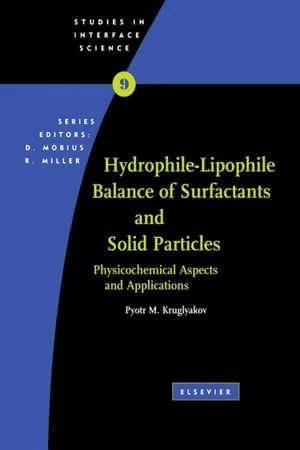
Hydrophile - Lipophile Balance of Surfactants and Solid Particles
Physicochemical Aspects and Applications
- 404 pages
- English
- ePUB (mobile friendly)
- Available on iOS & Android
eBook - ePub
Hydrophile - Lipophile Balance of Surfactants and Solid Particles
Physicochemical Aspects and Applications
About this book
This book considers the different concepts of hydrophile-lipophile balance (HLB) of surfactants and solid particles and the main physicochemical properties of surfactant and solid interfaces which are used to definite the hydrophile-lipophile balance. The book comprehensively analyses all interfacial and bulk properties of surfactants used for the determination of HLB (such as interfacial tension, distribution coefficient, adsorption, surface pressure, surfactants solubility, structure characteristics, distribution between heteropolar phases, micellar formation, chromatographic characteristics, phase separation in emulsions, phase inversion temperature, formation of three phase systems).The central point of the book is the energetic interpretation of the balance, i.e. the hydrophile-lipophile ratio. At the same time the HLB-number systems of Griffin and Davies and other independant methods of the hydrophile-lipophile balance definitions are discussed: PIT, polarity indexes, surfactant affinity difference etc. The possibility of application of the different characteristics of the hydrophile-lipophile balance as a criterion of phase inversion in emulsions and microemulsion systems water-oil-surfactant are considered.For the first time the different methods of the hydrophile-lilophile balance definition for solid particles in compact and dispersed form are suggested by the author. The use of hydrophile-lipophile characteristics of solid particles as a criterion of phase inversion in emulsion stabilisation and for other applications is discussed.
Information
Topic
Physical SciencesSubtopic
Physical & Theoretical ChemistryChapter 1
Physicochemical properties of surfactants used in the definition of hydrophile-lipophile balance
1.1 Classification of surfactants with respect to structure and chemical nature
Surfactants are substances which decrease the surface (interfacial) tension. It should be noted, of surfactants with respect to the structure and chemical nature however, that the interface can be chosen in such a way that any particular substance, being in a liquid or vapour phase, or a solution component, can act to decrease the surface or interfacial tension. In a more specific sense, the term “surfactant” denotes amphiphilic organic substances of an asymmetric molecular structure.
Typically, surfactant molecule consists of two parts, which possess properties that are opposite to each other by their nature. One part of the molecule (or ion) is the hydrophilic polar group, for example, -NH2, -OH, -COOH, -SO3H, -OSO3H, -COOMe, -OSO3Me, -N(CH3)3Cl, -CH2CH2O.
Another part is formed by a rather long hydrocarbon or hydrofluorine hydrophobic (oleophilic) chain. High molecular-weight surfactants (proteins, polyvinyl alcohols, polyacryl amide etc.) contain alternating hydrophilic and hydrophobic molecular groups distributed along the whole molecule.
These typical surfactants demonstrate always some surface activity at the water/gas and water/oil interface, and are often surface active at the interface between a solution and some solid phases.
With respect to their structure and chemical nature, surfactants can be divided into two major groups - non-ionic surfactants and surface-active electrolytes (colloidal electrolytes) which consist of a long-chain ion (surface active ion) and an ordinary inorganic ion (counterion).
The molecules of non-ionic surfactants contain polar groups unable to dissociate and possessing a significant affinity to water and other polar substances. Usually these groups incorporate atoms of oxygen, nitrogen, phosphorus or sulphur (alcohols, amines, ethers etc.).
Among the substances of this group of surfactants, the most significant are oxyethylated alkyl phenols, fatty alcohols, fatty acids, amines and block-copolymer surfactants (oxyethylene non-ionic surfactants), in which the polar part of the molecule consists of repeated oxyethylene group -CH2-O-CH2- and closing -OH, -COOH or -NH2 group.
The most common oil-soluble surfactants which belong to this group are ethers of fatty acids and polyatomic alcohols - pentaerythritol, triethanol amine, unhydro sorbite and unhydro xylite (like Span, Tween etc.)
The ionic surfactants, in turn, can be subdivided into two groups: anionic (anion-active) substances, for which the hydrophobic long-chain part responsible for the surface activity is incorporated into the anion, and cationic (cation-active) surfactants, where the cations are incorporated into the hydrocarbon or other hydrophobic radical which is responsible for the surface activity. Among the anionic surfactants, the most significant are the soaps of carbon acids (RCOOMe), alkyl sulphates (sulphoether salts) ROSO3Me, alkane sulphonates RSO3Me, alkyl aryl sulphonates RC6H5SO3Me, alkyl phosphates ROPO(OMe)2, salts of sulphosuccinic acids. The typical surfactants which belong to this class are sodium dodecyl sulphate, sodium oleate and sodium dodecyl benzene sulphonate.
Among the cationic surfactants, the most common are the salts of (primary, secondary and tertiary) amines, and quaternary salts of ammonium, for example, cetyl ammonium bromide and octadecyl pyridinium chloride.
The ampholytic surfactants, which demonstrate either anionic or cationic properties depending on the properties of the medium (pH), can be regarded to as a particular class. These substances usually comprise some polar groups, for example, dodecyl-β-alanine C12H25NHC2H4COOH contains both carboxy group and amino group. Depending on the ambient conditions (primarily on the pH value in aqueous media), in the solution these surfactants can form either surface-active anions or surface-active cations.
Finally, zwitter-ionic surfactants can be regar...
Table of contents
- Cover image
- Title page
- Table of Contents
- Studies in Interface Science
- Copyright page
- Preface
- Introduction
- Chapter 1: Physicochemical properties of surfactants used in the definition of hydrophile-lipophile balance
- Chapter 2: Stabilising ability of surfactants in emulsification and foam formation
- Chapter 3: Hydrophile-lipophile balance of surfactants
- Chapter 4: Hydrophile-lipophile balance of solid particles
- Chapter 5: Examples of the implementation of hydrophilicity- lipophilicity concepts in the development of the formulations of surfactants and selection of solid particles for certain purposes
- List of Symbols
- Abbreviations of surfactants and surfactant mixtures
- Acronyms
- Subject index
Trusted by 375,005 students
Access to over 1.5 million titles for a fair monthly price.
Study more efficiently using our study tools.
Frequently asked questions
Yes, you can cancel anytime from the Subscription tab in your account settings on the Perlego website. Your subscription will stay active until the end of your current billing period. Learn how to cancel your subscription
No, books cannot be downloaded as external files, such as PDFs, for use outside of Perlego. However, you can download books within the Perlego app for offline reading on mobile or tablet. Learn how to download books offline
Perlego offers two plans: Essential and Complete
- Essential is ideal for learners and professionals who enjoy exploring a wide range of subjects. Access the Essential Library with 800,000+ trusted titles and best-sellers across business, personal growth, and the humanities. Includes unlimited reading time and Standard Read Aloud voice.
- Complete: Perfect for advanced learners and researchers needing full, unrestricted access. Unlock 1.5M+ books across hundreds of subjects, including academic and specialized titles. The Complete Plan also includes advanced features like Premium Read Aloud and Research Assistant.
We are an online textbook subscription service, where you can get access to an entire online library for less than the price of a single book per month. With over 1.5 million books across 990+ topics, we’ve got you covered! Learn about our mission
Look out for the read-aloud symbol on your next book to see if you can listen to it. The read-aloud tool reads text aloud for you, highlighting the text as it is being read. You can pause it, speed it up and slow it down. Learn more about Read Aloud
Yes! You can use the Perlego app on both iOS and Android devices to read anytime, anywhere — even offline. Perfect for commutes or when you’re on the go.
Please note we cannot support devices running on iOS 13 and Android 7 or earlier. Learn more about using the app
Please note we cannot support devices running on iOS 13 and Android 7 or earlier. Learn more about using the app
Yes, you can access Hydrophile - Lipophile Balance of Surfactants and Solid Particles by Pyotr M Kruglyakov in PDF and/or ePUB format, as well as other popular books in Physical Sciences & Physical & Theoretical Chemistry. We have over 1.5 million books available in our catalogue for you to explore.