- 488 pages
- English
- ePUB (mobile friendly)
- Available on iOS & Android
eBook - ePub
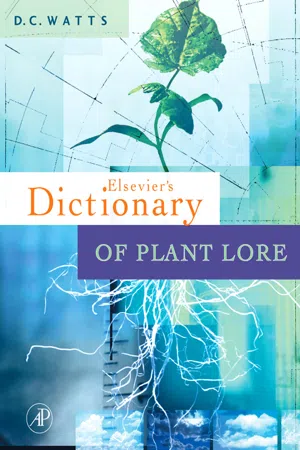
Dictionary of Plant Lore
About this book
Knowledge of plant names can give insight into largely forgotten beliefs. For example, the common red poppy is known as "Blind Man" due to an old superstitious belief that if the poppy were put to the eyes it would cause blindness. Many plant names derived from superstition, folk lore, or primal beliefs. Other names are purely descriptive and can serve to explain the meaning of the botanical name. For example, Beauty-Berry is the name given to the American shrub that belongs to the genus Callicarpa. Callicarpa is Greek for beautiful fruit. Still other names come from literary sources providing rich detail of the transmission of words through the ages.Conceived as part of the author's wider interest in plant and tree lore and ethnobotanical studies, this fully revised edition of Elsevier's Dictionary of Plant Names and Their Origins contains over 30,000 vernacular and literary English names of plants. Wild and cultivated plants alike are identified by the botanical name. Further detail provides a brief account of the meaning of the name and detailed commentary on common usage.* Includes color images * Inclusive of all Latin terms with vernacular derivatives * The most comprehensive guide for plant scientists, linguists, botanists, and historians
Information
A
Abies alba > SILVER FIR
Abies balsamea > BALSAM FIR
ABORTION
At the same time as being an aid to conception, TANSY leaves were chewed by unmarried pregnant girls to procure an abortion (Porter. 1969). Indeed, the poisonous oil of tansy has long been taken to induce abortion (Grigson). Exactly the same ambivalence is shown in beliefs concerning PARSLEY. It is an aid to conception on the one hand, and a contraceptive as well as an abortifacient on the other. Cambridgeshire girls would eat it three times a day to get an abortion, but the belief is actually widespread (Waring). Eating HORSERADISH leaves three times a day was a valued means in the Fen country of causing abortion (Porter. 1968), knowledge apparently not confined to East Anglia, for Whitlock mentions it as a Wiltshire remedy, if that is the right word to use.
LADY LAUREL (Daphne mezereum) is a poisonous plant, dangerously violent in its action. Presumably that is the reason for its inclusion in a list of abortifacients used in Dutch folk medicine (van Andel). According to Dodonaeus, it is so strong that it had only to be applied on the belly to kill the child. OLEANDER, too, is extremely poisonous, and has been used for abortions in India (P A Simpson). Hungarian gypsies recommended oleander leaves in wine, together with those of peony, as well as ergot, for abortions (Erdos. 1958). A certain Granny Gray, of Littleport, in Cambridgeshire, used to make up pills from the very poisonous HEMLOCK, penny-royal and rue. They were famous in the Fen country for abortions (Porter. 1969) in the mid-19th century. SAVIN, probably the most notorious of the poisonous abortifacients, had been in use, as a matter of common knowledge, since ancient times, and was certainly well known in the 16th and 17th centuries, for instance, the scurrilous lines in Middleton’s play, A game of chess, act 1; sc. 2:
To gather fruit, find nothing but the savin-tree,
Too frequent in nuns’ orchards, and there planted
By all conjecture, to destroy fruit rather.
Some of the common names for the tree bear witness to this usage, names like Cover-shame and Bastard Killer. And its contraceptive properties were well-known, too. It was said that a stallion would never cover a mare if there was any savin in the stable (G E Evans. 1966). Even ARNICA, dangerous as it is, has been used in folk medicine (Schauenberg & Paris). MARSH ROSEMARY (Ledum palustre) is another traditional abortifacient (Schauenberg & Paris), and even the dried flowers of FEVERFEW have been used in Europe (Lewis & Elvin-Lewis). A volatile oil made from the wood of VIRGINIAN JUNIPER, a close relative of Savin, has been used for abortions (Weiner); if this is the substance known as Red Cedar Wood Oil, then it must have been a thoroughly dangerous process (Usher). It is claimed that the Blackfoot Indians used the rhizome of SWEET FLAG to cause abortions (Johnston). That sounds highly unlikely, considering the plant’s universal usage as a mild carminative.
RUE should never be taken if the patient is pregnant (Gordon. 1977) – with good reason, for it has often been used for abortions (Clair). French folklore insists that there was a law forbidding its cultivation in ordinary gardens. It was said that the specimen in the Paris Botanical Garden had to be enclosed to prevent pregnant girls from stealing it. In the Deux-Savres region of France it was believed that it caused any woman who merely touched it with the hem of her dress to miscarry (Sebillot). HEMP leaves were recommended in Cambridgeshire, the aim being to cause severe vomiting, often enough to result in a miscarriage. In the Scottish Highlands, it seems that the MOUNTAIN CLUBMOSS was used for the purpose. James Robertson, who toured the West Highlands and Islands in 1768, noted that “the Lycopodium selago is said to be such a strong purge that it will bring on an abortion” (quoted in Beith).
NUTMEGS were used at one time – the women in London who were the practitioners were actually known as “nutmeg ladies” (Emboden. 1979). BITING STONECROP is traditionally known as abortive (Schauenberg & Paris). ‘A Middle English Rimed Medical Treatise’ has:
She that drynkes fumiter and the stoncrope
Schal neuere yong childe in cradell roke.
In other words, they caused sterility or abortion (I B Jones). A surprising report involves HOUSELEEK. Some of the plants would be boiled, and the water given to the girl to drink. Later on, she would be told to climb a high wall and jump down, and that would do the trick (Vickery). One assumes that the second part of the treatment would have been the only operative one, yet the plant appears in a list of abortifacients used in Dutch folk medicine (Van Andel). The dried flowers of SAFFLOWER have been used in Chinese medicine as a “blood invigorator”, whatever that means, though one meaning is certainly to promote menstruation, which is presumably why the flowers have the reputation in China of causing abortion (F P Smith). PENNYROYAL, too, is a known abortifacient (V G Hatfield. 1994), surprising, perhaps, for a plant that is almost a panacea. But it is also an emmenagogue (Cameron), which would explain the usage.
It is said that a root decoction of the African tree CATCHTHORN (Zizyphus abyssinica) will cause abortion (Palgrave & Palgrave). BUSY LIZZIE was an African plant originally, and some groups used its root as an abortifacient (Watt & Breyer-Brandwijk). SCARLET LEADWORT (Plumbago indica) is a well known abortifacient in India and Malaysia, but it is a thoroughly dangerous practice, and could be lethal.
(P A Simpson). It is the root that is used, apparently by introduction into the vagina, and that would cause violent local inflammation (Gimlette). Its close relative, CEYLON LEADWORT (Plumbago zeylanica) is used in the same way in the Philippines (Watt & Breyer-Brandwijk), and in Guyana, where it is called Gully-root, the leaf decoction of GUINEA-HEN WEED (Petiveria alliacea) is used (Laguerre).
Abrus precatorius > PRECATORY BEAN
ABSCESS
GROUNDSEL, MALLOW or MARSH MALLOW poultices were quite common for boils and abscesses (Hampshire FWI, Flück, Tongue. 1965), and a hot compress made from FENUGREEK seeds was used in the same way (Flück). The inner leaves of CABBAGE could be used, too (V G Hatfield. 1994), and in Ireland, a favourite treatment was to make a tea from BROOM tops, and bathe the place with this (Maloney). MADONNA LILY petals, macerated in alcohol, usually brandy, were bound to abscesses, boils and ulcers (Porter), and to all sorts of other skin eruptions. A poultice of WILD SORREL leaves was used in parts of South Africa to treat an abscess (Watt & Breyer-Brandwijk). Similarly, a poultice of chickweed is still prescribed by herbalists (Warren-Davis).
ABSINTHE
Thr drink known as Absinthe was actually taken as a “tonic drink”; it became very popular by the end of the 19th century. Made from oils of WORMWOOD, combined with anise, coriander and hyssop, it is actually a narcotic alcoholic drink, banned now that it is realised that it causes permanent neural damage (Emboden. 1979). Besides upsetting the nervous system, it irritates the stomach and increases heart action, and could cause disorientation, delirium and hallucination (Le Strange). At one time, wormwood was used in the preparation of all sorts of medicated wines and ales. Nowadays, extract of aniseed has replaced wormwood in aromatic liqueurs, in Pernod for instance, though small amounts of wormwood are still added to vermouth, which is a fortified white wine (Le Strange).
Acacia catechu > CUTCH TREE
Acacia dealbata > SILVER WATTLE
Acacia karroo > MIMOSA THORN
Acacia seyal > SHITTAH
Acanthus mollis > BEAR’S BREECH
Acer campestre > FIELD MAPLE
Acer negundo > BOX ELDER
Acer pseudo-platanus > SYCAMORE
Acer saccharum > SUGAR MAPLE
Achillea lanulosa > WOOLLY YARROW
Achillea millefolium > YARROW
Achillea ptarmica > SNEEZEWORT
Aconitum napellus > MONKSHOOD
ACORNS
have their own folklore. In some parts of the Continent they were put into the hands of the dead (Friend). Their cups and stems are the pipes smoked by the leprechauns (Ô Súilleabháin), and the cups are fairies’ shelter, as Shakespeare knew : “All their elves, for fear, creep into acorn-cups, and hide them there” (Midsummer Night’s Dream act 1. sc 1). Carrying one around in your pocket or purse is a way to keep yourself youthful, and to preserve health and vitality (Waring), or to prevent rheumatism (Thomas & Thomas). Dreaming of then is a good sign – it shows that health, strength and wordly wealth will be the dreamer’s (Raphael), for acorns were in ancient times the symbol of fecundity – the acorn in its cup was one of the earliest phallic emblems (the acorn is the masculine, and the cup the feminine) (Wellcome). But over most of Europe, and in America, a plentiful crop of acorns augurs a poor corn crop next year. There was a form of marriage divination connected with them, or rather, their cups – two of them were taken, one named for the lover, and the other f...
Table of contents
- Cover image
- Title page
- Table of Contents
- Copyright
- Dedication
- PREFACE
- Chapter 1: A
- Chapter 2: B
- Chapter 3: C
- Chapter 4: D
- Chapter 5: E
- Chapter 6: F
- Chapter 7: G
- Chapter 8: H
- Chapter 9: I
- Chapter 10: J
- Chapter 11: K
- Chapter 12: L
- Chapter 13: M
- Chapter 14: N
- Chapter 15: O
- Chapter 16: P
- Chapter 17: Q
- Chapter 18: R
- Chapter 19: S
- Chapter 20: T
- Chapter 21: U
- Chapter 22: V
- Chapter 23: W
- Chapter 24: X
- Chapter 25: Y
- Chapter 26: Z
- BIBLIOGRAPHY
Trusted by 375,005 students
Access to over 1.5 million titles for a fair monthly price.
Study more efficiently using our study tools.
Frequently asked questions
Yes, you can cancel anytime from the Subscription tab in your account settings on the Perlego website. Your subscription will stay active until the end of your current billing period. Learn how to cancel your subscription
No, books cannot be downloaded as external files, such as PDFs, for use outside of Perlego. However, you can download books within the Perlego app for offline reading on mobile or tablet. Learn how to download books offline
Perlego offers two plans: Essential and Complete
- Essential is ideal for learners and professionals who enjoy exploring a wide range of subjects. Access the Essential Library with 800,000+ trusted titles and best-sellers across business, personal growth, and the humanities. Includes unlimited reading time and Standard Read Aloud voice.
- Complete: Perfect for advanced learners and researchers needing full, unrestricted access. Unlock 1.5M+ books across hundreds of subjects, including academic and specialized titles. The Complete Plan also includes advanced features like Premium Read Aloud and Research Assistant.
We are an online textbook subscription service, where you can get access to an entire online library for less than the price of a single book per month. With over 1.5 million books across 990+ topics, we’ve got you covered! Learn about our mission
Look out for the read-aloud symbol on your next book to see if you can listen to it. The read-aloud tool reads text aloud for you, highlighting the text as it is being read. You can pause it, speed it up and slow it down. Learn more about Read Aloud
Yes! You can use the Perlego app on both iOS and Android devices to read anytime, anywhere — even offline. Perfect for commutes or when you’re on the go.
Please note we cannot support devices running on iOS 13 and Android 7 or earlier. Learn more about using the app
Please note we cannot support devices running on iOS 13 and Android 7 or earlier. Learn more about using the app
Yes, you can access Dictionary of Plant Lore by D.C. Watts in PDF and/or ePUB format, as well as other popular books in Biological Sciences & Botany. We have over 1.5 million books available in our catalogue for you to explore.