- 610 pages
- English
- ePUB (mobile friendly)
- Available on iOS & Android
eBook - ePub
About this book
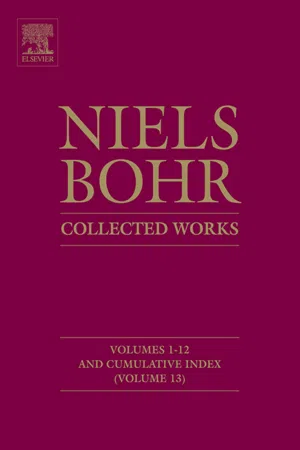
The Niels Bohr Collected Works are now complete with the publication of Volume 12, Popularization and People (1911-1962).Niels Bohr is generally regarded as one of the most influential physicists of the twentieth century. The following are only some of the high points. In 1913, Bohr proposed a revolutionary model of the atom breaking with classical conceptions of physics. In 1921, he established the Institute for Theoretical Physics at the University of Copenhagen, which became the centre for the new physics visited by the younger generation of physicists from all over the world. From 1927, he oversaw the development leading to the "Copenhagen interpretation" of quantum mechanics which for Bohr formed the foundation for an epistemology valid beyond physics based on Bohr's complementarity concept. In 1939, he explained the mechanism of nuclear fission. Finally, from 1943 until the end of his life in 1962, he carried out a personal political mission to establish an open world between nations which he considered to be necessary in view of the existence of the atomic bomb.All these contributions are amply documented in the earlier volumes of the Niels Bohr Collected Works. This last volume documents Niels Bohr as a person and his efforts to explain quantum physics and its implications to physicists and non-physicists alike. While his activity over many years in the area of superconductivity illustrates his striving for synthesis in physics, his encyclopaedia articles and radio speech for Scandinavian gymnasium students document his effort to make quantum physics and its implications understandable to the general public. The bulk of the volume comprises Bohr's many published writings about his predecessors (for example Isaac Newton), teachers and colleagues (for example Ernest Rutherford and Albert Einstein), family and friends. These writings, which include several rare pieces of autobiogaphy, bring new perspectives to Bohr's life and document his substantial social network, both internationally and within his beloved Denmark.In addition to Bohr's publications reproduced in Parts I and II, the volume includes a more brief Part III with selected correspondence, as well as an inventory of relevant manuscripts. It concludes with a bibliography of Bohr's many publications, chronologically arranged with references to where they can be found in the various volumes of the Collected Works. The volume is illustrated with many new photographs.* Niels Bohr * Collected Works * Archival Documents * Original Photographs
Information
Topic
PhilosophiePART I
Overview and Popularization
Introduction
Finn Aaserud
A major driving force behind Niels Bohr’s long career in theoretical physics was his striving for overview and unity in his own field as well as in its broader philosophical and practical implications. This disposition played a crucial role in Bohr’s success as a teacher and inspirer of generations of physicists. It is expressed in several of his publications, most of which are reproduced in earlier volumes of the Niels Bohr Collected Works, notably in Volumes 6, 7 and 10, and in Part 2 of Volume 11. Bohr’s striving for synthesis may serve as a common denominator for the remainder of Bohr’s publications, which are reproduced in this last volume of his Collected Works. The striving is especially evident in the publications presented here directed to fellow physicists, the general public and gymnasium students.
1 ELECTRON THEORY AND SUPERCONDUCTIVITY
The first four writings reproduced below – the only known book review by Bohr, which dates from 1915, an unpublished set of proofs, a manuscript and a published discussion contribution at a conference – were directed to physicists. The first item reviews a book-length account of the electron theory of matter – the subject of Bohr’s 1911 doctor’s thesis – while the others discuss the phenomenon of superconductivity, which was discovered in 1911 and which refers to the ability of certain metals at temperatures close to absolute zero to conduct electricity without resistance.1
The review concerns “The Electron Theory of Matter”, a book written by Bohr’s esteemed colleague and senior by six years, Owen Richardson.2 It was based on a series of lectures for graduate students at Princeton University, where Richardson taught from 1906 to 1913, before he returned to King’s College, London, to take up a professorship there. Bohr liked the book. He wrote to his brother Harald, “I have been busy reading an excellent book by Richardson which I am to review in ‘Nature’. It is a text book on the entire electron theory. I am learning much from it, and I am looking forward to studying some parts of it more closely.”
Bohr used the opportunity of the review to express his view on the state of theoretical physics more broadly. Only a few years earlier, Bohr wrote, classical electromagnetic theory had been thought to constitute “a final accomplishment of ordinary mechanics, and there appeared to be no limit to the application of the general principles of the theory.”3 Now the situation had changed completely:
“If at present we may speak of a programme for the future development, it would, perhaps, be to examine the constitution of the special atomic systems actually existing, and then, by means of the directly observable properties of matter, possibly to deduce the general principles. If so, the evolution would be exactly the reverse of that anticipated.”
Half a decade later Bohr would establish his institute in Copenhagen on the basis of precisely such an experiment-driven conception of theoretical physics.
Although Richardson mentioned superconductivity,4 Bohr did not refer to it in his review. Nevertheless, as it was directly related to the problems Bohr had discussed in his 1911 doctor’s thesis, there can be no doubt that the discovery had caught Bohr’s attention. Indeed, a manuscript reproduced in the Bohr Collected Works shows that he touched upon the phenomenon in a lecture at the University of Copenhagen in 1914.5 The understanding of superconductivity became a lifelong challenge to Bohr, even though his only publication on the subject is a brief discussion contribution at a conference at Leiden University in June 1953 in memory of the Dutch physicists Hendrik Antoon Lorentz, a pioneer in the electron theory of metals, and Heike Kamerlingh Onnes, who discovered superconductivity.6 Bohr’s publication, however, has a long prehistory.
A quantum theory of the electric conductivity of metals was developed by Felix Bloch in 1928 at Werner Heisenberg’s institute in Leipzig. Bloch based the theory on his recognition that individual electrons can propagate freely through a perfectly periodic lattice. It turned out, however, that the complete disappearance of resistance at low temperatures could not be explained on this basis. Thus a major riddle remained.
During his half-year long stay in Copenhagen from October 1931 Bohr stimulated Bloch to take up a problem concerning atomic collisions in the penetration of charged particles through matter. This was a major theme for Bohr throughout his career. Although being new to the field, Bloch was able to solve the problem to Bohr’s great satisfaction. Looking back more than thirty years later, Bloch recalled that this influence from Bohr induced him to become “more interested in the basic phenomena underlying some problem than just in producing resu...
Table of contents
- Cover image
- Title page
- Table of Contents
- Copyright page
- Foreword
- The Volumes of the Niels Bohr Collected Works
- Abbreviated Titles of Periodicals
- Other Abbreviations
- Acknowledgements
- Part I: Overview and Popularization
- Part II: People
- Part III: Selected Correspondence
- Inventory of Relevant Manuscripts in the Niels Bohr Archive
- Bibliography of Niels Bohr's Publications Reproduced in the Collected Works
- Index
Trusted by 375,005 students
Access to over 1.5 million titles for a fair monthly price.
Study more efficiently using our study tools.
Frequently asked questions
Yes, you can cancel anytime from the Subscription tab in your account settings on the Perlego website. Your subscription will stay active until the end of your current billing period. Learn how to cancel your subscription
No, books cannot be downloaded as external files, such as PDFs, for use outside of Perlego. However, you can download books within the Perlego app for offline reading on mobile or tablet. Learn how to download books offline
Perlego offers two plans: Essential and Complete
- Essential is ideal for learners and professionals who enjoy exploring a wide range of subjects. Access the Essential Library with 800,000+ trusted titles and best-sellers across business, personal growth, and the humanities. Includes unlimited reading time and Standard Read Aloud voice.
- Complete: Perfect for advanced learners and researchers needing full, unrestricted access. Unlock 1.5M+ books across hundreds of subjects, including academic and specialized titles. The Complete Plan also includes advanced features like Premium Read Aloud and Research Assistant.
We are an online textbook subscription service, where you can get access to an entire online library for less than the price of a single book per month. With over 1.5 million books across 990+ topics, we’ve got you covered! Learn about our mission
Look out for the read-aloud symbol on your next book to see if you can listen to it. The read-aloud tool reads text aloud for you, highlighting the text as it is being read. You can pause it, speed it up and slow it down. Learn more about Read Aloud
Yes! You can use the Perlego app on both iOS and Android devices to read anytime, anywhere — even offline. Perfect for commutes or when you’re on the go.
Please note we cannot support devices running on iOS 13 and Android 7 or earlier. Learn more about using the app
Please note we cannot support devices running on iOS 13 and Android 7 or earlier. Learn more about using the app
Yes, you can access Popularization and People (1911-1962) by in PDF and/or ePUB format, as well as other popular books in Philosophie & Philosophie et éthique en sciences. We have over 1.5 million books available in our catalogue for you to explore.