- 576 pages
- English
- ePUB (mobile friendly)
- Available on iOS & Android
eBook - ePub
About this book
Post harvest biology and technology of citrus fruits is gaining importance as the therapeutic value of citrus fruits is realized and supported by the increase in health awareness among the general public.This book is the most comprehensive reference on citrus fruit biology, biotechnology and quality. Basic and applied scientific information is interwoven to serve the researcher, marketer, scientist, nutritionist, or dietician. With discussions of fruit morphology, anatomy, physiology and biochemistry and chapters on growth phases, maturity standards, grades and physical and mechanical characteristics of citrus trees, this book provides the foundation for understanding growth, harvest and post harvest aspects of these important plants. Insect-pests and diseases, irrigation, nutrition and rootstocks are also addressed.
- Provides practical tips for post harvest management
- Includes all aspects of citrus fruit biology, technology and quality evaluation
- Discusses biotechnological applications and potential fresh citrus fruit quality improvement
- Evaluates medicinal and therapeutic applications and recent clinical findings
- Exhaustive glossary included
Information
Topic
CommerceSubtopic
Agrobusiness1
INTRODUCTION
Publisher Summary
This chapter describes citrus fruit production and prospects in the postharvest context. Efforts are continuing worldwide to develop methods, technologies, and gadgets to preserve the quality of freshly harvested citrus fruit while it is taken from orchard to market shelves at distant places. For postharvest technologies to be effective, trials and evaluations are necessary on a commercial scale. Successful fruit-quality management requires a combined effort from producers, marketing and handling personnel, transporters, and researchers. Sustainable and increased citrus production is possible with sound postharvest management and marketing. Grade standards, international quality criteria, packaging needs, food safety norms, and sanitary and phytosanitary requirements have acquired greater significance in the post-WTO scenario. These challenges need to be met for the healthy growth of the international fresh citrus fruit trade.
I CITRUS FRUIT PRODUCTION AND PROSPECTS
The role of citrus fruits in providing nutrients and medicinal value has been recognized since ancient times. Citrus fruits, belonging to the genus Citrus of the family Rutaceae, are well known for their refreshing fragrance, thirst-quenching ability, and providing adequate vitamin C as per recommended dietary allowance (RDA). In addition to ascorbic acid, these fruits contain several phytochemicals, which play the role of neutraceuticals, such as carotenoids (lycopene and β-carotene), limonoids, flavanones (naringins and rutinoside), and vitamin-B complex and related nutrients (thiamine, riboflavin, nicotinic acid/niacin, pantothenic acid, pyridoxine, folic acid, biotin, choline, and inositol). The flavonoids from citrus juices, particularly those from oranges and grapefruit, are effective in improving blood circulation and possess antiallergic, anticarcinogenic, and antiviral properties (Filatova and Kolesnova, 1999). Fresh grapefruits, pummelos, and oranges also provide fiber and pectin, which are known to reduce the risk of heart attacks if taken daily in the diet. Fresh citrus fruit consumption is important because the nutrients and health-promoting factors (especially antioxidants) from these sources are immediately available to the body and the loss of nutrients is negligible compared with processed juices.
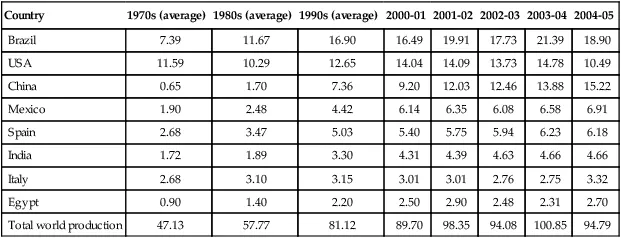
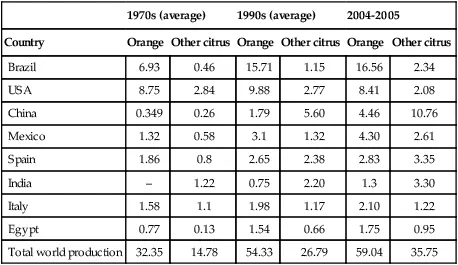
Citrus is the most widely produced fruit, as a group of several species, and it is grown in more than 80 countries (Chang, 1992). Citrus cultivation not only is remunerative, but it also generates employment, and as stated previously, fruits have nutritive and therapeutic value. Citrus stands first among fruit crops in the world with respect to production leaving behind grapes, apples, and banana. World citrus production increased at the rate of 4.5 percent every year during the 1990s, which resulted in an output of 98.35 million tons during 2001–02, and that figure crossed the 100 million tons mark during 2003–04 (FAO, 2006). Almost half of this production was in the Americas (North and South), and about 10–12 percent was in Europe (Mediterranean). Production trends indicate that oranges constitute about 60 percent of the total citrus output, followed by mandarins, clementines, satsumas, and tangerines, which comprise about 20 percent of the output. The group of lemons and limes constitute 11–12 percent, and grapefruit and pummelos comprise roughly 5–6 percent. Since the 1970s production increased and doubled by 2004–05, and this increase was mainly due to increased orange production (Tables 1.1 and 1.2). Nearly 68.16 million tons of citrus fruits have been consumed as fresh produce (either domestically or by exports), while 26.63 million tons were utilized for processing out of 94.79 million total tons produced worldwide during 2004–05 (FAO, 2006). This trend clearly indicates importance of preserving the natural qualities of fresh citrus fruits after harvest for either domestic markets or export. World population is slated to be nearly 10 billion by 2050, therefore, projected citrus production has to increase at a suitable growth rate to meet this increasing demand.
TABLE 1.1
Citrus Output of Some Major Producing Countries and the World (million tons)
| Country | 1970s (average) | 1980s (average) | 1990s (average) | 2000-01 | 2001-02 | 2002-03 | 2003-04 | 2004-05 |
| Brazil | 7.39 | 11.67 | 16.90 | 16.49 | 19.91 | 17.73 | 21.39 | 18.90 |
| USA | 11.59 | 10.29 | 12.65 | 14.04 | 14.09 | 13.73 | 14.78 | 10.49 |
| China | 0.65 | 1.70 | 7.36 | 9.20 | 12.03 | 12.46 | 13.88 | 15.22 |
| Mexico | 1.90 | 2.48 | 4.42 | 6.14 | 6.35 | 6.08 | 6.58 | 6.91 |
| Spain | 2.68 | 3.47 | 5.03 | 5.40 | 5.75 | 5.94 | 6.23 | 6.18 |
| India | 1.72 | 1.89 | 3.30 | 4.31 | 4.39 | 4.63 | 4.66 | 4.66 |
| Italy | 2.68 | 3.10 | 3.15 | 3.01 | 3.01 | 2.76 | 2.75 | 3.32 |
| Egypt | 0.90 | 1.40 | 2.20 | 2.50 | 2.90 | 2.48 | 2.31 | 2.70 |
| Total world production | 47.13 | 57.77 | 81.12 | 89.70 | 98.35 | 94.08 | 100.85 | 94.79 |
Source: FAO (2003), FAO (2006).
TABLE 1.2
Sweet Orange Production Vis-à-Vis Other Citrus Produced in Major Citrus Growing Countries of the World (million tons)
| 1970s (average) | 1990s (average) | 2004-2005 | ||||
| Country | Orange | Other citrus | Orange | Other citrus | Orange | Other citrus |
| Brazil | 6.93 | 0.46 | 15.71 | 1.15 | 16.56 | 2.34 |
| USA | 8.75 | 2.84 | 9.88 | 2.77 | 8.41 | 2.08 |
| China | 0.349 | 0.26 | 1.79 | 5.60 | 4.46 | 10.76 |
| Mexico | 1.32 | 0.58 | 3.1 | 1.32 | 4.30 | 2.61 |
| Spain | 1.86 | 0.8 | 2.65 | 2.38 | 2.83 | 3.35 |
| India | – | 1.22 | 0.75 | 2.20 | 1.3 | 3.30 |
| Italy | 1.58 | 1.1 | 1.98 | 1.17 | 2.10 | 1.22 |
| Egypt | 0.77 | 0.13 | 1.54 | 0.66 | 1.75 | 0.95 |
| Total world production | 32.35 | 14.78 | 54.33 | 26.79 | 59.04 | 35.75 |
Source: FAO (2003), FAO (2006).
Brazil leads in citrus production, with more than 18.90 million metric tons of fruit produced during 2004–05, followed by the United States and China. Brazilian citrus production is oriented toward processing, while U.S. citrus production is focused toward processing and the fresh fruit market. China’s citrus production is growing steadily, with 1.3 million ha under citrus in 2001 (Xin, 2001) and new plantations yet to bear fruit. Total citrus prod...
Table of contents
- Cover image
- Title page
- Table of Contents
- PREFACE
- ACKNOWLEDGMENTS
- Chapter 1: INTRODUCTION
- Chapter 2: COMMERCIAL FRESH CITRUS CULTIVARS AND PRODUCING COUNTRIES
- Chapter 3: POSTHARVEST LOSSES
- Chapter 4: PREHARVEST FACTORS AFFECTING FRUIT QUALITY AND POSTHARVEST LIFE
- Chapter 5: FRUIT MORPHOLOGY, ANATOMY, AND PHYSIOLOGY
- Chapter 6: FRUIT BIOCHEMISTRY
- Chapter 7: GROWTH, MATURITY, GRADE STANDARDS, AND PHYSICO-MECHANICAL CHARACTERISTICS OF FRUIT
- Chapter 8: HARVESTING
- Chapter 9: PREPARATION FOR FRESH FRUIT MARKET
- Chapter 10: PACKAGING
- Chapter 11: PRECOOLING AND REFRIGERATION
- Chapter 12: STORAGE SYSTEMS AND RESPONSE OF CITRUS FRUITS
- Chapter 13: TRANSPORTATION
- Chapter 14: MARKETING AND DISTRIBUTION
- Chapter 15: IRRADIATION
- Chapter 16: POSTHARVEST DISEASES AND THEIR MANAGEMENT
- Chapter 17: PHYSIOLOGICAL DISORDERS AND THEIR MANAGEMENT
- Chapter 18: POSTHARVEST TREATMENTS FOR INSECT CONTROL
- Chapter 19: FRUIT QUALITY CONTROL, EVALUATION, AND ANALYSIS
- Chapter 20: NUTRITIVE AND MEDICINAL VALUE OF CITRUS FRUITS
- Chapter 21: BIOTECHNOLOGICAL APPLICATIONS IN FRESH CITRUS FRUIT
- Chapter 22: WORLD FRESH CITRUS TRADE AND QUARANTINE ISSUES
- ANNEXURE I
- ANNEXURE II
- GLOSSARY
- INDEX
Trusted by 375,005 students
Access to over 1.5 million titles for a fair monthly price.
Study more efficiently using our study tools.
Frequently asked questions
Yes, you can cancel anytime from the Subscription tab in your account settings on the Perlego website. Your subscription will stay active until the end of your current billing period. Learn how to cancel your subscription
No, books cannot be downloaded as external files, such as PDFs, for use outside of Perlego. However, you can download books within the Perlego app for offline reading on mobile or tablet. Learn how to download books offline
Perlego offers two plans: Essential and Complete
- Essential is ideal for learners and professionals who enjoy exploring a wide range of subjects. Access the Essential Library with 800,000+ trusted titles and best-sellers across business, personal growth, and the humanities. Includes unlimited reading time and Standard Read Aloud voice.
- Complete: Perfect for advanced learners and researchers needing full, unrestricted access. Unlock 1.5M+ books across hundreds of subjects, including academic and specialized titles. The Complete Plan also includes advanced features like Premium Read Aloud and Research Assistant.
We are an online textbook subscription service, where you can get access to an entire online library for less than the price of a single book per month. With over 1.5 million books across 990+ topics, we’ve got you covered! Learn about our mission
Look out for the read-aloud symbol on your next book to see if you can listen to it. The read-aloud tool reads text aloud for you, highlighting the text as it is being read. You can pause it, speed it up and slow it down. Learn more about Read Aloud
Yes! You can use the Perlego app on both iOS and Android devices to read anytime, anywhere — even offline. Perfect for commutes or when you’re on the go.
Please note we cannot support devices running on iOS 13 and Android 7 or earlier. Learn more about using the app
Please note we cannot support devices running on iOS 13 and Android 7 or earlier. Learn more about using the app
Yes, you can access Citrus Fruit by Milind Ladaniya,Milind Ladanyia in PDF and/or ePUB format, as well as other popular books in Commerce & Agrobusiness. We have over 1.5 million books available in our catalogue for you to explore.