eBook - ePub
Models for Planning Wildlife Conservation in Large Landscapes
- 720 pages
- English
- ePUB (mobile friendly)
- Available on iOS & Android
eBook - ePub
Models for Planning Wildlife Conservation in Large Landscapes
About this book
A single-resource volume of information on the most current and effective techniques of wildlife modeling, Models for Planning Wildlife Conservation in Large Landscapes is appropriate for students and researchers alike. The unique blend of conceptual, methodological, and application chapters discusses research, applications and concepts of modeling and presents new ideas and strategies for wildlife habitat models used in conservation planning. The book makes important contributions to wildlife conservation of animals in several ways: (1) it highlights historical and contemporary advancements in the development of wildlife habitat models and their implementation in conservation planning; (2) it provides practical advice for the ecologist conducting such studies; and (3) it supplies directions for future research including new strategies for successful studies.Intended to provide a recipe for successful development of wildlife habitat models and their implementation in conservation planning, the book could be used in studying wildlife habitat models, conservation planning, and management techniques. Additionally it may be a supplemental text in courses dealing with quantitative assessment of wildlife populations. Additionally, the length of the book would be ideal for graduate student seminar course.Using wildlife habitat models in conservation planning is of considerable interest to wildlife biologists. With ever tightening budgets for wildlife research and planning activities, there is a growing need to use computer methods. Use of simulation models represents the single best alternative. However, it is imperative that these techniques be described in a single source. Moreover, biologists should be made aware of alternative modeling techniques. It is also important that practical guidance be provided to biologists along with a demonstration of utility of these procedures. Currently there is little guidance in the wildlife or natural resource planning literature on how best to incorporate wildlife planning activities, particularly community-based approaches. Now is the perfect time for a synthestic publication that clearly outlines the concepts and available methods, and illustrates them.
- Only single resource book of information not only on various wildlife modeling techniques, but also with practical guidance on the demonstrated utility of each based on real-world conditions.
- Provides concepts, methods and applications for wildlife ecologists and others within a GIS context.
- Written by a team of subject-area experts
Information
Topic
Scienze biologicheSubtopic
BiologiaChapter 1
General Principles for Developing Landscape Models for Wildlife Conservation
Joshua J. Millspaugh, Robert A. Gitzen, David R. Larsen, Michael A. Larson and Frank R. Thompson III.
Models are abstract descriptions of systems or processes (Starfield and Bleloch 1991, Haefner 1996). In other words, a model is a formal framework for organizing and synthesizing existing knowledge about an ecological system. Models have become pervasive tools in natural resources management, large-scale planning, and landscape ecology (Shenk and Franklin 2001, Scott et al. 2002). Models help address fundamental questions about wildlife habitat relationships and habitat management. For example, models are useful for evaluating the potential impacts of management alternatives (Morrison et al. 1998, Larson et al. 2004, Shifley et al. 2006), predicting species occurrence (Scott et al. 2002), and assessing economic implications of management decisions (Haight and Gobster, this volume).
Landscape models take many forms, including statistical models that quantify relationships and patterns among variables (e.g., Niemuth et al., this volume; Hepinstall et al., this volume), conceptual models that offer a qualitative construct of a system, and simulation models that project landscape features into the future (e.g., He, this volume; Oliver et al., this volume). Landscape models can produce output that is as difficult to analyze and understand as data from the original system. For examining and presenting the results from landscape simulation models, ecologists need tools that facilitate interpretation of complex multivariate patterns (Shifley et al., this volume). For this reason, visualization tools are often used with landscape models because they make complex data easier to understand (McGaughey 1997, 1999).
Because of the usefulness and widespread application of models, researchers and decision makers should be well informed about potential strengths and limitations of these models. Here, we review principles underlying the construction and use of models, with an emphasis on their application to large-scale wildlife conservation planning. In addition to outlining general principles of modeling, we offer advice about using models in an adaptive management framework, addressing uncertainty, and making models useful and transparent. We also encourage a focus on viability and population objectives (Johnson et al., this volume) in modeling and we present a broadened concept of viability for species of conservation concern and game species as an important measure in understanding wildlife response in large landscapes. To communicate results from landscape models, we need tools for visualizing these results. Therefore, we end the chapter by briefly discussing some basic theory, dangers, and utility of visualization software. We refer readers to other relevant papers and books, such as Box (1979), Starfield and Bleloch (1991), Hilborn and Mangel (1997), Starfield (1997), Williams et al. (2002), Shenk and Franklin (2001), and Scott et al. (2002), that further discuss philosophical considerations of modeling in natural resources.
Uses of Models
Modeling has become widespread in natural resources management because models can be incredibly useful and practical tools. Johnson (2001) defined three categories of purposes for models: explanation, prediction, and decision making.
1 Explanatory models are used to describe or decipher the workings of systems. Such models attempt to identify the mechanisms involved in the system.
2 Predictive models are used to forecast future states of systems or results of management actions. Prediction is a common use of landscape models and allows the user to determine the potential impacts of various proposed management actions (e.g., Shifley et al. 2006). The opportunity to ask “what if?” questions is especially attractive to natural resource managers.
3 Decision-support models are used to identify management strategies that will produce desired results. Optimization techniques are one useful example of decision-support models used in planning resource management (Moore et al. 2000).
A given model may be used for more than one purpose. For example, habitat suitability models may be used to investigate the relative importance of key habitat characteristics and simultaneously predict future habitat suitability. Many of the habitat suitability and population models discussed in this book and elsewhere are decision-support models that allow managers to assess the relative trade-offs of management actions.
Philosophy of Modeling
In this section, we summarize general principles that modelers and end users should consider when working with models, regardless of the model purpose. We re-emphasize points frequently made in introductions to modeling, especially Starfield (1997).
Every Biologist Constructs Models
Some biologists view modeling as a mathematical art of little relevance to real-world management problems. However, every biologist constructs models. Every scientist and manager has an intellectual framework of hypotheses about how his or her focal system is organized, what factors drive changes in key resources, how the system will respond to management actions, and what the major uncertainties and holes are in this framework. Whether these scientists and managers admit it, this framework is the basis for a conceptual model that can be translated easily into narratives, diagrams, pictures, equations, and even computer programs (i.e., into quantitative models).
There are multiple potential purposes for formalizing one’s intellectual framework into a model, whether conceptual or quantitative. Regardless of whether one constructs a landscape simulation model or draws a diagram on the back of a napkin, constructing a model forces biologists to confront their assumptions about the system and the support for these assumptions. It prompts them to consider the most critical uncertainties inhibiting scientists and managers from better understanding the system. It can act as a framework for integrating new information and is a tool for more rigorous thought about the system (White 2001). Finally, it forces the biologists to expose hypotheses and assumptions to critiques from others. In the case of complex, high-profile management decisions, a manager may be unable to recommend and defend (perhaps in court) a course of action without well-developed quantitative models (Swartzman 1996, Starfield 1997, Walters and Martell 2004:3–4).
Models Are Useful Despite a Lack of Data or Understanding
As frameworks for the organization and synthesis of existing information, “all models are wrong, but some are useful” (Box 1979). Ultimately, we seek a sophisticated, accurate understanding of natural systems, precise estimates of important parameters and their dynamics, and good knowledge about the specific effects of various management alternatives. In such an optimal situation, we might have at least moderate confidence in model predictions, even though there is still significant uncertainty. For example, even biologists who are skeptical about most models are comfortable using predictive results in this situation (e.g., daily weather forecasts produced from atmospheric models) despite knowing that such forecasts are often inaccurate.
However, in wildlife habitat modeling, we usually possess limited data and an incomplete understanding of the system (Holling 1978; Fig. 1-1). Models can be especially useful tools for decision making and for prioritizing efforts to address these gaps in our understanding. The argument that modeling should not be used unless data are adequate is just as misguided as arguing that no new management actions should be tried unless we completely understand the system and can predict the specific effects with high certainty. Managers have to act in the face of uncertainty; models help them make as defensible a choice as is currently feasible. Similarly, researchers have to justify why they are proposing studies of a particular aspect of the resource. Model building helps us evaluate the relative importance of various influences on a system and identify data that should be collected (Starfield 1997; Shifley et al., this volume).
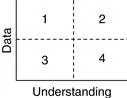
Fig. 1-1 A classification of modeling from Holling (1978). The x-axis represents understanding of a system (from limited to complete), and the y-axis represents the quality and quantity of data (from incomplete to adequate) that are available for use in model-building. Ecological models typically are based on limited data and incomplete understanding of systems, and thus fall in region 3 (Starfield and Bleloch 1991).
Models Should Be Constructed for Specific Purposes
A model can be seen as a structural framework for our current knowledge and as a tool for exploring uncertainties in our knowledge. To create a useful framework or tool, we need clear, specific objectives for the modeling effort. The purpose of the model should determine its structure; scope, resolution, and complexity; its user interface and output; and how it is evaluated (Starfield 1997, Nichols 2001, Kettenring et al. 2006).
In defining the purpose for the model, we should address multiple issues:
1 Who are the intended end users of the model? What are the technical skill levels of these end users?
2 How will the model be used: for evaluating management alternatives, determining high priorities for future research, communicating what we know to other stakeholders, or simply clarifying for our own benefit what we know and need to learn about the system?
3 What spatial and temporal context do we want to explore? For example, do we care about breeding season patterns only, modeling short-term forecasts or long-term dynamics, a specific management area or an ecological province?
4 How will the model be evaluated?
5 Are we building the model for long-term use? How will it be updated as our understanding of the system improves?
Predicting the Future Is a Lofty Goal
Ecological systems are driven by factors with high variability and unpredictability, and observed ecological patterns are shaped partially by random processes (e.g., Hubbell 2001, Fuentes et al. 2006). Modeling experts understand that even the best model rarely can accurately forecast the future condition of natural systems (e.g., Boyce 2001, White 2001, Walters and Martell 2004:10–11), except sometimes over short time spans. In the face of this variability, the predictive value of models usually comes not in forecasting the expected future condition of a resource, but in projecting a range of potential conditions given the likelihood of different stochastic events (Clark and Schmitz 2001). However, with increasing time, previously undocumented events or misunderstood processes are likely to move the system beyond a range of variability predictable from our current knowledge (but see Brook et al. 2000).
Ther...
Table of contents
- Cover image
- Title page
- Table of Contents
- Copyright
- Foreword
- Preface
- List of Contributors
- List of Reviewers
- Chapter 1. General Principles for Developing Landscape Models for Wildlife Conservation
- Chapter 2. Application of Population Viability Analysis to Landscape Conservation Planning
- Chapter 3. Multispecies Conservation Planning on U.S. Federal Lands
- Chapter 4. Geographic Approaches to Biodiversity Conservation: Implications of Scale and Error to Landscape Planning
- Chapter 5. Social and Economic Considerations for Planning Wildlife Conservation in Large Landscapes
- Chapter 6. Landscape Considerations for Conservation Planning on Private Lands
- Chapter 7. A Multiscale, Stepwise Approximation Approach for Wildlife Conservation Assessment and Planning
- Chapter 8. An Emerging Agency-Based Approach to Conserving Populations Through Strategic Habitat Conservation
- Chapter 9. A Review of Methods for Quantifying Wildlife Habitat in Large Landscapes
- Chapter 10. Wildlife Habitat-Relationships Models: Description and Evaluation of Existing Frameworks
- Chapter 11. Lessons Learned from Using GIS to Model Landscape-Level Wildlife Habitat
- Chapter 12. A Review of LANDIS and Other Forest Landscape Models for Integration with Wildlife Models
- Chapter 13. Simulating Landscape Change Using the Landscape Management System
- Chapter 14. Development and Application of Habitat Suitability Models to Large Landscapes
- Chapter 15. Modeling Understory Vegetation and Its Response to Fire
- Chapter 16. Validation of Landscape-Scale Decision Support Models That Predict Vegetation and Wildlife Dynamics
- Chapter 17. Methods for Determining Viability of Wildlife Populations in Large Landscapes
- Chapter 18. Dynamic Landscape Metapopulation Models and Sustainable Forest Management
- Chapter 19. Habitat Networks for Terrestrial Wildlife: Concepts and Case Studies
- Chapter 20. Landscape-Level Planning for Conservation of Wetland Birds in the U.S. Prairie Pothole Region
- Chapter 21. Plum Creek’s Central Cascades Habitat Conservation Plan and Modeling for the Northern Spotted Owl
- Chapter 22. Application of Models to Conservation Planning for Terrestrial Birds in North America
- Chapter 23. Modeling Bird Responses to Predicted Changes in Land Cover in an Urbanizing Region
- Chapter 24. A Decision Framework for Choosing Models in Large-Scale Wildlife Conservation Planning
- Index
Trusted by 375,005 students
Access to over 1.5 million titles for a fair monthly price.
Study more efficiently using our study tools.
Frequently asked questions
Yes, you can cancel anytime from the Subscription tab in your account settings on the Perlego website. Your subscription will stay active until the end of your current billing period. Learn how to cancel your subscription
No, books cannot be downloaded as external files, such as PDFs, for use outside of Perlego. However, you can download books within the Perlego app for offline reading on mobile or tablet. Learn how to download books offline
Perlego offers two plans: Essential and Complete
- Essential is ideal for learners and professionals who enjoy exploring a wide range of subjects. Access the Essential Library with 800,000+ trusted titles and best-sellers across business, personal growth, and the humanities. Includes unlimited reading time and Standard Read Aloud voice.
- Complete: Perfect for advanced learners and researchers needing full, unrestricted access. Unlock 1.5M+ books across hundreds of subjects, including academic and specialized titles. The Complete Plan also includes advanced features like Premium Read Aloud and Research Assistant.
We are an online textbook subscription service, where you can get access to an entire online library for less than the price of a single book per month. With over 1.5 million books across 990+ topics, we’ve got you covered! Learn about our mission
Look out for the read-aloud symbol on your next book to see if you can listen to it. The read-aloud tool reads text aloud for you, highlighting the text as it is being read. You can pause it, speed it up and slow it down. Learn more about Read Aloud
Yes! You can use the Perlego app on both iOS and Android devices to read anytime, anywhere — even offline. Perfect for commutes or when you’re on the go.
Please note we cannot support devices running on iOS 13 and Android 7 or earlier. Learn more about using the app
Please note we cannot support devices running on iOS 13 and Android 7 or earlier. Learn more about using the app
Yes, you can access Models for Planning Wildlife Conservation in Large Landscapes by Joshua Millspaugh,Frank R. Thompson in PDF and/or ePUB format, as well as other popular books in Scienze biologiche & Biologia. We have over 1.5 million books available in our catalogue for you to explore.