- 328 pages
- English
- ePUB (mobile friendly)
- Available on iOS & Android
eBook - ePub
Analysis and Design Principles of MEMS Devices
About this book
Sensors and actuators are now part of our everyday life and appear in many appliances, such as cars, vending machines and washing machines. MEMS (Micro Electro Mechanical Systems) are micro systems consisting of micro mechanical sensors, actuators and micro electronic circuits. A variety of MEMS devices have been developed and many mass produced, but the information on these is widely dispersed in the literature. This book presents the analysis and design principles of MEMS devices. The information is comprehensive, focusing on microdynamics, such as the mechanics of beam and diaphragm structures, air damping and its effect on the motion of mechanical structures. Using practical examples, the author examines problems associated with analysis and design, and solutions are included at the back of the book. The ideal advanced level textbook for graduates, Analysis and Design Principles of MEMS Devices is a suitable source of reference for researchers and engineers in the field.
- Presents the analysis and design principles of MEMS devices more systematically than ever before
- Includes the theories essential for the analysis and design of MEMS includes the dynamics of micro mechanical structures
- A problem section is included at the end of each chapter with answers provided at the end of the book
Information
Subtopic
Industrial EngineeringChapter 1
Introduction to MEMS Devices
MEMS, the acronym of “Micro Electro Mechanical Systems”, are generally considered as micro systems consisting of micro mechanical sensors, actuators and micro electronic circuits. As microelectronics is a well-developed technology, the research and development of MEMS is concentrated on the research and development of micro mechanical sensors and actuators, or micro mechanical transducers. Or, we can say that micro mechanical sensors and actuators are the basic devices for MEMS (Note that the word “transducer” is often used as a synonym of “sensor”. However, it is sometimes read as “sensors and actuators”.) Therefore, this book studies the analysis and design principles of the basic devices of MEMS, the micro mechanical sensors and actuators (or the micro mechanical transducers).
Before we can study the fundamental theories of micro mechanical transducers, readers are expected to have some basic knowledge on micro transducers. This chapter is to give the readers some material to get familiar with some important MEMS devices.
Generally, the scope of MEMS devices is very broad. As MEMS devices are the offspring of microelectronics and micro mechanical technologies, the most important MEMS devices are sensors using piezoresistive, capacitive and vibration sensing schemes, and the actuators using electrostatic driving. This introduction and the theories studied in the following chapters will be restricted in these respects.
It is assumed that the readers have had enough knowledge on microelectronics and micro machining technologies so that they can understand the schematic drawings of the device structures and the processing steps for the devices in this chapter.
For those who do not have enough knowledge on microelectronics and micro mechanical technologies, reading of relevant material [1,2,3] prior to this study is advisable. On the contrary, for those who are quite familiar with MEMS devices already, they may skip this chapter and proceed to Chapter 2 directly.
§1.1 Piezoresistive Pressure Sensor
§1.1.1 Piezoresistance Effect
(1) Metal Strain Gauge
The metal strain gauge was discovered long before the discovery of the piezoresistance effect in semiconductors and has still been widely used for mechanical transducers in industries. Due to the affinity between metal strain gauge sensors and piezoresistive sensors, the metal strain gauge is first briefly introduced in this section.
Consider a metal filament with a circular cross section. If the radius of the cross section is r, the length of the filament is l and the resistivity of the material is ρ, the resistance of the filament is R=ρl/πr2. If the filament is stretched by an external force F, the stress in the filament is T=F/πr2 and the strain (the relative elongation) in the filament is ε≡ Δl/l=T/E, where E is the Young’s Modulus of the material. As metal is usually a polycrystalline material with a fine grain structure, its mechanical and electrical properties are isotropic. Thus, the relative change in resistance caused by the force is

As well known in mechanics, the longitudinal stretch of a filament is always accompanied with it a lateral contraction, i.e. Δr/r = −v(Δl/l), where v is the Poisson ratio of the material. For most materials, vhas a value of about 0.3. Thus we have

Usually, the relative change of resistivity, Δρ/ρ, is a function of stress/strain and is expressed as πT = πEε, where π is the piezoresistive coefficient of the material. Therefore, we have

where G, the relative change in resistance per unit strain, is referred to as the gauge factor, or, G factor, of the filament.
As π is negligible for metal materials, the gauge factor is just a little larger than unity, i.e., G ≈ 1 + 2v = 1.5 ∼ 2.0. As the maximum strain of the gauge is in the order of 10−3, the relative change of the resistance is also in the order of 10−3.
(2) Strain Gauge Sensors
Strain gauges can be made of metal foil as well as metal wire. Fig. 1.1.1(a) and (b) schematically show a force sensor using four metal foil strain gauges as sensing elements. The strain gauges R1 ∼ R4 are glue-bonded onto the metal beam supported by a metal cylinder. The strain gauges are interconnected into a Wheatstone bridge as shown in Figure 1.1.1(c). As the output of the bridge, ΔV, is proportional to the force F, a force sensor is formed.
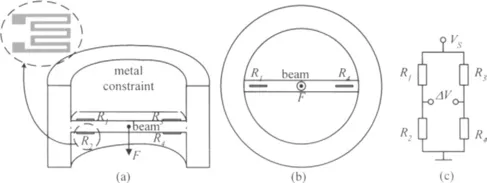
Fig. 1.1.1 A strain gauge force sensor (a) cross-sectional view (insert: the serpentine pattern of a metal foil strain gauge); (b) top-view; (c) Wheatstone bridge
As the strain gauges are bonded onto the mechanical structure that is fabricated by conventional machining technique, the strain gauge force sensor is referred to as a conventional mechanical sensor.
(3) Piezoresistance Effect
S. C. Smith discovered in 1954 that the change in resistance of a strained (or stressed) germanium or silicon filament was much larger than that of a metal strain gauge [4]. He discovered that the change in resistance was mainly caused by the change in resistivity of the material instead of the change of the geometric dimensions.
Therefore, the effect is referred to as the piezoresistance effect. Though piezoresistance effect is quite similar to the strain gauge effect of metal but the difference between them is significant
(a) The effect of metal strain gauge is caused by the geometric deformation of the resistor, whereas piezoresistance effect is caused by the change in resistivity of the material. As a result, the effect of piezoresistance can be two orders of magnitude larger than that of the metal strain gauge effect.
(b) The effect of metal strain gauge is isotropic whereas the effect of piezoresistance is generally anisotropic. This means that, (ΔR/R), (π) and (I) are tensors and the relation among them, (ΔR/R)≅(π)(T), is a tensor equation. Further discussion on the piezoresistive tensors of silicon will be given in Chapter 6.
With the discovery of piezoresistance effect, people realized that the large effect of resistance change would have important applications in sensors, especially in mechanical sensors dominated at that time by metal strain gauges. Soon a semiconductor piezoresistive sensing element (a semiconductor strain gauge or a piezoresistor) was developed and found applications in mechanical sensors. Though a semiconductor strain gauge has much higher sensitivity than a metal one, the metal strain gauge matches the metal substrate better and shows better stability than a semiconductor strain gauge. Therefore, semiconductor strain gauge has not been successful in replacing the metal strain gauge sensors.
§1.1.2 Piezoresistive Pressure Transducer
(1) Silicon as a Mechanical Material
With the rapid development of silicon technology in the 1960s, the excellent mechanical properties of silicon material were understood in addition to its versatile electrical and thermal properties. Therefore, efforts were made to make use of silicon as a mechanical material. First, piezoresistors were made by selective diffusion into a silicon wafer by planar process so that the silicon wafer could be used as a ...
Table of contents
- Cover image
- Title page
- Table of Contents
- Copyright
- Dedication
- Preface
- Summary
- Chapter 1: Introduction to MEMS Devices
- Chapter 2: Mechanics of Beam and Diaphragm Structures
- Chapter 3: Air Damping
- Chapter 4: Electrostatic Actuation
- Chapter 5: Capacitive Sensing and Effects of Electrical Excitation
- Chapter 6: Piezoresistive sensing
- Answers to the Problems
- Subject Index
Trusted by 375,005 students
Access to over 1.5 million titles for a fair monthly price.
Study more efficiently using our study tools.
Frequently asked questions
Yes, you can cancel anytime from the Subscription tab in your account settings on the Perlego website. Your subscription will stay active until the end of your current billing period. Learn how to cancel your subscription
No, books cannot be downloaded as external files, such as PDFs, for use outside of Perlego. However, you can download books within the Perlego app for offline reading on mobile or tablet. Learn how to download books offline
Perlego offers two plans: Essential and Complete
- Essential is ideal for learners and professionals who enjoy exploring a wide range of subjects. Access the Essential Library with 800,000+ trusted titles and best-sellers across business, personal growth, and the humanities. Includes unlimited reading time and Standard Read Aloud voice.
- Complete: Perfect for advanced learners and researchers needing full, unrestricted access. Unlock 1.5M+ books across hundreds of subjects, including academic and specialized titles. The Complete Plan also includes advanced features like Premium Read Aloud and Research Assistant.
We are an online textbook subscription service, where you can get access to an entire online library for less than the price of a single book per month. With over 1.5 million books across 990+ topics, we’ve got you covered! Learn about our mission
Look out for the read-aloud symbol on your next book to see if you can listen to it. The read-aloud tool reads text aloud for you, highlighting the text as it is being read. You can pause it, speed it up and slow it down. Learn more about Read Aloud
Yes! You can use the Perlego app on both iOS and Android devices to read anytime, anywhere — even offline. Perfect for commutes or when you’re on the go.
Please note we cannot support devices running on iOS 13 and Android 7 or earlier. Learn more about using the app
Please note we cannot support devices running on iOS 13 and Android 7 or earlier. Learn more about using the app
Yes, you can access Analysis and Design Principles of MEMS Devices by Minhang Bao in PDF and/or ePUB format, as well as other popular books in Technology & Engineering & Industrial Engineering. We have over 1.5 million books available in our catalogue for you to explore.