- 544 pages
- English
- ePUB (mobile friendly)
- Available on iOS & Android
eBook - ePub
Nanomaterials for Medical Applications
About this book
This title covers recent advances in a variety of biomedical applications of nanostructured materials, as the field evolves from prototype device to real-world application. It presents the main types of nanomaterial used in medical application today: semiconductor nanomaterials, Magnetic nanomaterials, metal nanoparticles, Carbon nanomaterials, Hydrogel nanocomposites, Liposomes, Dendrimers, Polymer nanocomposites, and Biodegradable polymers. Structurally the work is demarcated into the six most popular areas of research:(1) biocompatibility of nanomaterials with living organisms in their various manifestations(2) nanobiosensors for clinical diagnostics, detecting biomolecules which are useful in the clinical diagnosis of genetic, metabolically acquired, induced or infectious disease(3) targeted drug delivery for nanomaterials in their various modifications(4) nanomedical devices and structures which are used in the development of implantable medical devices and structures such as nanorobots(5) nanopharmacology, as novel nanoparticles are increasingly engineered to diagnose conditions and recognize pathogens, identify ideal pharmaceutical agents to treat the condition or pathogens, fuel high-yield production of matched pharmaceuticals (potentially in vivo), locate, attach or enter target tissue, structures or pathogens; and dispense the ideal mass of matched biological compound to the target regions(6) nanotoxicology and remediation, which focuses on finished and on-going various toxicity evaluations on various nanomaterials that are used and currently being developed for medical applications.
- Discusses the most important biomedical applications and devices of nanomaterials: drug delivery, medical imaging, gene therapy, nanorobots, biosensors and diagnostics
- Focuses on current commercialized techniques and applications, ensuring the work is entirely relevant to a rapidly evolving field
- Reviews the most recent studies on nanomaterial toxicity, thereby responding to the widescale private, policy and public interest in nanoscience
Information
Chapter 1
Introduction
Chapter Outline
1.1 Nanotechnology Potential Applications and Market Analysis
1.2 NMs for medical applications
1.3 Historical and future perspective
1.4 The future of nanotechnology
This chapter serves as an introduction to nanotechnology and focuses on nanomaterials (NMs) in particular. It will introduce the various potential applications of nanotechnology in general and the various medical applications of NMs in particular. The chapter will also present a market analysis of nanotechnology and will converge into the market analysis of NMs specifically in medical applications. A summary of the various chapters of the book will be presented individually to have a glimpse of the contents of each chapter. In addition, this chapter will focus on the market analysis of nanotechnology and of NMs as well as the regulatory status and the historical perspectives. The author’s view of the future of nanotechnology in medicine will be described.
1.1 Nanotechnology Potential Applications and Market Analysis
Nanotechnology seeks to discover, describe, and manipulate the unique properties of matter at the nanoscale in order to develop new capabilities with potential applications across all fields of science, engineering, technology, and medicine. In the United States, the National Nanotechnology Initiative (NNI) was established to support the advances in nanoscale science and technology that are predicted to have an enormous potential economic impact. Various potential applications of NMs and nanotechnology have been touted in scientific and layman press for the promises of the ability of nanoscale technology to revolutionize life as we know it. Outside enormous speculations and hype, the NNI can point to current applications of NMs and nanodevices that are already impacting our nation’s commerce as well as advances that are mature enough to promise impacts in the near future.
Nanotechnology is continuing to show that it is an evolving technology that has influenced various areas of research and industry. It has shown a trend toward a pivotal role in various industry segments in the coming years. The economic activities from nanotech are wide in scope and are anticipated to have a huge impact on nearly all-industrial sectors and will enter the consumer market in large quantities.1 The convergence of nanotechnology and biotechnology has given rise to various prospective biomedical applications.1 The nanoscale nature of NMs and nanodevices allows applications at the subcellular scales with higher accuracy in targeting cellular and tissue-specific clinical applications that can yield maximum therapeutic effects with minimal or no bad effects.
In the last 10 years, increase in awareness and understanding of the factors that govern growth and properties of NMs has led to a number of novel structures and functionalities.2–9 These nanostructures include nanofibers, nanotubes, amphiphilic protein scaffolds, and nanowires that have potential applications in the electronic industry, biomedical field, computer information technology, etc.2–17 Knowing the potential economic impact of NMs, various governments worldwide showed support for nanotechnology. In 2004, support for nanotechnology was $989 M from US (federal), $815 from Japan, $402 from EU, $318 M from Germany, $205M from France, $114 from the UK, $$90 M from China, $188M from South Korea, and $3.9M from India.18
In the US, the NNI is the body coordinating Federal programs and investment in research and development (R&D) activities in nanoscale science, engineering, technology, and related efforts across 25 agencies and programs.19 The NNI is regularly reviewed by the President’s Council of Advisors on Science and Technology (PCAST) since the council was designated in 2004. Based on the NNI PCAST review report,20 the US Federal Government has proposed a budget of $1.8 billion in fiscal year (FY) 2013 for 15 agencies with budgets dedicated to nanotechnology R&D.20 This 2013 budget request represents a total funding of $18 billion from 2004 to 2013.
According to a newly released report by the RNCOS industry Research Solutions in April 2012,21 the US nanotechnology market has significant R&D activities on the initial phase of emerging products. Based on this report,1 the leading areas of development are in nanobio, NMs, surfaces, electronics, and IT and instrumentation. The NM segment is by far the most lucrative and marketable segment in the US especially in California and Massachusetts where a well-established nanotechnology community exists. This growth is supported by the NNI that proposed an investment around US$ 2.13 billion in nanotechnology.21
As has been predicted by various experts, the past few years have seen a significant growth rate in global nanotechnology market that created new opportunities for improving the characterization of NMs, monitoring capabilities, minimizing contaminations in the environment, emergence of new NMs, and many more. The RNCOS report predicts that the US and Europe will likely remain as the major geographic markets for nanotechnology until 20141 and the market share of Asia Pacific region is expected to grow significantly in the nanotechnology market. According to RNCOS, with increasing usage of nanotechnology in various applications, global nanotechnology market is projected to reach US$ 26 billion by the end of 2014, growing at a compound annual growth rate (CAGR) of around 20% since 2011.
1.2 NMs for Medical Applications
This book is focused in one particular area of nanotechnology, which is the NMs. NMs are smaller than or comparable to a virus (20–450 nm), a protein (5–50 nm), or a gene (2-nm wide and 10–100 nm long), and it is bigger than the molecule of water but smaller than a bacteria (1 µm) or a pollen (100 µm) (Figure 1.1). In addition to the size, specific NMs can be manipulated under an external magnetic field or can be observed instrumentally to exhibit bright stable fluorescence, Raman active, or other unique characteristics that lead to their various applications in the medical field.22–32 In addition, properly engineered NMs are stable and allow attachment of multiple kinds of biomolecules leading to their highly efficient use in medicine.5,9,23,24,33–78
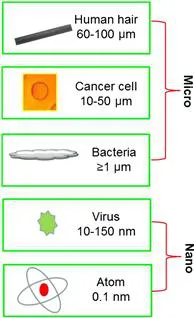
FIGURE 1.1 Comparative sizes of various micro- and nanoparticles.
(For color version of this figure, the reader is referred to the online version of this book)
NMs have structural features and properties in between those of single atoms/molecules and continuous bulk materials and have at least one dimension in the nanometer range (1 nm = 1 × 10⁻⁹ m). They include clusters,1,2 nanoparticles (NPs),2–10,79–96 quantum dots (QDs),9,97–100 nanotubes,7,101 as well as the collection or organization of these individual structures into two- and three-dimensional assemblies. The nanoscale dimensions of NMs bring optical, electronic, magnetic, catalytic, and other properties that are distinct from those of atoms/molecules or bulk materials. In order to exploit the special properties that arise due to the nanoscale dimensions of materials, researchers must control and manipulate the size, shape, and surface functional groups of NMs, and structure them into periodically ordered assemblies to create new products, devices, and technologies or improve existing ones.102–109 The science of controlling, manipulating, or engineering the properties and utilizing these NMs for the purpose of building microscopic machinery is termed as nanotechnology. The control and manipulation process can be done using the “top-down” or “bottom-up” approach. In the “top-down” approach, large chunks of materials are broken down into nanostructures by lithography or any other outside force that impose order on NMs.110
NMs are directly relevant to medicine because of the role of nanoscale phenomena, such as enzyme action, cell cycle, cell signaling, and damage repair. NMs can be used to create tools for analyzing the structure of cells and tissues from the atomic and cellular levels and to design and create biocompatible materials at the nanoscale for therapies, diagnostics, and replacements. NMs can be used to create precisely targeted drugs that are engineered to locate and sit on specific proteins and nucleic acids associated with the disease and/or disorders. These NMs can also be used to deliver small organic molecules and peptides at effective sites of action to carry out their function more effectively, protected from degradation, immune attack, and shielded to pass through barriers that block the passage of large molecules.
At present, NMs are being tested for various biomedical applications to learn if they can help facilitate sensitive and accurate medical diagnostics as well as for effective therapeutics. More specifically for drug delivery purposes, the use of NMs is attracting increasing attention due to their unique capabilities and their negligible side effects not only in cancer therapy but also in the treatment of other ailments. Among all types of NMs, biocompati...
Table of contents
- Cover image
- Title page
- Table of Contents
- Copyright
- Foreword
- Preface
- Acknowledgements
- Chapter 1. Introduction
- Chapter 2. Types of Nanomaterials and Corresponding Methods of Synthesis
- Chapter 3. Biocompatibility and Functionalization
- Chapter 4. Nanobiosensors
- Chapter 5. Targeted Drug Delivery
- Chapter 6. Nanomedical Devices
- Chapter 7. Nanopharmacology
- Chapter 8. Nanotoxicology and Remediation
- Chapter 9. Conclusions
- Index
Trusted by 375,005 students
Access to over 1.5 million titles for a fair monthly price.
Study more efficiently using our study tools.
Frequently asked questions
Yes, you can cancel anytime from the Subscription tab in your account settings on the Perlego website. Your subscription will stay active until the end of your current billing period. Learn how to cancel your subscription
No, books cannot be downloaded as external files, such as PDFs, for use outside of Perlego. However, you can download books within the Perlego app for offline reading on mobile or tablet. Learn how to download books offline
Perlego offers two plans: Essential and Complete
- Essential is ideal for learners and professionals who enjoy exploring a wide range of subjects. Access the Essential Library with 800,000+ trusted titles and best-sellers across business, personal growth, and the humanities. Includes unlimited reading time and Standard Read Aloud voice.
- Complete: Perfect for advanced learners and researchers needing full, unrestricted access. Unlock 1.5M+ books across hundreds of subjects, including academic and specialized titles. The Complete Plan also includes advanced features like Premium Read Aloud and Research Assistant.
We are an online textbook subscription service, where you can get access to an entire online library for less than the price of a single book per month. With over 1.5 million books across 990+ topics, we’ve got you covered! Learn about our mission
Look out for the read-aloud symbol on your next book to see if you can listen to it. The read-aloud tool reads text aloud for you, highlighting the text as it is being read. You can pause it, speed it up and slow it down. Learn more about Read Aloud
Yes! You can use the Perlego app on both iOS and Android devices to read anytime, anywhere — even offline. Perfect for commutes or when you’re on the go.
Please note we cannot support devices running on iOS 13 and Android 7 or earlier. Learn more about using the app
Please note we cannot support devices running on iOS 13 and Android 7 or earlier. Learn more about using the app
Yes, you can access Nanomaterials for Medical Applications by Zoraida Aguilar in PDF and/or ePUB format, as well as other popular books in Technology & Engineering & Materials Science. We have over 1.5 million books available in our catalogue for you to explore.