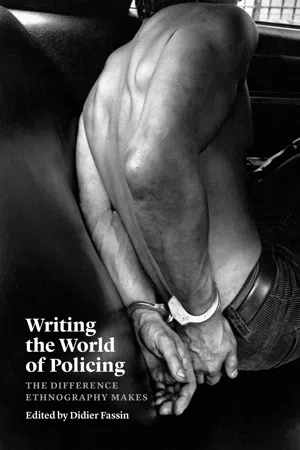
As policing has recently become a major topic of public debate, it was also a growing area of ethnographic research. Writing the World of Policing brings together an international roster of scholars who have conducted fieldwork studies of law enforcement in disadvantaged urban neighborhoods on five continents. How, they ask, can ethnography illuminate the role of the police in society? Are there important aspects of policing that are not captured through interviews and statistics? And how can the study of law enforcement shed light on the practice of ethnography? What might studying policing teach us about the epistemological and ethical challenges of participant observation? Beyond these questions of crucial interest for criminology and, more generally, the social sciences, Writing the World of Policing provides a timely discussion of one of the most problematic institutions in contemporary society.
- English
- ePUB (mobile friendly)
- Available on iOS & Android
eBook - ePub
About this book
Information
Publisher
University of Chicago PressYear
2017Print ISBN
9780226497648
9780226497501
eBook ISBN
9780226497785
Topic
Sciences socialesSubtopic
CriminologiePART ONE
Position
ONE
Accountability: Ethnographic Engagement and the Ethics of the Police (United States)
Steve Herbert
The uniformed police are the most socially obvious manifestation of the state’s capacity for violence. Other institutions, such as the military and the prison, also perform state-sanctioned violence, but they are less visible than the police. The police’s capacity for violence, of course, is justified as integral to the rule of law and the need for social order. Yet police violence must be constrained, lest the power of the state exceed legitimate bounds. In other words, the police must be held accountable in some fashion to the public, to best ensure necessary limits on their coercive power.
I use this chapter to consider what it might mean for ethnographies of the police to be oriented toward ensuring greater police accountability. I am particularly interested in how a focus on accountability might impact the ethical conduct of fieldwork. I illustrate my discussion with reference to fieldwork conducted as part of a project with my colleague, Katherine Beckett. That project sought to investigate and critique social control tools in Seattle that criminalize the presence of individuals in spaces from which they are banned.1
I use three vignettes from one day of fieldwork to focus my analysis. After describing those vignettes, I outline three different roles that a police ethnographer commonly plays—as professional, as public actor, and as ethical human. As professionals, ethnographers must adhere to common standards of inquiry, ones that typically emphasize some degree of neutral, analytic detachment from the milieu under study. As public actors, ethnographers should arguably inform the populace about police practice, particularly when it eclipses lawful or ethical bounds. As ethical humans, ethnographers must treat the officers they encounter with consistent respect and honesty.
As it turns out, these are roles that the police also commonly play. I thus consider the variant roles of the ethnographer alongside the analogous roles for the police, and consider how these roles can vary across both groups and how they can conflict. I seek to show how these conflicts create intractable dilemmas for the police ethnographer, particularly anyone who pursues the project of police accountability.
I offer no easy resolutions to these conflicts here. My more modest hope is to gain greater clarity on the nature of these tensions and how one might proceed in the face of them. In the end, it seems clear that an ethnographer focused on police accountability cannot escape some degree of ethically questionable behavior. If Eric Gable is correct that fieldwork “is an intrinsically guilty act,” then this is especially true for those who study the police.2
Ethnographic Encounters: Three Moments
It is 5 a.m., my earliest arrival ever for a ride-along. The police station is eerily quiet, but I am expected, and thus I am quickly escorted inside by a young officer. He seems inexperienced with the concept of a ride-along. His awkwardness combines with my sleepiness to make our initial conversations halting. I fear it could be a trying day.
That fear is quickly dispelled, because this is not the usual ride-along. I am with a special unit, part of the “Neighborhood Corrections Initiative.” The NCI is a joint operation of the Seattle Police Department (SPD) and the Washington State Department of Corrections (DOC). It partners an SPD officer with a DOC community corrections officer. The SPD officer possesses all of the powers of those on patrol: he can respond to presumed violations of criminal law, intervene in troublesome situations to restore order, and use legally sanctioned violence when justifiable. The DOC officer possesses even more robust powers, at least with respect to those recently released from prison. Such “DOC active” individuals must submit to searches of their bodies, cars, or homes whenever requested by community corrections officers. Placed together, the officers can reinforce each other’s power and can intervene intrusively into the lives of many citizens they encounter.
Three moments during this ride-along can help focus my analysis of the ethical dilemmas that accompany fieldwork that is explicitly oriented toward enabling greater accountability for police actions.
Moment One: As we leave the station, the SPD officer responds eagerly to questions about the NCI. A garrulous contrast to his younger colleague, the SPD officer evinces much enthusiasm for his partnership. He emphasizes the DOC officer’s ability to override some restrictions on police actions, including those created by the Fourth Amendment to the US Constitution, which should prohibit searches and seizures of individuals without “probable cause” of a crime. The SPD officer expresses envy that his partner can ignore such restrictions with anyone who is “DOC active.” Says the SPD officer, gesturing to his colleague: “The power this guy possesses is awesome.”
Moment Two: The SPD officer steers toward Seattle’s Aurora Avenue for their first task. A state highway, Aurora was once Seattle’s main north-south thoroughfare. The construction in the 1960s of a federal interstate highway running parallel to Aurora led to the latter’s decline, evidenced in part by numerous run-down motels notorious for hosting sales of drugs and sexual services. The NCI vehicle heads to one of those motels. The officers wish to check on a registered sex offender, whose pariah and financial statuses deny him access to any tonier lodgings. The officers want to ensure he is complying with various DOC-imposed restrictions.
They never make it to his room. Instead, their attention is captivated by two men in the parking lot who flee when the police van arrives. Like hunting dogs, the officers bolt from the van and give chase. I follow more languidly but soon encounter the officers and their quarry. The now-suspects have their hands on a car while the SPD officer calls in their names on his shoulder-mounted radio device. What he learns leads him to handcuff each of them. Each falls victim to an innovative use of criminal trespass law. Via a program created by the SPD, business owners can sign agreements that essentially transfer their trespass authority to the police. If an officer sees an individual on any such business’s property without “any legitimate purpose,” the officer can “admonish” that individual. That means that the individual cannot return to that business for a year. Any such return leaves the individual susceptible to arrest. As he closes the handcuffs, the officer makes his intentions plain. “We have a zero tolerance policy here on Aurora,” he says. “I don’t care where else you go, but you must be any place other than Aurora.”
Moment Three: The officers spend much of their day cruising the street looking for anything suspicious. On a break, they park in front of another motel, a sagging one-story affair that runs perpendicular to the highway. They are approached by two individuals about a nonemergency matter: they cannot convince their elderly mother to leave one of the motel’s units. The SPD officer, bored by such matters, leaves the conversation to his DOC colleague and walks down the row of motel units. He pauses by a sight he considers anomalous: a late-model BMW parked in front of one unit. What, he wonders, is such a nice car doing at a dilapidated motel? He considers it his duty to find out. He goes to the unit fronting the car and bangs the door, announcing himself as an SPD officer. He waits a few seconds. Greeted by no response, he repeats his pounding and announcement. A third such outburst proves necessary before the door opens. Inside, the officer finds a man and a presumed sex worker; there is also a recently used crack pipe on the bedside table. When I enter, the officer is hectoring the man, whose head droops under the resulting guilt. Turning to the woman, the officer tosses a coin in the air and asks her to call heads or tails. Her choice is a lucky one, he says: she wins, and thus he will not arrest her. Each pledges to disperse immediately, and the officers and I return to the car.
The Position of the Police and of the Ethnographer
Each of these incidents troubled me; each illustrated a police interest and willingness to intrude rather brusquely into citizens’ lives. The early conversation reveals an SPD officer distressingly unbothered by the US Constitution, whose strictures he arguably later ignores. Although he does not physically enter the motel room for an unauthorized search, his loud remonstrations undoubtedly left the occupants feeling compelled to allow him inside. And although his arrests for criminal trespass are legal, his actions reproduce a program that criminalizes the mere presence of unwanted individuals in particular places.
My unease raises several questions. Am I obligated to inform the officers of my condemnation of their actions? If so, why? If not, what must I say to them about my presence in their workday lives? As I consider these questions, should it matter that these officers are representatives of the state? That they can exercise coercive force? Should I play a role in ensuring accountability for police actions? Or should I be beholden to the norms of professional social science? If so, what do such norms dictate that I do? Should I prioritize any ethical obligations I arguably possess to the police as research subjects? If so, what are those obligations? Or are any such obligations obviated by an arguable need for me to render transparent police practices that might otherwise escape public scrutiny? Should I pursue the project of police accountability and, if so, does that compromise my ethical relationship to officers I observe?
That fieldworkers exist in complicated ethical relations with those they study is hardly a novel realization; ethnographers are commonly vexed about how to situate themselves toward those they observe.3 Such questions, I contend, are heightened if one’s focus is the police. As Egon Bittner long ago argued, the capacity to exercise legitimate state violence makes the police unique and deeply structures what they do.4 The police ethnographer may see such violence and will likely wonder if it is justified. As Beatrice Jauregui and John Van Maanen note, it is particularly challenging to position oneself ethically vis-à-vis officers who commit acts of violence that are themselves ethically questionable.5 What must a fieldworker do in response? Is there any obligation to help hold the police accountable for questionable acts of violence?6
Certainly, the capacity for violence is precisely why police accountability is so important; without it, officers might too easily abuse their power. Accountability measures are thus those that help check potential police excesses. Many such measures are focused on responses to alleged instances of police misbehavior. As a result, much of the literature on police accountability addresses how best to construct formalized review procedures when citizens allege officer misconduct.7
Yet rarely does a police action lead to public discussion of any sort. At this writing, the United States is witnessing an effusion of public conversation about excessive police force; Michael Brown and Eric Garner are now household names and symbolize race-inflected and unnecessary lethal police violence. Despite these robust conversations—aided by public commentary from the US Attorney General and the Director of the Federal Bureau of Investigation—it remains the case that the vast majority of police-citizen contacts occur in front of only one or a handful of individuals and receive little to no attention when the encounter ends. This is particularly true for those individuals who concerned me on Aurora: the housing-challenged and otherwise destitute, the street-level sex worker, the previously incarcerated. Police intrusions into the lives of such people are routine and rarely documented.
Thus, just as lethal police violence must undergo scrutiny, so must more commonplace and seemingly banal encounters with the impoverished. The extent of physical violence I observed on Aurora involved handcuffing and arresting. Yet the significant power of the police was still readily on display. Indeed, the book to which my fieldwork contributed demonstrated the consequential complications that enhanced social control creates for the lives of many poor people in Seattle.8 We intended to question these social control practices. In other words, we sought to hold the police and other social actors accountable for how their power was being exercised against disadvantaged Seattleites.
However, in consciously choosing to emphasize police accountability, I arguably placed myself in an awkward, and even ethically compromised, relation to the officers I observed. The ethnographer does need to develop an analytic distance from his/her research subjects and to evaluate the milieu in terms of broader conceptual frameworks. For that reason, there is always a disjuncture between the ethnographer and ethnographic subjects. But when an ethnographer takes an avowedly political stance to provide critical assessments of police practice, then the research will likely run counter to the officers’ interests as they would define them. For instance, I doubt the officers on Aurora would have cooperated with me very much had they known that my subsequent analysis would strongly critique their practices.
All ethnographers, of course, are critical of the practices they observe. They necessarily step outside the immediate frames of references used by their subjects. In these practices of critique, ethnographers seek to explicate subjects’ actions within wider frameworks of understanding. Yet the project that led me to Aurora that day was quite explicitly critical in the more common sense of that term: I sought evidence of particular police practices so that I could more legitimately condemn them. My coauthor and I sought to write an accessible manuscript that would generate public scrutiny of social control mechanisms that we believed needed review and reform.
This more critical stance toward the police rendered me incapable of various maneuvers that many ethnographers deploy to address potential disjunctures between themselves and those they study. Aware of the power imbalance inherent in the relation between fieldworkers and subjects, some ethnographers seek to collaborate or oth...
Table of contents
- Cover
- Title Page
- Copyright Page
- Contents
- INTRODUCTION Ethnographying the Police
- PART I : Position
- PART II : Observation
- PART III : Description
- Index
Trusted by 375,005 students
Access to over 1.5 million titles for a fair monthly price.
Study more efficiently using our study tools.
Frequently asked questions
Yes, you can cancel anytime from the Subscription tab in your account settings on the Perlego website. Your subscription will stay active until the end of your current billing period. Learn how to cancel your subscription
No, books cannot be downloaded as external files, such as PDFs, for use outside of Perlego. However, you can download books within the Perlego app for offline reading on mobile or tablet. Learn how to download books offline
Perlego offers two plans: Essential and Complete
- Essential is ideal for learners and professionals who enjoy exploring a wide range of subjects. Access the Essential Library with 800,000+ trusted titles and best-sellers across business, personal growth, and the humanities. Includes unlimited reading time and Standard Read Aloud voice.
- Complete: Perfect for advanced learners and researchers needing full, unrestricted access. Unlock 1.5M+ books across hundreds of subjects, including academic and specialized titles. The Complete Plan also includes advanced features like Premium Read Aloud and Research Assistant.
We are an online textbook subscription service, where you can get access to an entire online library for less than the price of a single book per month. With over 1.5 million books across 990+ topics, we’ve got you covered! Learn about our mission
Look out for the read-aloud symbol on your next book to see if you can listen to it. The read-aloud tool reads text aloud for you, highlighting the text as it is being read. You can pause it, speed it up and slow it down. Learn more about Read Aloud
Yes! You can use the Perlego app on both iOS and Android devices to read anytime, anywhere — even offline. Perfect for commutes or when you’re on the go.
Please note we cannot support devices running on iOS 13 and Android 7 or earlier. Learn more about using the app
Please note we cannot support devices running on iOS 13 and Android 7 or earlier. Learn more about using the app
Yes, you can access Writing the World of Policing by Didier Fassin in PDF and/or ePUB format, as well as other popular books in Sciences sociales & Criminologie. We have over 1.5 million books available in our catalogue for you to explore.