"A grand and thrilling selection of Hoosier writing presented through the fraught lens of Christmas . . . a fascinating and utterly enjoyable read." —Michael Dahlie, award-winning author of The Best of Youth
In
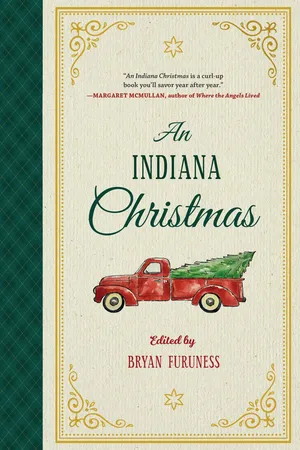
An Indiana Christmas, editor Bryan Furuness brings together timeless short stories, poems, plays, and letters to help you get into the holiday spirit. Lose yourself in classics like "In God We Trust: All Others Pay Cash" by Jean Shepherd, which inspired the beloved movie
A Christmas Story, and "A Feel in the Christmas Air"
by James Whitcomb Riley, along with more recent literary works like "The Myth of the Perfect Christmas Photo Family" by Kelsey Timmerman and "While Mortals Sleep" by famed Indiana writer Kurt Vonnegut. To achieve the perfect combination of Christmas nostalgia and cheer, Furuness has curated Hoosier stories that allow you to experience an idyllic holiday gathering in "Indiana Winter" by Susan Neville, feel the excitement of a child on Christmas Eve with "Earthbound" by Barbara Shoup, and face the loneliness of a drifter on Christmas night in "Howard Garfield, Balladeer" by Edward Porter. The collection even offers the chance to read a Christmas war dispatch from the late, great Hoosier journalist Ernie Pyle.
Heartfelt and unique, "the stories, poems, and essays in An Indiana Christmas will stay with you long after reading, no matter the season" (Sarah Layden, author of The Story I Tell About Myself).
"A curl-up book you will savor year after year." —Margaret McMullan, author of
Where the Angels Lived
- 242 pages
- English
- ePUB (mobile friendly)
- Available on iOS & Android
eBook - ePub
An Indiana Christmas
About this book
Information
Publisher
Indiana University PressYear
2020Print ISBN
9780253050281
9780253050281
eBook ISBN
9780253052650
Topic
Theology & ReligionSubtopic
Literary EssaysA REVERSIBLE SANTA CLAUS
I
Mr. William B. Aikins, alias “Softy” Hubbard, alias Billy The Hopper, paused for breath behind a hedge that bordered a quiet lane and peered out into the highway at a roadster whose taillight advertised its presence to his felonious gaze. It was Christmas Eve, and after a day of unseasonable warmth a slow, drizzling rain was whimsically changing to snow.
The Hopper was blowing from two hours’ hard travel over rough country. He had stumbled through woodlands, flattened himself in fence corners to avoid the eyes of curious motorists speeding homeward or flying about distributing Christmas gifts, and he was now bent upon committing himself to an interurban trolley line that would afford comfortable transportation for the remainder of his journey. Twenty miles, he estimated, still lay between him and his domicile.
The rain had penetrated his clothing and vigorous exercise had not greatly diminished the chill in his blood. His heart knocked violently against his ribs and he was dismayed by his shortness of wind. The Hopper was not so young as in the days when his agility and genius for effecting a quick “get-away” had earned for him his sobriquet. The last time his Bertillon measurements were checked (he was subjected to this humiliating experience in Omaha during the Ak-Sar-Ben carnival three years earlier) official note was taken of the fact that The Hopper’s hair, long carried in the records as black, was rapidly whitening.
At forty-eight a crook—even so resourceful and versatile a member of the fraternity as The Hopper—begins to mistrust himself. For the greater part of his life, when not in durance vile, The Hopper had been in hiding, and the state or condition of being a fugitive, hunted by keen-eyed agents of justice, is not, from all accounts, an enviable one. His latest experience of involuntary servitude had been under the auspices of the state of Oregon, for a trifling indiscretion in the way of safe-blowing. Having served his sentence, he skillfully effaced himself by a year’s siesta on a pineapple plantation in Hawaii. The island climate was not wholly pleasing to The Hopper, and when pineapples palled he took passage from Honolulu as a stoker, reached San Francisco (not greatly chastened in spirit), and by a series of characteristic hops, skips, and jumps across the continent landed in Maine by way of the Canadian provinces. The Hopper needed money. He was not without a certain crude philosophy, and it had been his dream to acquire by some brilliant coup a sufficient fortune upon which to retire and live as a decent, law-abiding citizen for the remainder of his days. This ambition, or at least the means to its fulfillment, can hardly be defended as praiseworthy, but The Hopper was a singular character and we must take him as we find him. Many prison chaplains and jail visitors bearing tracts had striven with little success to implant moral ideals in the mind and soul of The Hopper, but he was still to be cataloged among the impenitent; and as he moved southward through the commonwealth of Maine he was so oppressed by his poverty, as contrasted with the world’s abundance, that he lifted forty thousand dollars in a neat bundle from an express car which Providence had sidetracked, apparently for his personal enrichment, on the upper waters of the Penobscot. Whereupon he began perforce playing his old game of artful dodging, exercising his best powers as a hopper and skipper. Forty thousand dollars is no inconsiderable sum of money, and the success of this master stroke of his career was not to be jeopardized by careless moves. By craftily hiding in the big woods and making himself agreeable to isolated lumberjacks who rarely saw newspapers, he arrived in due course on Manhattan Island, where with shrewd judgment he avoided the haunts of his kind while planning a future commensurate with his new dignity as a capitalist.
He spent a year as a diligent and faithful employee of a garage which served a fashionable quarter of the metropolis; then, animated by a worthy desire to continue to lead an honest life, he purchased a chicken farm fifteen miles as the crow flies from Center Church, New Haven, and boldly opened a bank account in that academic center in his newly adopted name of Charles S. Stevens, of Happy Hill Farm. Feeling the need of companionship, he married a lady somewhat his junior, a shoplifter of the second class, whom he had known before the vigilance of the metropolitan police necessitated his removal to the Far West. Mrs. Stevens’s inferior talents as a petty larcenist had led her into many difficulties, and she gratefully availed herself of The Hopper’s offer of his heart and hand.
They had added to their establishment a retired yegg who had lost an eye by the premature popping of the “soup” (i.e., nitroglycerin) poured into the crevices of a country post office in Missouri. In offering shelter to Mr. James Whitesides, alias “Humpy” Thompson, The Hopper’s motives had not been wholly unselfish, as Humpy had been entrusted with the herding of poultry in several penitentiaries and was familiar with the most advanced scientific thought on chicken culture.
The roadster was headed toward his home and The Hopper contemplated it in the deepening dusk with greedy eyes. His labors in the New York garage had familiarized him with automobiles, and while he was not ignorant of the pains and penalties inflicted upon lawless persons who appropriate motors illegally, he was the victim of an irresistible temptation to jump into the machine thus left in the highway, drive as near home as he dared, and then abandon it. The owner of the roadster was presumably eating his evening meal in peace in the snug little cottage behind the shrubbery, and The Hopper was aware of no sound reason why he should not seize the vehicle and further widen the distance between himself and a suspicious-looking gentleman he had observed on the New Haven local.
The Hopper’s conscience was not altogether at ease, as he had, that afternoon, possessed himself of a bill-book that was protruding from the breast pocket of a dignified citizen whose strap he had shared in a crowded subway train. Having foresworn crime as a means of livelihood, The Hopper was chagrined that he had suffered himself to be beguiled into stealing by the mere propinquity of a piece of red leather. He was angry at the world as well as himself. People should not go about with bill-books sticking out of their pockets; it was unfair and unjust to those weak members of the human race who yield readily to temptation.
He had agreed with Mary when she married him and the chicken farm that they would respect the Ten Commandments and all statutory laws, state and federal, and he was painfully conscious that when he confessed his sin she would deal severely with him. Even Humpy, now enjoying a peace that he had rarely known outside the walls of prison, even Humpy would be bitter. The thought that he was again among the hunted would depress Mary and Humpy, and he knew that their harshness would be intensified because of his violation of the unwritten law of the underworld in resorting to purse-lifting, an infringement upon a branch of felony despicable and greatly inferior in dignity to safe-blowing.
These reflections spurred The Hopper to action, for the sooner he reached home the more quickly he could explain his protracted stay in New York (to which metropolis he had repaired in the hope of making a better price for eggs with the commission merchants who handled his products), submit himself to Mary’s chastisement, and promise to sin no more. By returning on Christmas Eve, of all times, again a fugitive, he knew that he would merit the unsparing condemnation that Mary and Humpy would visit upon him. It was possible, it was even quite likely, that the short, stocky gentleman he had seen on the New Haven local was not a “bull”—not really a detective who had observed the little transaction in the subway—but the very uncertainty annoyed The Hopper. In his happy and profitable year at Happy Hill Farm he had learned to prize his personal comfort, and he was humiliated to find that he had been frightened into leaving the train at Bansford to continue his journey afoot, and merely because a man had looked at him a little queerly.
Any Christmas spirit that had taken root in The Hopper’s soul had been disturbed, not to say seriously threatened with extinction, by the untoward occurrences of the afternoon.
II
The Hopper waited for a limousine to pass and then crawled out of his hiding place, jumped into the roadster, and was at once in motion. He glanced back, fearing that the owner might have heard his departure, and then, satisfied of his immediate security, negotiated a difficult turn in the road and settled himself with a feeling of relief to careful but expeditious flight. It was at this moment, when he had urged the car to its highest speed, that a noise startled him—an amazing little chirrupy sound which corresponded to none of the familiar fore-warnings of engine trouble. With his eyes to the front he listened for a repetition of the sound. It rose again—it was like a perplexing cheep and chirrup, changing to a chortle of glee.
“Goo-goo! Goo-goo-goo!”
The car was skimming a dark stretch of road and a superstitious awe fell upon The Hopper. Murder, he gratefully remembered, had never been among his crimes, though he had once winged a too-inquisitive policeman in Kansas City. He glanced over his shoulder, but saw no pursuing ghost in the snowy highway; then, looking down apprehensively, he detected on the seat beside him what appeared to be an animate bundle, and, prompted by a louder “goo-goo,” he put out his hand. His fingers touched something warm and soft and were promptly seized and held by Something.
The Hopper snatched his hand free of the tentacles of the unknown and shook it violently. The nature of the Something troubled him. He renewed his experiments, steering with his left hand and exposing the right to what now seemed to be the grasp of two very small mittened hands.
“Goo-goo! Goody; teep wunnin’!”
“A kid!” The Hopper gasped.
That he had eloped with a child was the blackest of the day’s calamities. He experienced a strange sinking feeling in the stomach. In moments of apprehension a crook’s thoughts run naturally into periods of penal servitude, and the punishment for kidnapping, The Hopper recalled, was severe. He stopped the car and inspected his unwelcome fellow passenger by the light of matches. Two big blue eyes stared at him from a hood and two mittens were poked into his face. Two small feet, wrapped tightly in a blanket, kicked at him energetically.
“Detup! Mate um skedaddle!”
Obedient to this command The Hopper made the car skedaddle, but superstitious dread settled upon him more heavily. He was satisfied now that from the moment he transferred the strap-hanger’s bill-book to his own pocket he had been hoodooed. Only a jinx of the most malevolent type could have prompted his hurried exit from a train to dodge an imaginary “bull.” Only the blackest of evil spirits could be responsible for this involuntary kidnapping!
“Mate um wun! Mate um ’ippity stip!”
The mittened hands reached for the wheel at this juncture and an unlooked-for “jippity skip” precipitated the young passenger into The Hopper’s lap.
This mishap was attended with the jolliest baby laughter. Gently but with much firmness The Hopper restored the youngster to an upright position and supported him until sure he was able to sustain himself.
“Ye better set still, little feller,” he admonished.
The little feller seemed in no wise astonished to find himself abroad with a perfect stranger and his courage and good cheer were not lost upon The Hopper. He wanted to be severe, to vent his rage for the day’s calamities upon the only human being within range, but in spite of himself he felt no animosity toward the friendly little bundle of humanity beside him. Still, he had stolen a baby and it was incumbent upon him to free himself at once of the appalling burden; but a baby is not so easily disposed of. He could not, without seriously imperiling his liberty, return to the cottage. It was the rule of housebreakers, he recalled, to avoid babies. He had heard it said by burglars of wide experience and unquestioned wisdom that babies were the most dangerous of all burglar alarms. All things considered, kidnapping and automobile theft were not a happy combination with which to appear before a criminal court. The Hopper was vexed because the child did not cry; if he had shown a bad disposition The Hopper might have abandoned him; but the youngster was the cheeriest and most agreeable of traveling companions. Indeed, The Hopper’s spirits rose under his continued “goo-gooing” and chirruping.
“Nice little Shaver!” he said, patting the child’s knees.
Little Shaver was so pleased by this friendly demonstration that he threw up his arms in an effort to embrace The Hopper.
“Bil-lee,” he gurgled delightedly.
The Hopper was so astonished at being addressed in his own lawful name by a strange baby that he barely averted a collision with a passing motor truck. It was unbelievable that the baby really knew his name, but perhaps it was a good omen that he had hit upon it. The Hopper’s resentment against the dark fate that seemed to pursue him vanished. Even though he had stolen a baby, it was a merry, brave little baby who didn’t mind at all being run away with! He dismissed the thought of planting the little shaver at a door, ringing the bell and running away; this was no way to treat a friendly child that had done him no injury, and The Hopper highly resolved to do the square thing by the youngster even at personal inconvenience and risk.
The snow was now falling in generous Christmasy flakes, and the high speed the car had again attained was evidently deeply gratifying to the young person, whose reckless tumbling about made it necessary for The Hopper to keep a hand on him.
“Steady, little un; steady!” The Hopper kept mumbling.
His wits were busy trying to devise some means of getting rid of the youngster without exposing himself to the danger of arrest. By this time someone was undoubtedly busily engaged in searching for both baby and car; the police far and near would be notified, and would be on the lookout for a smart roadster containing a stolen child.
“Merry Christmas!” a boy shouted from a farm gate.
“M’y Kwismus!” piped Shaver.
The Hopper decided to run the machine home and there ponder the disposition of his blithe companion with the care the unusual circumstances demanded.
“’Urry up; me’s goin’ ’ome to me’s gwanpa’s kwismus t’ee!”
“Right ye be, little un; right ye be!” affirmed The Hopper.
The youngster was evidently blessed with a sanguine and confiding nature. His reference to his grandfather’s Christmas tree impinged sharply upon The Hopper’s conscience. Christmas had never figured very prominently in his scheme of life. About the only Christmases that he recalled with any pleasure were those that he had spent in prison, and those were marked only by Christmas dinners varying with the generosity of a series of wardens.
But Shaver was entitled to all the joys of Christmas, and The Hopper had no desire to deprive him of them.
“Keep a-larfin’, Shaver, keep a-larfin’,” said the Hopper. “Ole Hop ain’t a-goin’ to hurt ye!”
The Hopper, feeling his way cautiously round the fringes of New Haven, arrived presently at Happy Hill Farm, where he ran the car in among the chicken sheds behind the cottage a...
Table of contents
- Cover
- Title Page
- Copyright
- Dedication
- Contents
- Preface
- Acknoweldgments
- Earthbound
- Winter Scene, Past Midnight
- The Fable of the Cut-up Who Came Very Near Losing His Ticket, but Who Turned Defeat into Victory
- Making Pierogi on Christmas Eve
- Keeping Christmas Our Way
- Digging and Grousing
- The farm wife finds grace in her empty barn
- The farm wife makes her Christmas list
- Indiana Winter
- Home for the Holidays
- A Reversible Santa Claus
- Two Pieces
- Shepherds, Why This Jubilee?
- Pictures from a Clapboard House
- Too Cold
- Winter Runes
- Trifles
- December Barns of Darkness
- In Sunset and Moonlight, What Gathered Our Thoughts Was the Adhesive Dark
- Nanny Anne and the Christmas Story
- Blessed rancor of music
- Wealth
- The Christmas Long Ago
- A Feel in the Christmas Air
- A Song for Christmas
- Baby Alive
- Santa Claus, Indiana
- Howard Garfield, Balladeer
- The Five Little Sykeses, excerpt from Mr. Bingle
- The Schneebrunzer
- The Myth of the Perfect Christmas Photo Family
- Treasure!
- December, excerpt from Abe Martin’s Almanack
- Beasley’s Christmas Party
- Excerpt from In God We Trust: All Others Pay Cash
- While Mortals Sleep
- Contributors
Trusted by 375,005 students
Access to over 1.5 million titles for a fair monthly price.
Study more efficiently using our study tools.
Frequently asked questions
Yes, you can cancel anytime from the Subscription tab in your account settings on the Perlego website. Your subscription will stay active until the end of your current billing period. Learn how to cancel your subscription
No, books cannot be downloaded as external files, such as PDFs, for use outside of Perlego. However, you can download books within the Perlego app for offline reading on mobile or tablet. Learn how to download books offline
Perlego offers two plans: Essential and Complete
- Essential is ideal for learners and professionals who enjoy exploring a wide range of subjects. Access the Essential Library with 800,000+ trusted titles and best-sellers across business, personal growth, and the humanities. Includes unlimited reading time and Standard Read Aloud voice.
- Complete: Perfect for advanced learners and researchers needing full, unrestricted access. Unlock 1.5M+ books across hundreds of subjects, including academic and specialized titles. The Complete Plan also includes advanced features like Premium Read Aloud and Research Assistant.
We are an online textbook subscription service, where you can get access to an entire online library for less than the price of a single book per month. With over 1.5 million books across 990+ topics, we’ve got you covered! Learn about our mission
Look out for the read-aloud symbol on your next book to see if you can listen to it. The read-aloud tool reads text aloud for you, highlighting the text as it is being read. You can pause it, speed it up and slow it down. Learn more about Read Aloud
Yes! You can use the Perlego app on both iOS and Android devices to read anytime, anywhere — even offline. Perfect for commutes or when you’re on the go.
Please note we cannot support devices running on iOS 13 and Android 7 or earlier. Learn more about using the app
Please note we cannot support devices running on iOS 13 and Android 7 or earlier. Learn more about using the app
Yes, you can access An Indiana Christmas by Bryan Furuness in PDF and/or ePUB format, as well as other popular books in Theology & Religion & Literary Essays. We have over 1.5 million books available in our catalogue for you to explore.