- 200 pages
- English
- ePUB (mobile friendly)
- Available on iOS & Android
eBook - ePub
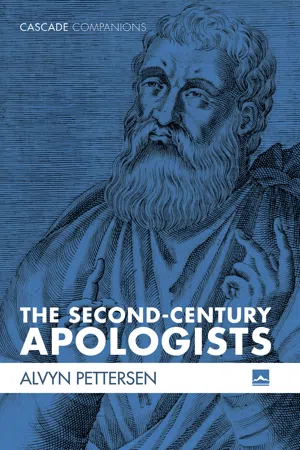
The Second-Century Apologists
About this book
"They bring three charges against us: atheism, Thyestean banquets, and Oedipean unions." So a late second-century Christian Apologist wrote with reference to his critics. Against these and other charges the Apologists rallied. Not so, they maintained. It was not the Christians but their critics who were the atheists and the Christians were the true theists. They were atheists only insofar as they denied the fabricated gods of the cults and the immoral deities of theaters. That, they explained, was why Christians absented themselves, whatever the cost, from the imperial cult, theaters, and amphitheaters. They were not cannibals, as Thyestes was when he ate the flesh of his children. To suggest otherwise was to misunderstand Christians consuming Christ's flesh and blood at the Eucharist. Nor were they imitators of Oedipus, who entered into sexual relations with Jocasta, his Queen and, though he knew it not, also his mother. Christians did exchange the kiss of peace. They did love one another. They were not, however, incestuous. Any promiscuous love on their part extended only to a very practical love of every needy soul.
This book explores these arguments, especially noting the Apologists' commitment to God's oneness, to Christians not worshipping anything made, and to humans properly caring for fellow creatures.
Information
Topic
Theology & ReligionSubtopic
Christian Theology3
Christianity—Not New, and It Is True
The mid-to-late second-century Apologists were adamant that Christianity was not new and was true. Theophilos, for example, stressed that Christian teaching was “neither modern nor mere fables”;84 Tatian robustly countered charges that his Christian beliefs were “new-fangled barbarian doctrines”;85 and Justin, though not listing novelty as one of the charges brought against Christianity, denied that what he and other Christians confessed with regards to Christ were “mere marvelous tales.”86 Indeed, employing themes common to the Apologists’s general defense of Christianity’s antiquity, he asked,
Why should we believe . . . that [a crucified man] is the firstborn of the unbegotten God and will pass judgement on the entire human race unless we have found testimony concerning him made public before he came and was born as man.87
Severally, and together, the Apologists either asserted or assumed that Christianity both was not new and was true; and this they asserted within a Greco-Roman world where, generally speaking, a belief’s antiquity sustained its claim to be true, even as a belief’s novelty undermined its truth claim.88
The arguments of the Apologists that Christianity was not novel but antique are several and widely shared: the Hebrew prophets, amongst whom Moses was placed, were, in the words of Justin, “our teachers,”89 teachers from whom Christians had received instruction concerning creation itself,90 Christ and the gentile mission,91 and the final judgement.92 Indeed, Christianity’s antiquity, the Apologists argued, was underlined by the extraordinary antiquity of Moses, the first prophet: Moses, they maintained, antedated Homer, the “oldest of poets and historians.”93 He antedated the Trojan war, of which Homer wrote, by either four hundred94 or one thousand years.95 Indeed, they asserted, he antedated the ancient cities of Egypt.96 It is not surprising then that both Justin and Theophilos claimed that Moses was more ancient than all the Greek writers and poets.97 Comparatively speaking, they then implied, it was Greco-Roman thinking, rather than Christianity, which was novel, and whose truths claims were suspect.
Within this context, Athenagoras’s silence concerning Moses’s remote antiquity may therefore seem a strange silence. Perhaps, however, his silence, though noticeable, is not total. Certainly, in mentioning the charges levelled against Christians, Athenagoras recorded those of atheism, Thyestean feasts, and Oedipean unions,98 but not that of Christianity’s novelty. Elsewhere, however, he did state the grounds for Christian believing:
we [sc. Christians] have prophets as witnesses to what we think and believe, witnesses driven by a divinely inspired Spirit to speak about God and the things of God. . . . It would therefore be irrational, he continued, to abandon belief in the Spirit from God who has moved the prophets’s mouths like musical instruments and to attend to human opinions.99
These “prophets” were not named here by Athenagoras. Yet, it would be strange not to identify amongst them Moses, Isaiah, and Jeremiah, prophets to whom Athenagoras more generally referred in his writings, and to whom other Apologists referred when seeking to refute the charge of Christianity being novel. Further, Athenagoras’s reference here to the godly inspiration of these prophets’s utterances echoes the thinking of other Apologists when they treated the charge that Christianity was but a recent human invention. Athenagoras’s thinking in these matters may therefore be not so dissimilar from that of other contemporary and near contemporary Apologists.
The Apologists indeed reinforced their argument that the Hebrew prophets—who, they claimed, foretold the truths later held by Christians—were more ancient than the Greek poets and philosophers by maintaining that these latter were dependent for some of their ideas upon the beliefs of these former. Plato, they asserted, “borrowed” from Moses:100 he depended upon Moses for his views on God’s creation of the world,101 the soul’s immortality, post-mortem punishment, and the contemplation of things heavenly.102 They even maintained that the Greek poets ...
Table of contents
- Title Page
- Acknowledgments
- Introduction
- The Second-Century Greco-Roman World
- Six Greek Christian Apologists
- Christianity—Not New, and It Is True
- Atheists? Guilty as Charged
- Atheists?—Not Guilty as Charged
- Thyestean Banquets and Oedipean Intercourse
- Postscript
- General History Outline
- Bibliography
Trusted by 375,005 students
Access to over 1.5 million titles for a fair monthly price.
Study more efficiently using our study tools.
Frequently asked questions
Yes, you can cancel anytime from the Subscription tab in your account settings on the Perlego website. Your subscription will stay active until the end of your current billing period. Learn how to cancel your subscription
No, books cannot be downloaded as external files, such as PDFs, for use outside of Perlego. However, you can download books within the Perlego app for offline reading on mobile or tablet. Learn how to download books offline
We are an online textbook subscription service, where you can get access to an entire online library for less than the price of a single book per month. With over 1.5 million books across 990+ topics, we’ve got you covered! Learn about our mission
Look out for the read-aloud symbol on your next book to see if you can listen to it. The read-aloud tool reads text aloud for you, highlighting the text as it is being read. You can pause it, speed it up and slow it down. Learn more about Read Aloud
Yes! You can use the Perlego app on both iOS and Android devices to read anytime, anywhere — even offline. Perfect for commutes or when you’re on the go.
Please note we cannot support devices running on iOS 13 and Android 7 or earlier. Learn more about using the app
Please note we cannot support devices running on iOS 13 and Android 7 or earlier. Learn more about using the app
Yes, you can access The Second-Century Apologists by Alvyn Pettersen in PDF and/or ePUB format, as well as other popular books in Theology & Religion & Christian Theology. We have over 1.5 million books available in our catalogue for you to explore.