eBook - ePub
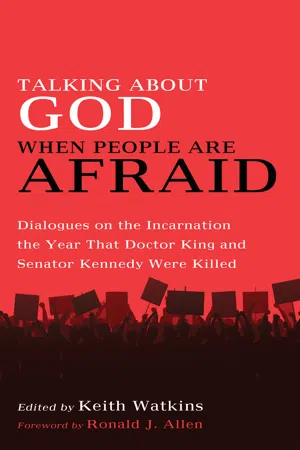
Talking About God When People Are Afraid
Dialogues on the Incarnation the Year That Doctor King and Senator Kennedy Were Killed
- 142 pages
- English
- ePUB (mobile friendly)
- Available on iOS & Android
eBook - ePub
Talking About God When People Are Afraid
Dialogues on the Incarnation the Year That Doctor King and Senator Kennedy Were Killed
About this book
The Dialogues on the Incarnation presented in this book show a group of four preachers as they endeavored to help the people in their church make theological sense at a time when optimism and fear were intermingled. Although the details of life in the early 2020s differ from those in the 1960s when these sermons were delivered, preachers today face a similar challenge--to proclaim a Christian vision that interprets the interior experience of listeners and the dynamics of the outer world where strife, epidemic disease, and global warming dominate the news. These sermons show how preachers can draw upon their own insights and upon biblical scholarship, history, theology, ethics, philosophy, and psychology as they proclaim their gospel message. In the year when Doctor Martin Luther King Jr. and Senator Robert Kennedy were assassinated, these dialogues were described as "an experiment in preaching." They now are published, nearly sixty years later, to encourage and instruct a new generation of church leaders to continue the pastoral challenge of talking about God when most people are afraid.
Information
Topic
Theology & ReligionSubtopic
Christian MinistryLenten Dialogues: The Tragic Vision
Lent 1: In Sight of the City He Wept
The season of preparation for Easter, which may historically have been the Christian adaptation of springtime celebrations of awakening in pre-Christian cultures, is called Lent and includes the forty-day period (excluding Sundays) before Easter Day. And even though the people of our free church tradition have carefully avoided subservience to a “Church Year” with its prescribed festivals and holy days, we have shared with practically all the branches of the church this time of special teaching and encouragement, of personal penitence and discipline in the hope of renewal for individuals and institutions.
The readings from the Scripture and the sermons during this season encourage introspection in the light of the gospel of the crucified and risen Lord. There is often an alternation between consideration of events in Christ’s life and events in our own. Everywhere one observes a wider participation in study and worship, a more serious effort to grapple with the meanings of Christian faith and the styles of Christian life.
In the past generation there has been a re-awakening of the tragic sense of life after a long period of superficial optimism in which a variety of “gospels of modernity” promised to resolve all the vast contradictions of life by means of some simple scheme of science or education. Joining the poets and dramatists and disillusioned philosophers and writers have been many theologians and serious adherents of the Christian faith, making common cause against the sentimentality of former generations, vigorously attacking that delusive optimism which held that goodness always triumphs.
The events of our time and the conditions in which we find ourselves, with all their improbables and fluidity, force serious people toward a tragic vision of life. We speak of every step we take as “the calculated risk.” Nowhere are there any guarantees of security and no one dares promise any immediate renovation of our present disorder, either the urban crisis or the Vietnam War. Hordes of refugees live in a special type of misery, an additional quarter million of them created in the last month. Without citizenship and in exile, we call them “displaced persons.” But Nathan Scott has pointed out that we are all “displaced persons,” who cannot find anywhere a satisfactory dwelling place in the world of our time. There is outer disorder plainly visible to everyone, but the inner world of the private self is just as troubled by fear, remorse, and sometimes hysteria. “The ancient issues of tragedy,” he says, “are reinstated with a new kind of urgency.”24
The people whose vision is of the tragic cast are preoccupied by these facts of human existence. Their focus is on the background of danger against which the human drama must be enacted; the circumstances and situations, the forces and powers in the midst of which choices must be made and life lived. They are aware of what Paul Tillich called the “boundary situations” of human existence, where people are nakedly exposed and the limitations and imperfections of their creatureliness can be no longer hid from view.
While it is true that the final accent of the Christian proclamation is not on tragedy, but on hope and victory, it is just as true that there is no significant note of hope that does not take account of our condition as it really is, the world without and within, the suffering and sickness of humankind. Christians have to take seriously the passion of Jesus, the pain and anguish of our Lord, its evidence of the God who himself suffers and thereby accomplishes our deliverance. Too much of our prayer and worship is an escape, taking us away from the real concerns of life into a world of make-believe and inaction. Such prayer and worship may yield a comforting illusion, as John Macquarrie suggests, “but the price paid for this illusion is that the believer is prevented from entering fully either into the enjoyment of the pathos of a truly human existence.”25
The tragic sense of life is not alien to Christian faith. As Scott puts it, “the penultimate event in the Christian story—Calvary—can be made no sense of at all apart from the kind of perception the tragedian seeks to assist us in attaining.” Only those who have accepted a “vocation to tragedy” can understand the whole point and meaning of Job’s declaration, “I know that my redeemer liveth,” or the full poignancy and gloriousness of Paul’s word, “If God be for us, who can be against us?”26
We rob ourselves of the depth of meaning in Christian faith, the full joy of affirmation and commitment, when we are unwilling to confront in all its stark tragedy the gospel account of the closing days of Jesus’ ministry, seeing in it the revelation of humanity’s best and worst, life’s terrible and glorious realities: God.27 At worst, that leaves us with human actors obeying the decrees of God so that they had no responsibility or guilt.
Whatever we think of the interpretations of the first Christians, it is clear that the church’s faith was particularly concerned with this piece of tradition. It was the center of preaching and teaching. The problem for us now, twenty centuries later, is to weigh the various interpretations of New Testament authors (for there are more than one), set them alongside what we can discover of ancient history from other sources, exercise caution and critical judgment regarding details of the story, and face the fact, as Bornkamm puts it, that “all we can recognize are outlines of the course of events of the last week.”28
Success and failure, popularity and enmity had been part and parcel of Jesus’ ministry from the start. At the beginning he had rejected a political interpretation of his mission and he never was able to get his disciples to understand. He went to Jerusalem for a final judgment on that mission, to deliver the message of the coming kingdom of God in the city which he himself called “the city of the Great King.” That decision was the turning point in his life. Later tradition makes it seem as though he only went there to seek his death, to fulfill the prophecies. But modern interpreters of Jesus believe he went to confront the people in the holy city with the message of the kingdom of God and to summon them at the eleventh hour to make their decision. He had to go to Jerusalem; it was not only the capital city, but also the place connected from ancient times with Israel’s destiny. We can’t know when he came to the realization of his own possible and violent end, nor can we know at what moment his readiness to accept death turned into the certainty of it. But there can be no doubt that he knew the road to Jerusalem led to new and serious conflict with the religious and temporal rulers.
It is probable that Jesus had been to Jerusalem many times, and even possible that he had worked at his ministry there. Maurice Goguel, in his great Life of Jesus published in Paris in 1932, developed the theory that Jesus spent the closing months of the year 27 in Jerusalem, where he was disappointed in the misunderstanding that greeted him. He gained some disciples and the general sympathy of the masses but aroused the hostility of the authorities so that he had to leave the city and withdraw to Perea. There he spent another three months with his disciples, and then came back to Jerusalem for the final few days, hoping when he returned that the masses would greet him boldly and he would be able to brave the opposition of the priests. Goguel believed that sequence of events best fits the Gospel accounts and the sense of meaning they convey. I find it a powerful thesis, and particularly his placing the story of Jesus’ weeping over the city at the point when he left it to go to Perea rather than when he approached it on what we call Palm Sunday. That is possible because in Matthew and Mark almost the same words are in a different setting (Matt 23:37–39).
Whenever it was uttered, that lamentation over the city must have been at the spot in the road from Jerusalem to Bethany that winds around the southeast slope of the Mount of Olives. There is a place where the whole city...
Table of contents
- Title Page
- Foreword
- Acknowledgments
- An Experiment in Preaching
- Advent Dialogues: Born to Set the People Free
- Lenten Dialogues: The Tragic Vision
- Bibliography
Trusted by 375,005 students
Access to over 1.5 million titles for a fair monthly price.
Study more efficiently using our study tools.
Frequently asked questions
Yes, you can cancel anytime from the Subscription tab in your account settings on the Perlego website. Your subscription will stay active until the end of your current billing period. Learn how to cancel your subscription
No, books cannot be downloaded as external files, such as PDFs, for use outside of Perlego. However, you can download books within the Perlego app for offline reading on mobile or tablet. Learn how to download books offline
Perlego offers two plans: Essential and Complete
- Essential is ideal for learners and professionals who enjoy exploring a wide range of subjects. Access the Essential Library with 800,000+ trusted titles and best-sellers across business, personal growth, and the humanities. Includes unlimited reading time and Standard Read Aloud voice.
- Complete: Perfect for advanced learners and researchers needing full, unrestricted access. Unlock 1.5M+ books across hundreds of subjects, including academic and specialized titles. The Complete Plan also includes advanced features like Premium Read Aloud and Research Assistant.
We are an online textbook subscription service, where you can get access to an entire online library for less than the price of a single book per month. With over 1.5 million books across 990+ topics, we’ve got you covered! Learn about our mission
Look out for the read-aloud symbol on your next book to see if you can listen to it. The read-aloud tool reads text aloud for you, highlighting the text as it is being read. You can pause it, speed it up and slow it down. Learn more about Read Aloud
Yes! You can use the Perlego app on both iOS and Android devices to read anytime, anywhere — even offline. Perfect for commutes or when you’re on the go.
Please note we cannot support devices running on iOS 13 and Android 7 or earlier. Learn more about using the app
Please note we cannot support devices running on iOS 13 and Android 7 or earlier. Learn more about using the app
Yes, you can access Talking About God When People Are Afraid by Keith Watkins in PDF and/or ePUB format, as well as other popular books in Theology & Religion & Christian Ministry. We have over 1.5 million books available in our catalogue for you to explore.