![]()
That time of year thou mayst in me behold
When yellow leaves, or none, or few, do hang
Upon those boughs which shake against the cold,
Bare ruin’d choirs, where late the sweet birds sang.
In me thou seest the twilight of such day
As after sunset fadeth in the west,
Which by and by black night doth take away,
Death’s second self, that seals up all in rest.
In me thou see’st the glowing of such fire
That on the ashes of his youth doth lie,
As the death-bed whereon it must expire
Consumed with that which it was nourish’d by.
This thou perceivest, which makes thy love more strong,
To love that well which thou must leave ere long.
(Sonnet 73 by William Shakespeare)
Introduction
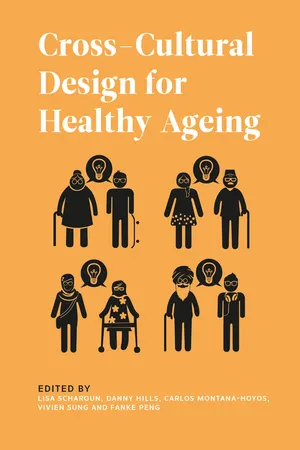
We wrote this book as a compilation of many years of research and pedagogical experiences around cross-cultural and multidisciplinary design for healthy ageing. In it, we combine different voices and perspectives, including descriptions of several cross-cultural design for healthy ageing workshops conducted with students from design and nursing disciplines in different Australasian locations. These experiences are described in detail, offering a roadmap and many ideas for readers to build upon. Literature reviews and background research inform these practical experiences, which were then used to develop new theory and insights around the topics, mainly from academic and pedagogic points of view. The multiplicity of voices of student participants in the workshops provides a more personalised account of these experiences, while our reflections highlight the pedagogic and life-changing value of these experiences.
We are a multidisciplinary team of researchers based mainly in Australia. Initially, a majority of the team members met while working at the University of Canberra (UC), with specialties in nursing, graphic design, industrial design, and fashion design, all from different cultural backgrounds and with interests in health and healthy ageing. Building on research undertaken with several study tours of Australian students from design and nursing to various Asian countries, mainly China and Singapore, and through collaborations with numerous partners including higher education institutions in Singapore, China, Hong Kong, and Taiwan, the research team explored the multi-layered relationships between design and healthy ageing.
The book is structured into eight chapters. This first chapter provides an overview and introduction, by establishing a background for ‘design for healthy ageing’ in relation to culture, cross-culturalism, multiculturalism, and other key topics. To contextualise the projects we conducted mainly in China, Australia, and Singapore, we also summarise some of the recent literature on related topics, exploring current practices around ageing and demographic trends within each country listed above, and identifying current and upcoming challenges in this area.
Design thinking, co-creation, multidisciplinarity, and cross-culturality are crucial today, but while they are desirable and sought by many, these multi-layered practices are also challenging. The second chapter explains design thinking and cross-cultural design methods that we used to address complex ‘wicked’ problems and social design challenges through multidisciplinary collaboration. Here we review the importance of working cross-culturally in today’s global marketplace and the value to new education systems, which prepare future professionals for the complex challenges our globalised world is facing. Culture and its different approaches, such as multi-, inter-, and cross-culturality are defined, and the metric of ‘cultural intelligence’ (CQ) and its importance are presented.
We also explain how we approached social design challenges through multidisciplinary collaboration. In terms of working in multidisciplinary teams, especially in the academic setting, is it often the case that related disciplines work between similar areas (for example, within the different creative disciplines, such as graphic design, industrial design, and interface design). However, these collaborations rarely extend into vastly different faculties (health and creative disciplines) in their undergraduate studies. Especially within health sciences, the concept of ‘multidisciplinarity’ rarely goes beyond the various health professions. It is also quite challenging in the health sciences to break out of specialisations.
Chapter 2 also defines the different aspects and practices of social design, along with associated design methodologies, as a means of discussing how we applied these practices in our cross-cultural design workshops. It also explains different learning models and best practice to develop multidisciplinary projects. Finally, it explains how it is essential for design and creative arts students to learn how to work with students from vastly different disciplines, as the reality of the current work environment is that they are as likely to work outside of their field of study as they are to work within it. We also describe and reflect on our processes and challenges in creating multidisciplinary teams to tackle social design problems.
Empathy, the ability to understand other people, or put simply as being able to ‘walk in another’s shoes’, is a key attribute for all socially-oriented activities, including design and nursing. In the third chapter of this book, we propose theoretical developments and conceptual models that can be deployed to other projects, mainly around empathy across cultures within user-centred and participatory design practices. These models help explain and allow for a better understanding of cross-cultural empathy, especially in the context of design for healthy ageing. Based on previous studies and literature reviews around cultural dimensions and cross-cultural issues, and related to the authors’ personal experiences, this chapter proposes a comprehensive framework for cross-cultural empathy in design, based on experiential learning for understanding people from different cultures. We propose a model with five levels, which include understanding what others (1) materialise, (2) say-do, (3) think-feel, (4) believe, and (5) value. The practical application of this model is also explained through examples of projects and case studies developed by the FutureAging Lab in 2016 and 2017.
In Chapter 4, the question that we posed is, do clinicians have a role in developing the knowledge and practice to contribute to designing products, services, and systems that promote dignity and enhance the quality of life of consumers of care? The authors of the chapter, all registered nurses, respond with an emphatic ‘yes’. In this chapter, we explain that this is because of the rise in non-communicable diseases, multiple chronic conditions, levels of disability, and healthcare utilisation in our older populations. Other factors include clinicians’ particular knowledge and skill sets, especially relating to biopsychosocial functioning, ability and disability, health literacy and health behaviours, the social determinants of health and well-being, health education and health promotion, the contexts of care, and practical issues such as the functionality and safety of equipment, devices, and built environments. Nurses provide the largest proportion of professional care in contemporary societies and are, as a profession, fundamentally person-focused in their approaches to care. As the authors explain, however, design thinking is generally not taught in preregistration nursing curricula, but design thinking approaches are starting to be activated as a means of driving innovation in healthcare quality, safety, and effectiveness. The point is that nurses have as much to learn from designers as designers have to learn from nurses. Working together, they might achieve remarkable outcomes.
A second case study of design for healthy ageing in China, as a part of study tours and international design workshops conducted during 2015 and 2017, is described in detail in Chapter 5. Since we initiated our first ‘design for healthy ageing’ cross-cultural and multidisciplinary workshops in Shanghai, we have grown and expanded over time into subsequent study tours to China in 2016 and 2017. We brought five Chinese and two Australian universities to work together in order to find cross-cultural solutions to the problems of ageing in southern China. Workshop participants were selected on the basis of the diversity of their cultural backgrounds, among other factors, enabling Australian and across-China (Guangdong and Guangxi provinces) perspectives. Participants were also selected from a range of creative and health disciplines, namely architecture, fashion design, graphic design, industrial design, creative writing, communications, media arts, cultural heritage, and nursing. This mix of disciplines allowed for a more vibrant creative response, as a larger knowledge pool enabled knowledge sharing across a variety of creative fields. The differences between urban and rural culture in South China are also reflected in this chapter, as China’s urban population, economic development, and the phenomenon of empty nesters in rural areas have made healthy ageing a major challenge for older people.
In Chapter 6, we discuss a third case study, the ‘design for healthy ageing’ workshops conducted in Singapore in 2017 and 2018. While these two countries have many cultural differences, they also share some similarities. Singapore and Australia are both considered multicultural societies, with a focus on tolerance of religious and cultural belief systems across a wide range of cultural backgrounds. In this chapter we explain how our Australian government-funded initiative brought together over one hundred students in design and nursing from the major urban centres of Singapore, Hong Kong, and Taipei with four cities in Australia (Melbourne, Canberra, Sydney, and Brisbane). Students explored the concept of ‘design for healthy ageing in multicultural societies’ through an initial, extensive research report followed by lectures, site visits, and intensive workshops. They then designed strategies and prototypes for new technologies and approaches around key issues such as social isolation, dealing with new technologies, dementia care, mobility, residential care, and community engagement. In this chapter, we outline our process and the benefits of this approach.
Our seventh chapter is almost solely devoted to the often eloquent and heartfelt experiential reflections of design and nursing students who participated in the study tours in 2017 and 2018. These intense, two-week experiences comprise cultural immersion, cross-cultural communication and collaboration, multidisciplinary teamwork and leadership development, and some free time for exploration, sharing, bonding, and discovery. As revealed by the nursing and design students, many felt that their participation was a major highlight of their university studies. More importantly, many found that their participation had a considerable impact – one which they expected to endure over time – on how they approach working with others and with older people, both personally and professionally. There was a deep level of satisfaction experienced by accompanying staff members in witnessing the transformative nature of the student experiences as they embraced the challenges set before them in the study tour and workshops. This chapter also outlines outcomes from a ‘before and after’ study of student experiences in terms of cultural intelligence and satisfaction with tour processes and outcomes.
Finally, in the last chapter, we offer conclusions and recommendations, demonstrating how bringing together multicultural and cross-cultural groups of students from vastly different disciplines such as the creative arts, design, and health sciences can bring about interesting new perspectives and solutions to issues that are global in scale. The collaboration of the different disciplines, cultures, ages, and voices described in this book demonstrate that perspectives and approaches to health and ageing do differ considerably across cultures, people and regimes of thought. We conclude the book by summarising our arguments and synthesising our findings, to provide a succinct framework for our processes while also suggesting further areas for exploration.
Design for healthy ageing
As the multidisciplinary nature of design for healthy ageing requires a holistic, integrative, and transdisciplinary perspective, in order to understand what design for healthy ageing means, it is important to discuss the term and provide some short definitions for each key topic. This is not intended to be undertaken in a reductionist manner but is important to lay a common language for a broad audience with possible different interpretations of keywords. Some initial definitions of ‘design’, ‘health’, and ‘ageing’ are provided in an effort to be comprehensive enough as to provide sufficient explanation for readers from diverse cultural and professional backgrounds, yet relatively simple as to cater to multiple audiences.
Design
Due to its broad meaning and the different approaches to its practice, design is a topic that is often misunderstood. While in many cases it can be related to planning, with applications like ‘design of education’ or ‘design of policies’, in this book we will focus mainly on design as a creative activity within the art, design, and innovation disciplines.
The word ‘design’ is both an action and its result. As an action or verb – to design – refers to a creative thinking and problem-solving process that enables the creation and development of ideas through iteration, visualisation, and materialisation into a reality, in a planned and methodical yet non-linear way. As a result – a design – as a noun, also describes the outcome of the previous action (Montana-Hoyos 2010). The understanding of design as a profession, discipline, or domain of knowledge has evolved through time and has been the study of research and theory around design.
Today, design practice is understood as a fusion between art, culture, technology, engineering, business, innovation, and many others. Furthermore, design today transcends the traditional physicality of ‘a design’ understood as a material entity within an industrial paradigm, such as a building, book, or piece of furniture, towards a dematerialisation of design of services, systems, user experiences, and more, within new information and digital ages. In this evolution, design has also changed from a cosmetic approach (decorating or making things beautiful) to tactical and strategic approaches that offer solutions to complex, ill-defined problems such as poverty, the degradation of the environment, or, as explained in this book, healthy ageing. We are experiencing the evolution of design towards social change while seeking the humanisation of multiple new disruptive technologies such as artificial intelligence (AI), internet of things (IoT), blockchain, and many others, which are changing our relationships with the world and creating new interfaces, digital environments, and even virtual and augmented realities...