- 192 pages
- English
- ePUB (mobile friendly)
- Available on iOS & Android
eBook - ePub
About this book
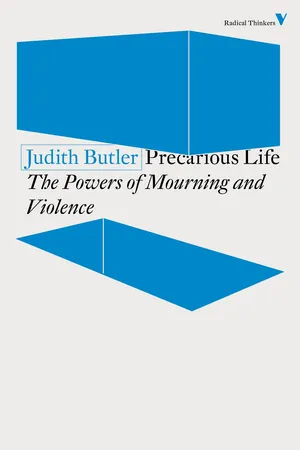
In her most impassioned and personal book to date, Judith Butler responds in this profound appraisal of post-9/11 America to the current US policies to wage perpetual war, and calls for a deeper understanding of how mourning and violence might instead inspire solidarity and a quest for global justice.
Information
1
EXPLANATION AND EXONERATION,
OR WHAT WE CAN HEAR
Since the events of September 11, we have seen both a rise of anti-intellectualism and a growing acceptance of censorship within the media. This could mean that we have support for these trends within the general population of the United States, but it could also mean that the media function as “public voices” that operate at a distance from their constituency, that both report the “voice” of the government for us, and whose proximity to that voice rests on an alliance or identification with that voice. Setting aside for the moment how the media act upon the public, whether, indeed, they have charged themselves with the task of structuring public sentiment and fidelity, it seems crucial to note that a critical relation to government has been severely, though not fully, suspended, and that the “criticism” or, indeed, independence of the media has been compromised in some unprecedented ways.
Although we have heard, lately, about the abusive treatment of prisoners, and war “mistakes” have been publicly exposed, it seems that neither the justification nor the cause of the war have been the focus of public intellectual attention. Only recently (fall, 2003), have the reasons for waging a preemptive war against Iraq begun to be subjected to public scrutiny. Indeed, thinking too hard about what brought this about has invariably raised fears that to find a set of causes will be to have found a set of excuses. This point was made in print by Michael Walzer, a “just war” proponent, and has worked as an implicit force of censorship in op-ed pages across the country. Similarly, we have heard from Vice-President Richard Cheney and Edward Rothstein of the New York Times, among several others, that the time to reassert not only American values but fundamental and absolute values has arrived. Intellectual positions that are considered “relativistic” or “post-” of any kind are considered either complicitous with terrorism or as constituting a “weak link” in the fight against it. The voicing of critical perspectives against the war has become difficult to do, not only because mainstream media enterprises will not publish them (most of them appear in the progressive or alternative print media or on the internet), but because to voice them is to risk hystericization and censorship. In a strong sense, the binarism that Bush proposes in which only two positions are possible—“Either you’re with us or you’re with the terrorists”—makes it untenable to hold a position in which one opposes both and queries the terms in which the opposition is framed. Moreover, it is the same binarism that returns us to an anachronistic division between “East” and “West” and which, in its sloshy metonymy, returns us to the invidious distinction between civilization (our own) and barbarism (now coded as “Islam” itself). At the beginning of this conflict, to oppose the war meant to some that one somehow felt sympathy with terrorism, or that one saw the terror as justified. But it is surely time to allow an intellectual field to redevelop in which more responsible distinctions might be heard, histories might be recounted in their complexity, and accountability might be understood apart from the claims of vengeance. This would also have to be a field in which the long-range prospects for global cooperation might work as a guide for public reflection and criticism.
The Left’s response to the war waged in Afghanistan ran into serious problems, in part because the explanations that the Left has provided to the question “Why do they hate us so much?” were dismissed as so many exonerations of the acts of terror themselves. This does not need to be the case. I think we can see, however, how moralistic anti-intellectual trends coupled with a distrust of the Left as so many self-flagellating First World elites has produced a situation in which our very capacity to think about the grounds and causes of the current global conflict is considered impermissible. The cry that “there is no excuse for September 11” has become a means by which to stifle any serious public discussion of how US foreign policy has helped to create a world in which such acts of terror are possible. We see this most dramatically in the suspension of any attempt to offer balanced reporting on the international conflict, the refusal to include important critiques of the US military effort by Arundhati Roy1 and Noam Chomsky, for instance, within the mainstream US press. This takes place in tandem with the unprecedented suspension of civil liberties for illegal immigrants and suspected terrorists, and the use of the flag as an ambiguous sign of solidarity with those lost on September 11 and with the current war, as if the sympathy with the one translates, in a single symbolic stroke, into support for the latter. The raw public mockery of the peace movement, and the characterization of anti-war demonstrations as anachronistic or nostalgic, work to produce a consensus of public opinion that profoundly marginalizes anti-war sentiment and analysis, putting into question in a very strong way the very value of dissent as part of contemporary US democratic culture.
The articulation of this hegemony takes place in part through producing a consensus on what certain terms will mean, how they can be used, and what lines of solidarity are implicitly drawn through this use. We reserve “acts of terror” for events such as the September 11 attacks on the United States, distinguishing these acts of violence from those that might be justified through foreign policy decisions or public declarations of war. On the other hand, these terrorist acts were construed as “declarations of war” by the Bush administration, which then positioned the military response as a justified act of self-defense. In the meantime, there remains ever-increasing ambiguity introduced by the very use of the term “terrorist,” which is then exploited by various powers at war with independence movements of various kinds. The term “terrorist” is used, for instance, by the Israeli state to describe any and all Palestinian acts of resistance, but none of its own practices of state violence. The term is also used by Putin to describe the Chechen struggle for independence, which then casts its own acts of violence against this province as justified acts of national self-defense. The United States, by using the term, positions itself exclusively as the sudden and indisputable victim of violence, even though there is no doubt that it did suffer violence. But it is one matter to suffer violence and quite another to use that fact to ground a framework in which one’s injury authorizes limitless aggression against targets that may or may not be related to the sources of one’s own suffering.
The point I would like to underscore here is that a frame for understanding violence emerges in tandem with the experience, and that the frame works both to preclude certain kinds of questions, certain kinds of historical inquiries, and to function as a moral justification for retaliation. It seems crucial to attend to this frame, since it decides, in a forceful way, what we can hear, whether a view will be taken as explanation or as exoneration, whether we can hear the difference, and abide by it.
There is as well a narrative dimension to this explanatory framework. In the United States, we begin the story by invoking a first-person narrative point of view, and telling what happened on September 11. It is that date and the unexpected and fully terrible experience of violence that propels the narrative. If someone tries to start the story earlier, there are only a few narrative options. We can narrate, for instance, what Mohammed Atta’s family life was like, whether he was teased for looking like a girl, where he congregated in Hamburg, and what led, psychologically, to the moment in which he piloted the plane into the World Trade Center. Or what was bin Laden’s break from his family, and why is he so angry? That kind of story is interesting to a degree, because it suggests that there is a personal pathology at work. It works as a plausible and engaging narrative in part because it resituates agency in terms of a subject, something we can understand, something that accords with our idea of personal responsibility, or with the theory of charismatic leadership that was popularized with Mussolini and Hitler in World War II.
This is doubtless easier to hear than that a network of individuals dispersed across the globe conjured and implemented this action in various ways. If there is a network, there must be a leader, a subject who is finally responsible for what others do. Perhaps we can hear, in a limited way, about the way in which the al-Qaeda group makes use of Islamic doctrine, and we want to know, to shore up our liberal framework, that they do not represent the religion of Islam, and that the vast majority of Muslims do not condone them. Al-Qaeda can be “the subject,” but do we ask where this comes from? Isolating the individuals involved absolves us of the necessity of coming up with a broader explanation for events. Though we are perhaps perplexed by why there is not a greater public repudiation by Muslim leaders (though many organizations have done that), we cannot quite understand why it might be difficult for Muslim leaders to join publicly with the United States on this issue even as they condemn quite clearly the acts of violence.
Our own acts of violence do not receive graphic coverage in the press, and so they remain acts that are justified in the name of self-defense, but by a noble cause, namely, the rooting out of terrorism. At one point during the war against Afghanistan, it was reported that the Northern Alliance may have slaughtered a village: Was this to be investigated and, if confirmed, prosecuted as a war crime? When a bleeding child or dead body on Afghan soil emerges in the press coverage, it is not relayed as part of the horror of war, but only in the service of a criticism of the military’s capacity to aim its bombs right. We castigate ourselves for not aiming better, as if the end goal is to aim right. We do not, however, take the sign of destroyed life and decimated peoples as something for which we are responsible, or indeed understand how that decimation works to confirm the United States as performing atrocities. Our own acts are not considered terrorist. And there is no history of acts that is relevant to the self-understanding we form in the light of these terrible events. There is no relevant prehistory to the events of September 11, since to begin to tell the story a different way, to ask how things came to this, is already to complicate the question of agency which, no doubt, leads to the fear of moral equivocation. In order to condemn these acts as inexcusable, absolutely wrong, in order to sustain the affective structure in which we are, on the one hand, victimized and, on the other, engaged in a righteous cause of rooting out terror, we have to begin the story with the experience of violence we suffered.
We have to shore up the first-person point of view, and preclude from the telling accounts that might involve a decentering of the narrative “I” within the international political domain. This decentering is experienced as part of the wound that we have suffered, though, so we cannot inhabit that position. This decentering is precisely what we seek to rectify through a recentering. A narrative form emerges to compensate for the enormous narcissistic wound opened up by the public display of our physical vulnerability. Our response, accordingly, is not to enter into international coalitions where we understand ourselves to be working with institutionally established routes of consensus-building. We relegate the United Nations to a second-order deliberative body, and insist instead on American unilateralism. And subsequently we ask, Who is with us? Who is against us? As a result, we respond to the exposure of vulnerability with an assertion of US “leadership,” showing once again the contempt we have for international coalitions that are not built and led by us. Such coalitions do not conflict with US supremacy, but confirm it, stoke it, insist upon it, with long-term implications for the future shape and possibility of global cooperation.
Perhaps the question cannot be heard at all, but I would still like to ask: Can we find another meaning, and another possibility, for the decentering of the first-person narrative within the global framework? I do not mean that the story of being attacked should not be told. I do not mean that the story that begins with September 11 should not be told. These stories have to be told, and they are being told, despite the enormous trauma that undermines narrative capacity in these instances. But if we are to come to understand ourselves as global actors, and acting within a historically established field, and one that has other actions in play, we will need to emerge from the narrative perspective of US unilateralism and, as it were, its defensive structures, to consider the ways in which our lives are profoundly implicated in the lives of others. My friends on the Left joke about having lost their First World complacency. Yes, this is true. But do we now seek to restore it as a way of healing from this wound? Or do we allow the challenge to First World complacency to stand and begin to build a different politics on its basis?
My sense is that being open to the explanations, poorly circulated as they are in the United States, that might help us take stock of how the world has come to take this form will involve us in a different order of responsibility. The ability to narrate ourselves not from the first person alone, but from, say, the position of the third, or to receive an account delivered in the second, can actually work to expand our understanding of the forms that global power has taken. But instead of remaining open to a consequential decentering of First Worldism, we tend to dismiss any effort at explanation, as if to explain these events would accord them rationality, as if to explain these events would involve us in a sympathetic identification with the oppressor, as if to understand these events would involve building a justificatory framework for them. Our fear of understanding a point of view belies a deeper fear that we shall be taken up by it, find it is contagious, become infected in a morally perilous way by the thinking of the presumed enemy. But why do we assume this? We claim to have gone to war in order to “root out” the sources of terror, according to Bush, but do we think that finding the individuals responsible for the attacks on the United States will constitute having gotten to the root? Do we not imagine that the invasion of a sovereign country with a substantial Muslim population, supporting the military regime in Pakistan that actively and violently suppresses free speech, obliterating lives and villages and homes and hospitals, will not foster more adamant and widely disseminated anti-American sentiment and political organizing? Are we not, strategically speaking, interested in ameliorating this violence? Are we not, ethically speaking, obligated to stop its further dissemination, to consider our role in instigating it, and to foment and cultivate another sense of a culturally and religiously diverse global political culture?
Part of the problem the United States is up against is that liberals quietly lined up behind the war effort, and supplied in part the rationale that keeps US state violence from being labeled as terrorist. It is not only the conservative Republicans who did not want to hear about “causes.” The “just war” liberal Left made plain that it did not want to hear from “excuseniks.” This coinage, rehabilitating the Cold War rhetoric about Soviet Russia, suggests that those who seek to understand how the global map arrived at this juncture through asking how, in part, the United States has contributed to the making of this map, are themselves, through the style of their inquiry, and the shape of their questions, complicitous with an assumed enemy. But to ask how certain political and social actions come into being, such as the recent terrorist attacks on the United States, and even to identify a set of causes, is not the same as locating the source of responsibility for these actions or, indeed, paralyzing our capacity to make ethical judgments on what is right or wrong.
No doubt there are forms of Left analysis that say simply that the United States has reaped what it has sown. Or they say that the United States has brought this state of events on itself. These are, as closed explanations, simply other ways of asserting US priority and encoding US omnipotence. These are also explanations that assume that these actions originate in a single subject, that the subject is not what it appears to be, that it is the United States that occupies the site of that subject, and that no other subjects exist or, if they exist, their agency is subordinated to our own. In other words, political paranoia of this kind is just another articulation of US supremacy. Paranoia is fed by the fantasy of omnipotence, and we see this evidenced in some of the more extreme explanations of this kind, that is, the attacks on September 11 were masterminded by the CIA or Mossad, the Israeli secret police. It is clear, though, that bin Laden did apprentice to the CIA and that the United States supported the Taliban since the 1990s, when it was deemed strategically useful. These links are not precisely causal explanations, but they are part of an explanatory framework. They do not translate into the notion that the United States performed these acts, but one can see how the connection becomes the occasion for the causal reduction, and a certain paranoia amplifies itself by seizing upon part of a broader explanatory picture.
What is generally heard when these opinions are expressed is that the United States is the culpable agent, that it is, effectively, the author of these events, and that the United States is solely responsible for this global outcome. This kind of reasoning is unacceptable to the press, and to the public in general, because it seems to blame the victim in this instance. But is this the only way to hear this point of view? And is this the only form this point of view takes? It seems that being most precise about this point, and publicizing it where one can, will be crucial for any effort by the Left to offer an anti-war viewpoint within contemporary public discourse.
If we believe that to think radically about the formation of the current situation is to exculpate those who committed acts of violence, we shall freeze our thinking in the name of a questionable morality. But if we paralyze our thinking in this way, we shall fail morality in a different way. We shall fail to take collective responsibility for a thorough understanding of the history that brings us to this juncture. We shall thereby deprive ourselves of the very critical and historical resources we need to imagine and practice another future, one that will move beyond the current cycle of revenge.
When President Arroyo of the Philippines on October 29, 2001, remarks that “the best breeding ground [for terrorism] is poverty,” or Arundhati Roy claims that bin Laden has been “sculpted from the spare rib of a world laid waste by America’s foreign policy,” something less than a strictly causal explanation is being offered. A “breeding ground” does not necessarily breed, but it can. And the “spare rib” that is said to emerge from a world laid waste by US foreign policy has, by definition, emerged in a strange and alchemical fashion. It is from waste that this rib is formed, as if the bone belongs to the dead, or is itself the animation of skeletal remains. This form of alchemical making is not the same as God creating Eve from the rib of Adam, life generating life, but has to be understood as death generating death through a means that is figural, not precisely causal. Indeed, both of them make use of figures—grounds and bones—to bespeak a kind of generation that precedes and exceeds a strictly causal frame. Both of them are pointing to conditions, not causes. A condition of terrorism can be necessary or sufficient. If it is necessary, it is a state of affairs without which terrorism cannot take hold, one that terrorism absolutely requires. If it is sufficient, its presence is enough for terrorism to take place. Conditions do not “act” in the way that individual agents do, but no agent acts without them. They are presupposed in what we do, but it would be a mistake to personify them as if they acted in the place of us. Thus, we can say, and ought to, that US imperialism is a necessary condition for the attacks on the United States, that these attacks would be impossible without the horizon of imperialism within which they occur. But to understand how US imperialism figures here, we have to understand not only how it is experienced by those who understand themselves as its victims, but how it enters into their own formation as acting and deliberating subjects.
This is the beginning of another kind of account. And this seems to be, for instance, what Mary Kaldor in The Nation points to when she claims that “in many of the areas where war takes place and where extreme networks pick up new recruits, becoming a criminal or joining a paramilitary group is literally the only opportunity for unemployed young men lacking formal education.”2 What effect did the killing of an estimated 200,000 Iraqi citizens, including tens of thousands of children, and the subsequent starvation of Muslim populations, predicted by Concern, a hunger relief organization, to reach six million by the year’s end, have on Muslim views of the United States? Is a Muslim life as valuable as legibly First World lives? Are the Palestinians yet accorded the status of “human” in US policy and press coverage? Will those hundreds of thousands of Muslim lives lost in the last decades of strife ever receive the equivalent to the paragraph-long obituaries in the New York Times that seek to humanize—often through nationalist and familial framing devices—thos...
Table of contents
- Cover Page
- Halftitle Page
- Title Page
- Copyright Page
- Dedication
- Contents
- Acknowledgments
- Preface
- 1. Explanation and Exoneration, or What We Can Hear
- 2. Violence, Mourning, Politics
- 3. Indefinite Detention
- 4. The Charge of Anti-Semitism: Jews, Israel, and the Risks of Public Critique
- 5. Precarious Life
- Notes
- Index
Trusted by 375,005 students
Access to over 1.5 million titles for a fair monthly price.
Study more efficiently using our study tools.
Frequently asked questions
Yes, you can cancel anytime from the Subscription tab in your account settings on the Perlego website. Your subscription will stay active until the end of your current billing period. Learn how to cancel your subscription
No, books cannot be downloaded as external files, such as PDFs, for use outside of Perlego. However, you can download books within the Perlego app for offline reading on mobile or tablet. Learn how to download books offline
Perlego offers two plans: Essential and Complete
- Essential is ideal for learners and professionals who enjoy exploring a wide range of subjects. Access the Essential Library with 800,000+ trusted titles and best-sellers across business, personal growth, and the humanities. Includes unlimited reading time and Standard Read Aloud voice.
- Complete: Perfect for advanced learners and researchers needing full, unrestricted access. Unlock 1.5M+ books across hundreds of subjects, including academic and specialized titles. The Complete Plan also includes advanced features like Premium Read Aloud and Research Assistant.
We are an online textbook subscription service, where you can get access to an entire online library for less than the price of a single book per month. With over 1.5 million books across 990+ topics, we’ve got you covered! Learn about our mission
Look out for the read-aloud symbol on your next book to see if you can listen to it. The read-aloud tool reads text aloud for you, highlighting the text as it is being read. You can pause it, speed it up and slow it down. Learn more about Read Aloud
Yes! You can use the Perlego app on both iOS and Android devices to read anytime, anywhere — even offline. Perfect for commutes or when you’re on the go.
Please note we cannot support devices running on iOS 13 and Android 7 or earlier. Learn more about using the app
Please note we cannot support devices running on iOS 13 and Android 7 or earlier. Learn more about using the app
Yes, you can access Precarious Life by Judith Butler in PDF and/or ePUB format, as well as other popular books in Politics & International Relations & Essays in Politics & International Relations. We have over 1.5 million books available in our catalogue for you to explore.