eBook - PDF
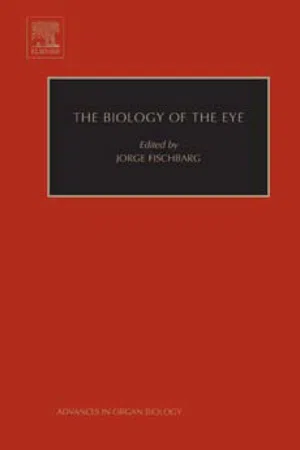
The Biology of the Eye
About this book
Acknowledgement This book is the result of a collective effort. Due to an oversight, mention of three of the contributors who played an especially decisive role in bringing the work to fruition was omitted from the book. They should share fully in the intellectual credits accruing from this publication. I would therefore like to acknowledge and thank the following for their outstanding contributions to editing the work: Dr. Morten Dornonville la Cour (MD, Dr. Med. Sci.) solicited and edited the chapters on retina, RPE, choroid, vitreous, immunology, and sclera. Dr. la Cour is a Lecturer, Eye Department, Copenhagen University Hospital, specializes in vitreoretinal surgery, and frequently lectures in the international scene. A trained mathematician, he has done research in retinal pigment epithelial physiology in the laboratories of Drs. Thomas Zeuthen and Sheldon Miller. Dr. Friedrich P.J. Diecke and Dr. Elliott M. Kanner also provided invaluable editorial assistance. Dr Diecke, who was formerly Professor and Chairman of the Department of Physiology, UMDNJ-New Jersey Medical School, is a Professor Emeritus at that institution. His research has concentrated on membrane transport mechanisms in lens epithelial cells, corneal endothelial cells and peripheral nerve and on the regulation of vascular smooth muscle contraction. Dr. Elliott M. Kanner was born in Canada in 1970. He graduated from Yale University in 1992 with a BS/MS degree in Molecular Biophysics and Biochemistry. He received his PhD degree from the Rockefeller University in 1999 and his MD degree from Weill/Cornell in 2001. He is currently an Ophthalmology resident at Columbia University. Jorge Fischbarg, December 2005 This book explores the many recent novel ideas about the eye in a systematic and synthetic way. It includes both basic sciences and applications towards clinical research. Chapters include both anatomical and functional descriptions of the different ocular tissues and treatments of a few subjects of practical importance for ophthalmologists. This book is intended for students in basic biomedical science interested in the eye, as well as ophthalmologists a comprehensive source on recent developments in ocular research.* Combines basic science and practical opthalmological subjects * Written with the simplicity of a textbook, while maintaining the comprehensive and rigorous approach of science papers * Includes contributions by well-known experts
Information
Subtopic
PhysiologyIndex
Biological SciencesTable of contents
- Cover Page
- The Biology of the Eye
- Contents
- List of Contributors
- Preface
- Chapter 1: Why the Eye Is Round
- Chapter 2: Tears and Their Secretion
- Chapter 3: The Cornea
- Chapter 4: The Corneal Endothelium
- Chapter 5: Ciliary Body and Ciliary Epithelium
- Chapter 6: The Lens
- Chapter 7: The Vitreous
- Chapter 8: The Retina
- Chapter 9: The Retinal Pigment Epithelium
- Chapter 10: The Choroid and Optic Nerve Head
- Chapter 11: Innate and Adaptive Immunity of the Eye
- Chapter 12: Drug Delivery to the Eye
- Chapter 13: The Sclera
- Index
Trusted by 375,005 students
Access to over 1.5 million titles for a fair monthly price.
Study more efficiently using our study tools.
Frequently asked questions
Yes, you can cancel anytime from the Subscription tab in your account settings on the Perlego website. Your subscription will stay active until the end of your current billing period. Learn how to cancel your subscription
No, books cannot be downloaded as external files, such as PDFs, for use outside of Perlego. However, you can download books within the Perlego app for offline reading on mobile or tablet. Learn how to download books offline
Perlego offers two plans: Essential and Complete
- Essential is ideal for learners and professionals who enjoy exploring a wide range of subjects. Access the Essential Library with 800,000+ trusted titles and best-sellers across business, personal growth, and the humanities. Includes unlimited reading time and Standard Read Aloud voice.
- Complete: Perfect for advanced learners and researchers needing full, unrestricted access. Unlock 1.5M+ books across hundreds of subjects, including academic and specialized titles. The Complete Plan also includes advanced features like Premium Read Aloud and Research Assistant.
We are an online textbook subscription service, where you can get access to an entire online library for less than the price of a single book per month. With over 1.5 million books across 990+ topics, we’ve got you covered! Learn about our mission
Look out for the read-aloud symbol on your next book to see if you can listen to it. The read-aloud tool reads text aloud for you, highlighting the text as it is being read. You can pause it, speed it up and slow it down. Learn more about Read Aloud
Yes! You can use the Perlego app on both iOS and Android devices to read anytime, anywhere — even offline. Perfect for commutes or when you’re on the go.
Please note we cannot support devices running on iOS 13 and Android 7 or earlier. Learn more about using the app
Please note we cannot support devices running on iOS 13 and Android 7 or earlier. Learn more about using the app
Yes, you can access The Biology of the Eye by Jorge Fischbarg in PDF and/or ePUB format, as well as other popular books in Biological Sciences & Physiology. We have over 1.5 million books available in our catalogue for you to explore.