eBook - PDF
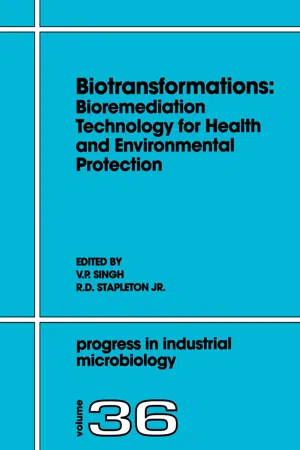
Biotransformations: Bioremediation Technology for Health and Environmental Protection
- 635 pages
- English
- PDF
- Available on iOS & Android
eBook - PDF
Biotransformations: Bioremediation Technology for Health and Environmental Protection
About this book
This volume provides a clear understanding of how microbes, following their degradative processes, contribute maximally to the benefit of mankind through biotransformations of waste materials as well as a wide variety of health-risk compounds.The book contains twenty four chapters contributed by leading scientists from different parts of the world, covering various aspects of bioremediation of xenobiotics such as toxic, carcinogenic, teratogenic, and mutagenic compounds, which include halogenated aromatics, derivatives of heavy metals, microbial toxins, tannins, dyes, sulfur compounds of coal and petroleum and pesticides. The bioremediation of agricultural residue, industrial as well as municipal wastes, fuel oils, lubricants, natural rubber products, and other synthetic polymers, which pollute the environment substantially, also constitutes an important component of the book. All biotechnological aspects of microbial transformations pertaining to biodegradation/bioremediation of hazardous wastes, ranging from screening methods for microbes with degradative potential, processes of degradation, strain improvement for enhanced biodegradation and elimination of xenobiotics of health and environmental concern have been dealt with. The book intends to widen the scope of Applied Microbiology and Biotechnology in general and biotransformations in particular. It will provide an opportunity for scientists in the areas of biochemistry, food industry, environmental science and engineering and their implications in technologically feasible, environment friendly and economically viable bioremediation options. Also, it forms an interface between agro-industrial establishments and the academic world and will generate new thought provoking ideas for scientists of future generations for the safeguard of both human and animal health as well as the environment.
Information
Table of contents
- Front Cover
- Biotransformations: Bioremediation Technology for Health and Environmental Protection
- Copyright Page
- Contents
- Preface
- List of abbreviations
- List of contributors
- Chapter 1. Bioremediation of compounds hazardous to health and the environment: An overview
- Chapter 2. Microbial degradation of polychlorinated biphenyls (PCBs) in the environment
- Chapter 3. Biodegradation of fuel oils and lubricants. Soil and water bioremediation options
- Chapter 4. Bioremediation technology for environmental protection through bioconversion of agro-industrial wastes
- Chapter 5. Enzymatic transformations of xenobiotics of health and environmental concern
- Chapter 6. Microbial degradation of chlorobenzoates (CBAs): Biochemical aspects and ecological implications
- Chapter 7. Microbial degradation of insecticides: An assessment for its use in bioremediation
- Chapter 8. Microbial variables for bioremediation of heavy metals from industrial effluents
- Chapter 9. Lactic acid bacteria in winemaking: Influence on sensorial and hygienic quality
- Chapter 10. Microbial transformation of aflatoxins
- Chapter 11. Biotransformations of tannery wastes
- Chapter 12. Oxidation of organic and inorganic sulfur compounds by aerobic heterotrophic marine bacteria
- Chapter 13. Lignin degradation by bacteria
- Chapter 14. Microbial bioremediation of textile effluents
- Chapter 15. Biodegradation of diaryl esters: Bacterial and fungal catabolism of phenylbenzoate and some of its derivatives
- Chapter 16. Degradation of natural rubber products by Nocardia species
- Chapter 17. Sewage treatment systems: Microbiological aspects
- Chapter 18. Electro-physical properties of microbial cells during the aerobic metabolism of toxic compounds
- Chapter 19. Microbial degradation of sulfur compounds present in coal and petroleum
- Chapter 20. Algae-dependent bioremediation of hazardous wastes
- Chapter 21. Some physiological characteristics of saprotrophic and ectomycorrhizal fungi producing sporophores on the urea-treated forest floor
- Chapter 22. Bioremediation of contaminated water bodies
- Chapter 23. Biotransformations and biodegradation in extreme environments
- Chapter 24. Bioremediation of hazardous ethylenebisdithiocarbamate (EBDC) fungicides
- Index
Trusted by 375,005 students
Access to over 1.5 million titles for a fair monthly price.
Study more efficiently using our study tools.
Frequently asked questions
Yes, you can cancel anytime from the Subscription tab in your account settings on the Perlego website. Your subscription will stay active until the end of your current billing period. Learn how to cancel your subscription
No, books cannot be downloaded as external files, such as PDFs, for use outside of Perlego. However, you can download books within the Perlego app for offline reading on mobile or tablet. Learn how to download books offline
Perlego offers two plans: Essential and Complete
- Essential is ideal for learners and professionals who enjoy exploring a wide range of subjects. Access the Essential Library with 800,000+ trusted titles and best-sellers across business, personal growth, and the humanities. Includes unlimited reading time and Standard Read Aloud voice.
- Complete: Perfect for advanced learners and researchers needing full, unrestricted access. Unlock 1.5M+ books across hundreds of subjects, including academic and specialized titles. The Complete Plan also includes advanced features like Premium Read Aloud and Research Assistant.
We are an online textbook subscription service, where you can get access to an entire online library for less than the price of a single book per month. With over 1.5 million books across 990+ topics, we’ve got you covered! Learn about our mission
Look out for the read-aloud symbol on your next book to see if you can listen to it. The read-aloud tool reads text aloud for you, highlighting the text as it is being read. You can pause it, speed it up and slow it down. Learn more about Read Aloud
Yes! You can use the Perlego app on both iOS and Android devices to read anytime, anywhere — even offline. Perfect for commutes or when you’re on the go.
Please note we cannot support devices running on iOS 13 and Android 7 or earlier. Learn more about using the app
Please note we cannot support devices running on iOS 13 and Android 7 or earlier. Learn more about using the app
Yes, you can access Biotransformations: Bioremediation Technology for Health and Environmental Protection by R.D. Stapleton Jr.,V.P. Singh,R.D. Stapleton, Jr. in PDF and/or ePUB format, as well as other popular books in Technology & Engineering & Environmental Management. We have over 1.5 million books available in our catalogue for you to explore.