- 589 pages
- English
- PDF
- Available on iOS & Android
eBook - PDF
About this book
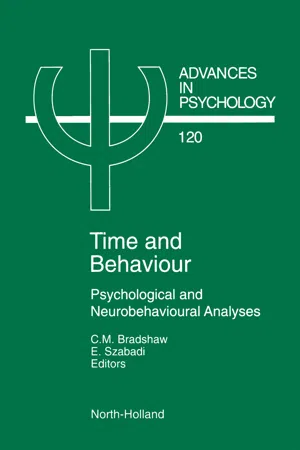
That time is both a dimension of behaviour and a ubiquitous controlling variable in the lives of all living things has been well recognized for many years.The last decade has seen a burgeoning of interest in the quantitative analysis of timing behaviour, and progress during the last five or six years has been particularly impressive, with the publication of several major new theoretical contributions.There has also been considerable progress in behavioural methodology during the past decade. In the area of reinforcement schedules, for example, the venerable interresponse–time schedule, fixed–interval peak procedure and interval bisection task have been complemented by a 'second generation' of incisive instruments for analyzing timing behaviour.Another area of recent development is the analysis of the neurobiological substrate of timing behaviour. Several research groups are currently studying the involvement of various central neurotransmitter systems in the timing behaviour, and the ability of centrally acting drugs and discrete brain lesions to alter timing processes. Yet another recent development in timing research is the growing dialogue between two fields that have grown up separately, although, superficially at least, they seem to have much in common: the experimental analysis of 'interval timing', traditionally the province of experimental psychology, and behavioural chronobiology. The last few years have seen a growing interest in the comparative properties of the internal 'clocks' that regulate biobehavioural rhythms with time bases in the circadian range or longer, and those that are entailed in timing of intervals in the range of seconds or minutes.All these areas of research, and others, are represented in the chapters that make up this volume. This book will help to promote further interactions among researchers who hail from disparate disciplines, but who share a common interest in the temporal properties of behaviour.
Information
Table of contents
- Cover
- Contents
- Preface
- Contributors
- Chapter 1. Dynamic models of rapid temporal control in animals
- Chapter 2. Timing and temporal search
- Chapter 3. Time's causes
- Chapter 4. Application of a mode-control model of temporal integration to counting and timing behaviour
- Chapter 5. Does a common mechanism account for timing and counting phenomena in the pigeon?
- Chapter 6. Pigeons' coding of event duration in delayed matching-to-sample
- Chapter 7. Ordinal, phase, and interval timing
- Chapter 8. Cooperation, conflict and compromise between circadian and interval clocks in pigeons
- Chapter 9. Factors influencing long-term time estimation in humans
- Chapter 10. How time flies: Functional and neural mechanisms of interval timing
- Chapter 11. On the human neuropsychology of timing of simple repetitive movements
- Chapter 12. 5-hydroxytryptamine and interval timing
- Index
Trusted by 375,005 students
Access to over 1.5 million titles for a fair monthly price.
Study more efficiently using our study tools.
Frequently asked questions
Yes, you can cancel anytime from the Subscription tab in your account settings on the Perlego website. Your subscription will stay active until the end of your current billing period. Learn how to cancel your subscription
No, books cannot be downloaded as external files, such as PDFs, for use outside of Perlego. However, you can download books within the Perlego app for offline reading on mobile or tablet. Learn how to download books offline
Perlego offers two plans: Essential and Complete
- Essential is ideal for learners and professionals who enjoy exploring a wide range of subjects. Access the Essential Library with 800,000+ trusted titles and best-sellers across business, personal growth, and the humanities. Includes unlimited reading time and Standard Read Aloud voice.
- Complete: Perfect for advanced learners and researchers needing full, unrestricted access. Unlock 1.5M+ books across hundreds of subjects, including academic and specialized titles. The Complete Plan also includes advanced features like Premium Read Aloud and Research Assistant.
We are an online textbook subscription service, where you can get access to an entire online library for less than the price of a single book per month. With over 1.5 million books across 990+ topics, we’ve got you covered! Learn about our mission
Look out for the read-aloud symbol on your next book to see if you can listen to it. The read-aloud tool reads text aloud for you, highlighting the text as it is being read. You can pause it, speed it up and slow it down. Learn more about Read Aloud
Yes! You can use the Perlego app on both iOS and Android devices to read anytime, anywhere — even offline. Perfect for commutes or when you’re on the go.
Please note we cannot support devices running on iOS 13 and Android 7 or earlier. Learn more about using the app
Please note we cannot support devices running on iOS 13 and Android 7 or earlier. Learn more about using the app
Yes, you can access Time and Behaviour by C.M. Bradshaw,E. Szabadi in PDF and/or ePUB format, as well as other popular books in Psychology & History & Theory in Psychology. We have over 1.5 million books available in our catalogue for you to explore.