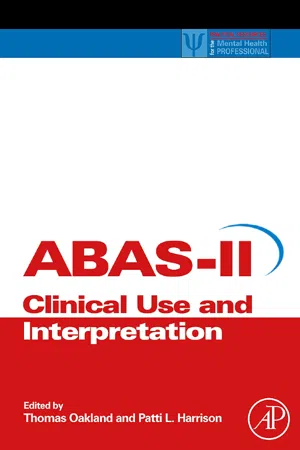
eBook - PDF
Adaptive Behavior Assessment System-II
Clinical Use and Interpretation
- 431 pages
- English
- PDF
- Available on iOS & Android
eBook - PDF
Adaptive Behavior Assessment System-II
Clinical Use and Interpretation
About this book
Adaptive Behavior Assessment System-II summarizes information on adaptive behavior and skills as well as general issues in adaptive behavior assessment with the goal of promoting sound assessment practice during uses, interpretations, and applications of the Adaptive Behavior Assessment System-II.
Adaptive behavior and skills refer to personal qualities associated with the ability to meet one's personal needs such as communication, self-care, socialization, etc. and those of others. Data from measures of adaptive behavior have been used most commonly in assessment and intervention services for persons with mental retardation. However, the display of adaptive behaviors and skills is relevant to all persons. The Adaptive Behavior Assessment System-II (ABAS-II) provides a comprehensive, norm-referenced assessment of the adaptive behavior and skills of individuals from birth through age 89. The comprehensive natures of the ABAS-II, ease in administration and scoring, and wide age range have resulted in its widespread use for a large number of assessment purposes. The book provides practical information and thus serves as a valuable resource for those who use the ABAS-II.
- Assists in the functional use of the ABAS-II
- Provides case studies illustrating use of the ABAS-II in comprehensive assessment and intervention planning
- Reviews scholarship on adaptive behaviors and skills
- Describes legal, ethical, and other professional standards and guidelines that apply to the use of the ABAS-II and other measures of adaptive behavior
- Discusses the use of the ABAS-II with autism, mental retardation; young children and those in elementary and secondary school; as well as incarcerated persons being evaluated for possible mental retardation
Information
Index
Psychology
136
School
and
Home
Living
Adaptive
Skills
Steere,
D.,
Rose,
E.,
&
Cavaiuolo,
D.
(2007).
Growing
Up:
Transition
to
Adult
Life
for
Students
with
Disabilities.
Boston:
Allyn
&
Ba
c
on.
Stokes,
T.
&
Baer,
D.
(1977).
An
impli
c
it
te
c
hnology
of
generalization.
Journal
of
Applied
Behavior
Analysis
,
10
,
349–367.
Szymanski,
E.
(1994).
Transition:
Life
span
and
life
spa
c
e
c
onsiderations
for
empowerment.
Exceptional
Children
,
60
,
402–410.
Taylor,
P.,
Collins,
B.
C.,
S
c
huster,
J.
W.,
&
K
leinert,
H.
(2002).
Tea
c
hing
laundry
skills
to
high
s
c
hool
students
with
disabilities:
Generalization
of
targeted
skills
and
nontargeted
information.
Education
and
Training
in
Mental
Retardation
and
Developmental
Disabilities
,
37
(20),
172–183.
Wagner,
M.,
Newman,
L.,
Cameto,
R.,
&
Levine,
P.
(2006).
The
a
c
ademi
c
a
c
hievement
and
fun
c
-
tional
performan
c
e
of
youth
with
disabilities.
A
Report
from
the
National
Longitudinal
Transition
Study-2
(NLTS2)
,
NCSER
2006–3000.
Menlo
Park,
CA:
SRI
International.
Westling,
D.
L.
&
F
ox,
L.
(2004).
Teaching
Students
with
Severe
Disabilities
,
3rd
edn.,
Upper
Saddle
River,
NJ:
Merrill.
Table of contents
- FRONT COVER
- ADAPTIVE BEHAVIOR ASSESSMENT SYSTEM-II: CLINICAL USE AND INTERPRETATION
- COPYRIGHT PAGE
- CONTENTS
- PREFACE
- LIST OF CONTRIBUTORS
- SECTION I: INTRODUCTION
- SECTION II: ABAS-II AND ADAPTIVE SKILL AREAS
- SECTION III: ABAS-II AND ASSESSMENT ACROSS AGE RANGES
- SECTION IV: ABAS-II AND ASSESSMENT FOR SPECIAL POPULATIONS
- INDEX
Trusted by 375,005 students
Access to over 1.5 million titles for a fair monthly price.
Study more efficiently using our study tools.
Frequently asked questions
Yes, you can cancel anytime from the Subscription tab in your account settings on the Perlego website. Your subscription will stay active until the end of your current billing period. Learn how to cancel your subscription
No, books cannot be downloaded as external files, such as PDFs, for use outside of Perlego. However, you can download books within the Perlego app for offline reading on mobile or tablet. Learn how to download books offline
Perlego offers two plans: Essential and Complete
- Essential is ideal for learners and professionals who enjoy exploring a wide range of subjects. Access the Essential Library with 800,000+ trusted titles and best-sellers across business, personal growth, and the humanities. Includes unlimited reading time and Standard Read Aloud voice.
- Complete: Perfect for advanced learners and researchers needing full, unrestricted access. Unlock 1.5M+ books across hundreds of subjects, including academic and specialized titles. The Complete Plan also includes advanced features like Premium Read Aloud and Research Assistant.
We are an online textbook subscription service, where you can get access to an entire online library for less than the price of a single book per month. With over 1.5 million books across 990+ topics, we’ve got you covered! Learn about our mission
Look out for the read-aloud symbol on your next book to see if you can listen to it. The read-aloud tool reads text aloud for you, highlighting the text as it is being read. You can pause it, speed it up and slow it down. Learn more about Read Aloud
Yes! You can use the Perlego app on both iOS and Android devices to read anytime, anywhere — even offline. Perfect for commutes or when you’re on the go.
Please note we cannot support devices running on iOS 13 and Android 7 or earlier. Learn more about using the app
Please note we cannot support devices running on iOS 13 and Android 7 or earlier. Learn more about using the app
Yes, you can access Adaptive Behavior Assessment System-II by Thomas Oakland,Patti L. Harrison in PDF and/or ePUB format, as well as other popular books in Psychology & Evaluation & Assessment in Education. We have over 1.5 million books available in our catalogue for you to explore.