In 2006 anthropologists Paul Rabinow and Gaymon Bennett set out to rethink the role that human sciences play in biological research, creating the Human Practices division of the Synthetic Biology Engineering Research Center—a facility established to create design standards for the engineering of new enzymes, genetic circuits, cells, and other biological entities—to formulate a new approach to the ethical, security, and philosophical considerations of controversial biological work. They sought not simply to act as watchdogs but to integrate the biosciences with their own discipline in a more fundamentally interdependent way, inventing a new, dynamic, and experimental anthropology that they could bring to bear on the center's biological research.
Designing Human Practices is a detailed account of this anthropological experiment and, ultimately, its rejection. It provides new insights into the possibilities and limitations of collaboration, and diagnoses the micro-politics which effectively constrained the potential for mutual scientific flourishing. Synthesizing multiple disciplines, including biology, genetics, anthropology, and philosophy, alongside a thorough examination of funding entities such as the National Science Foundation, Designing Human Practices pushes the social study of science into new and provocative territory, utilizing a real-world experience as a springboard for timely reflections on how the human and life sciences can and should transform each other.
eBook - ePub
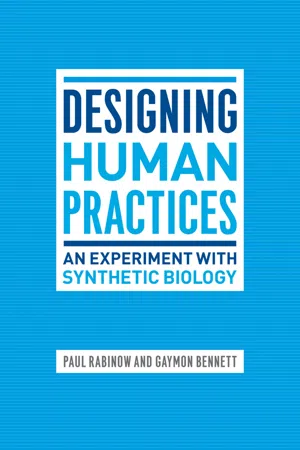
Designing Human Practices
An Experiment with Synthetic Biology
- English
- ePUB (mobile friendly)
- Available on iOS & Android
eBook - ePub
About this book
Information
Publisher
University of Chicago PressYear
2012Print ISBN
9780226703145
9780226703138
eBook ISBN
9780226703152
PART I
Human Practices:
Diagnosis
Diagnosis
1 The Setting
SynBERC: The Synthetic Biology Engineering Research Center
How can the growth of capacities be disconnected from the intensification of power relations?
MICHEL FOUCAULT1
In the wake of the various genome-sequencing projects of the 1990s, as well as the security sequels of 9/11, the globalization of information and finance capitalism, the life sciences have undertaken the challenge of redesign and coordination.2 It is a central working hypothesis of this book that the life sciences and the human sciences, as well as the relations between them, are currently unresolved about the status of their objects, the best venues in which to work on them, and the broader ethical framing of their undertakings.
If today there is a broad consensus that the genome sequences were not the key to life, only the “end of the beginning” of biology, as Sydney Brenner put it, then it follows logically at least that the ELSI (Ethical, Legal, and Social Implications) programs—which were constructed within that earlier political and scientific consensus about the significance of the genome-sequencing projects, while continuing to provide useful safeguards and as venues for conducting public conversations—are themselves limited in their scope by their original mandate to operate downstream and outside of the sequencing efforts.3
Agreeing with Brenner that there is a compelling need for scientists to rethink current understandings of the gene, we argue in a parallel fashion that there is an equally if not more compelling need to rethink the cornerstone concept of ELSI—social consequences. The need for rethinking what is meant by social consequences is actually more compelling because while it is habitual for normal bioscience that outdated concepts will sooner or later be replaced, there is no guarantee whatsoever that a parallel process exists for the human sciences (not to mention media discourse). It follows logically—although many pragmatic obstacles to making it a reality remain in place—that contemporary post-genomic research programs such as synthetic biology can no longer be constituted as they were in the recent past.4 We argue that the challenges of rethinking the ramifications taking place within the biosciences and the human sciences should be addressed. How to make this twofold task collaborative and synergistic, however, remains problematic.
Diagnosis: The Recent Past
After the completion of the human genome-sequencing projects, it became clear to most observers (and many participants) that the nucleotide sequences themselves were neither the “holy grail” nor the “code of codes” that the proponents of the projects hoped they would be. Nor were these seemingly endless strings of base pairs the key to “playing God” or “Franken-futures,” as opponents warned. By the early years of the twenty-first century, whatever work these analogies had originally been designed to do, they had become outmoded and misleading. It is now clear that the sequence information is one of the most important foundational elements—necessary but hardly sufficient—for constructing a contemporary biology.5
What was missing most conspicuously was a credible scientific program for moving from the hope (and desire) that bio-informatics would provide the technological means to deciphering an ever-increasing quantity of molecular information to a more closely calibrated strategy for laboratory experimentation in the near future. Correlatively, an honest inspection revealed an even bigger gap between the overflow of information and its promised transformation into ameliorative and lucrative applications. Finally, there was an amorphous but haunting awareness that what was required ultimately was a firmer scientific understanding of the material under consideration, an explanatory frame adequate to biological structure and function beyond suggestive statistical correlations and broad generalizations about life.
This overabundance of data and under-determination of its significance have yielded a surfeit of visions-cum-manifestos. The manifestos have been driven by the need to articulate and defend a new mission for the large bureaucracies and their costly technologies and facilities that had been constructed as part of the sequencing projects; by a desire to attract venture capitalists and other significant funders; by a drive to develop and implement research strategies that would be scientifically and financially rewarding; and so on. The hectic activity devoted to defining the framing and analogical correlatives of a convincing post-sequencing orientation goes some way to situating the effervescent (and largely evanescent) efforts to brand and promote proteomics, systems biology, synthetic biology, and the like, as the crucial next stage in bringing into existence the hoped-for wonder and bounty of a biologically based future of knowledge, health, and wealth, which had been so forcefully articulated and promoted by the proponents of the sequencing projects.
Equally significantly, but with less hoopla, by 2007 the ethics initiatives that had come into existence as part of the sequencing projects—the ELSI (Ethical, Legal, and Social Implications) programs—were also beginning to be critically scrutinized.6 These programs were constituted according to the terms of a political agreement among the Human Genome Project funders that ELSI would be supported on condition that it operated downstream of the science and technology, and should concern itself primarily with framing social consequences. The demand for rethinking this approach has come in part initially from the governmental funders of the multiple centers in nanotechnology and then in synthetic biology—that is, the U.S. Congress and the National Science Foundation.
Inquiry: The Near Future
One exemplary area of the new post-genomic life sciences is synthetic biology. Starting out as a placeholder term, or perhaps a hoped-for brand, during 2007 synthetic biology began to coalesce into a number of defined research programs. In its early years, synthetic biology has received attention from media and funders for two principal reasons: There are the audacious claims made by some spokespersons that synthetic biology will fashion living systems into—pick your analogy—biological LEGO sets, plug-and-play genetic robots, or genetic circuits. We have been told that (a) biological complexity will be refactored into simple constituent parts, and rational design and composition made child’s play (that is to say, undergraduates and high school students will be doing it with increasing facility); (b) the capacity to design and manipulate biological systems is uniquely suited to solve many of the world’s most pressing problems.7 The self-styled prophets confidently assert that synthetic biology is going to discover new therapeutics and lower their cost, afford the means to solve the energy crisis, be the key to biosecurity, and repair the environment.
Most broadly, post-genomics has seen the intensification of an engineering disposition in biology: understanding through making and remaking. Living systems, and their components, are being redesigned and refashioned. The challenge for synthetic biologists is to take biology beyond the guild-like restrictions of artisanal savior faire and to make it into a full-fledged engineering discipline, with all this entails in terms of standardization, modularization, and regularization. The task is to design and fabricate useful biological objects, with an express commitment to understanding only enough about how they work to make them work. Though there is disagreement about how exactly this feat might be accomplished, there is agreement that the goal of standardized biological engineering will require a re-assemblage of scientific subdisciplines, diverse forms of funding, institutional networks, governmental and nongovernmental agencies, legal standards, and the like.
In 2006 the National Science Foundation made a significant investment in synthetic biology through its Engineering Research Centers (ERC) directorate. The funding of the Synthetic Biology Engineering Research Center (SynBERC) was conditional on the inclusion of an equal and integrated “social implications” component. Our charge has been to fulfill this mandated condition. We have asked: What should that component look like? In the fall of 2006, one of us (Rabinow) traveled to Washington, D.C., to meet with the ERC directorate officials: to their credit, the officers at the NSF were frank in admitting that they did not know and encouraged innovative exploration of what such a component might be. Hence a challenge was put into play in a fashion parallel to the challenge of constituting a program for post-sequencing biology: What form should be given to a biological engineering center that incorporates collaboration as equals with human scientists?
What follows is an account of conceptual and ethical diagnosis and inquiry, as well as an attempt to organize, orient, and evaluate the human practices work that we agreed to undertake as one of SynBERC’s four “thrusts” (Parts, Devices, Chassis, Human Practices). The chapters of this book were written over the course of four years (2006–10). Although some minor adjustments have been made to the texts to minimize redundancy, we have explicitly resisted rectifying all of our prior formulations so as to preserve the temporality and context of these interventions. In this book, our purpose is to provide a kind of archive and chronicle of shits in temperament, expectation, conceptualization, as well as scientific and ethical capacity—or its neglect. At each of these junctures in our experiment, we faced the challenge of assessing, in real time, how our experiment was ramifying and how best to proceed.
The Site: SynBERC
During 2006, a group of researchers and engineers from an array of scientific disciplines proposed a project with the aim of rendering synthetic biology a full-fledged engineering discipline. Representing five major research universities—University of California, Berkeley; Massachusetts Institute of Technology; Harvard; University of California, San Francisco; and Prairie View Agricultural and Mining—the participants proposed to coordinate their research efforts through the development of a collaborative research center: the Synthetic Biology Engineering Research Center, or SynBERC (www.synberc.org). SynBERC is highly unusual on a number of counts. In addition to its far-reaching research and technology objectives, it embodied an innovative assemblage of multiple scientific subdisciplines, diverse forms of funding, complex institutional collaborations, an orientation to the near future, and intensive work with governmental and nongovernmental agencies, focused legal innovation, and imaginative use of media.
The reviewers and officials of the NSF reacted enthusiastically to the ambitious proposal. Before making the official award, however, NSF officials informed Jay Keasling, a professor of chemistry at UC Berkeley and the future director of the Center, that the award was contingent on including a “social implications” component. In the wake of the events of September 11, 2001, the proposal’s dual goal of (1) making biology easier to engineer and of (2) making materials and know-how openly available raised concerns about potential security ramifications. Keasling and his colleagues were perfectly willing to accept the need to address these issues, although neither the NSF nor the principal scientists and engineers who were to guide the Center had a well-formulated idea about what such a “social implications” component would look like or what it would do.
Keasling (presumably) turned to the dean of public policy at Berkeley for advice (or was approached by the dean). The dean proposed that an adjunct professor, Stephen Maurer, a lawyer with strong interests in economics, would be a suitable person to lead this component. Keasling, following the informal style of leadership that characterizes his approach to such matters, accepted the proposal. The short tenure of the first occupant of this ethics position was a troubled one. Maurer proposed, and argued forcefully for, two things. First, he advocated a mechanism to monitor “experiments of concern.” Second, he underlined the need for a procedure whereby the “community” of synthetic biologists would vote on a set of regulatory controls that would govern the relations of the nascent DNA synthesis industry and the community of synthetic biologists. The substance of Maurer’s proposals was eventually worked out in a report funded by the Sloan Foundation.8 His proposals consisted in drawing attention to the need to monitor the solicitation of DNA sequences that could be identified (by checking against an as yet to be developed database) as of possible use in known pathogenic agents. Although most of the concerned actors took the substance of Maurer’s proposals to be reasonable and desirable, personality conflicts and a battle over who was to set the terms for governance and potential regulation built to a point of total breakdown. After a contentious behind-the-scenes set of confrontations, in June 2006 Keasling and his colleagues pulled Maurer’s proposals at the very last minute from the agenda of Synthetic Biology 2.0, at UC Berkeley. This was done without informing Maurer, and no vote was taken.
In the wake of this theatrical turn of events—one that foreshadowed a governance style and a use of unequal power relations that lingers at SynBERC—Keasling invited Paul Rabinow, a professor of anthropology at Berkeley, and Ken Oye, an associate professor of political science at MIT, to jointly direct the so-called ethics, social consequences, public perception, legal considerations, risk assessment, and policy implications component. Both had been speakers at SB 2.0; each had found the other’s presentation interesting. The proposal made sense as there appeared to be a clear division of labor, with Oye concentrating on policy issues and Rabinow on ethics and the innovations in organizational form as well as the scientific objects to be produced by the Center. Oye and Rabinow accepted this formal arrangement and became the co-principal investigators of Thrust 4: Human Practices.
Human Practices
The unexpected invitation to become active participants in the construction of a multidisciplinary Center was both welcome and enticing. It was welcome in that Rabinow had already contributed to the early developments in synthetic biology, albeit as an anthropological observer.9 He had been asked to give a presentation at the first international conference on synthetic biology, SB 1.0, at MIT in 2005 and another at SB 2.0 at Berkeley in 2006.10 It was enticing given the programmatic statements that characterized the Center’s initial strategic plan. One of us (Rabinow) proposed to the other (Bennett) that we take up the challenge together. Bennett, at the time a student at the Graduate Theological Union in Berkeley, had been attending seminars in the anthropology department. Hence our collaboration began with two years of salient conceptual work already under way.
We agreed that it would be an exciting challenge to try to think through and put into practice a form of “post-ELSI” program. The mandated Ethical, Legal, and Social Implications program of the Human Genome Sequencing Initiative, while valuable in a number of ways, could not serve as a direct model for the future. Essentially, the ELSI model (to simplify but not betray) had a mandate to work outside and downstream of the technological and scientific work. ELSI’s directive was to deal with consequences, specifically “social consequences.” There was a broad agreement that at SynBERC (as well as at the NSF-funded nanotechnology engineering centers) the ethics work should be conducted alongside and collaboratively with the engineering programs.
We were fully aware that the power relations between the life sciences and human sciences were certain to be unequal. For more than a decade, one of us (Rabinow) had conducted anthropological work in the worlds of biotechnology and genomics. One of us (Bennett) had spent several years engaged as a bioethicist working on genomics and stem cell research. Hence, we were both aware that ambitious life scientists would have had a minimum of preparation and education, not to mention even an awareness, of the issues and developments in the human sciences and ethics in recent decades. We were aware that government officials might well be well-meaning but that they were under pressure to produce “first-order deliverables” and that their openness was likely to fade as pressures on them mounted from within their ...
Table of contents
- Cover
- Copyright
- Title Page
- Contents
- Acknowledgments
- Introduction: A Productive Experiment
- PART I. HUMAN PRACTICES: DIAGNOSIS
- PART II. HUMAN PRACTICES: INQUIRY
- Notes
- Bibliography
- Index
Trusted by 375,005 students
Access to over 1.5 million titles for a fair monthly price.
Study more efficiently using our study tools.
Frequently asked questions
Yes, you can cancel anytime from the Subscription tab in your account settings on the Perlego website. Your subscription will stay active until the end of your current billing period. Learn how to cancel your subscription
No, books cannot be downloaded as external files, such as PDFs, for use outside of Perlego. However, you can download books within the Perlego app for offline reading on mobile or tablet. Learn how to download books offline
Perlego offers two plans: Essential and Complete
- Essential is ideal for learners and professionals who enjoy exploring a wide range of subjects. Access the Essential Library with 800,000+ trusted titles and best-sellers across business, personal growth, and the humanities. Includes unlimited reading time and Standard Read Aloud voice.
- Complete: Perfect for advanced learners and researchers needing full, unrestricted access. Unlock 1.5M+ books across hundreds of subjects, including academic and specialized titles. The Complete Plan also includes advanced features like Premium Read Aloud and Research Assistant.
We are an online textbook subscription service, where you can get access to an entire online library for less than the price of a single book per month. With over 1.5 million books across 990+ topics, we’ve got you covered! Learn about our mission
Look out for the read-aloud symbol on your next book to see if you can listen to it. The read-aloud tool reads text aloud for you, highlighting the text as it is being read. You can pause it, speed it up and slow it down. Learn more about Read Aloud
Yes! You can use the Perlego app on both iOS and Android devices to read anytime, anywhere — even offline. Perfect for commutes or when you’re on the go.
Please note we cannot support devices running on iOS 13 and Android 7 or earlier. Learn more about using the app
Please note we cannot support devices running on iOS 13 and Android 7 or earlier. Learn more about using the app
Yes, you can access Designing Human Practices by Paul Rabinow,Gaymon Bennett in PDF and/or ePUB format, as well as other popular books in Social Sciences & Science History. We have over 1.5 million books available in our catalogue for you to explore.