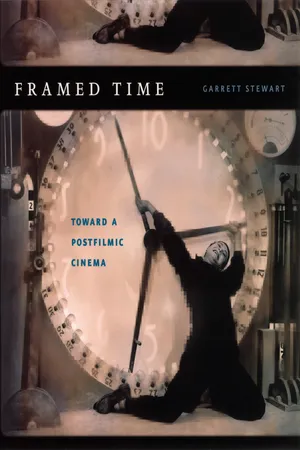
Framed Time
eBook - PDF

Framed Time

Toward a Postfilmic Cinema

  1. English
  2. PDF
  3. Available on iOS & Android
eBook - PDF

Framed Time

Toward a Postfilmic Cinema

About this book

Italian director Michelangelo Antonioni claimed, three decades ago, that different conceptions of time helped define the split in film between European humanism and American science fiction. And as Garrett Stewart argues here, this transatlantic division has persisted since cinema's 1995 centenary, made more complex by the digital technology that has detached movies from their dependence on the sequential frames of the celluloid strip.
Brilliantly interpreting dozens of recent films—from Being John Malkovich, Donnie Darko, and The Sixth Sense to La mala educaciĂłn and CachĂ© —Stewart investigates how their treatments of time reflect the change in media from film's original rolling reel to today's digital pixel. He goes on to show—with 140 stills—how American and European narratives confront this shift differently: while Hollywood movies tend to revolve around ghostly afterlives, psychotic doubles, or violent time travel, their European counterparts more often feature second sight, erotic telepathy, or spectral memory. Stewart questions why these recent plots, in exploring temporality, gravitate toward either supernatural or uncanny apparitions rather than themes of digital simulation. In doing so, he provocatively continues the project he began with Between Film and Screen, breaking new ground in visual studies, cinema history, and media theory.

Frequently asked questions

Yes, you can cancel anytime from the Subscription tab in your account settings on the Perlego website. Your subscription will stay active until the end of your current billing period. Learn how to cancel your subscription.
At the moment all of our mobile-responsive ePub books are available to download via the app. Most of our PDFs are also available to download and we're working on making the final remaining ones downloadable now. Learn more here.
Perlego offers two plans: Essential and Complete
  • Essential is ideal for learners and professionals who enjoy exploring a wide range of subjects. Access the Essential Library with 800,000+ trusted titles and best-sellers across business, personal growth, and the humanities. Includes unlimited reading time and Standard Read Aloud voice.
  • Complete: Perfect for advanced learners and researchers needing full, unrestricted access. Unlock 1.4M+ books across hundreds of subjects, including academic and specialized titles. The Complete Plan also includes advanced features like Premium Read Aloud and Research Assistant.
Both plans are available with monthly, semester, or annual billing cycles.
We are an online textbook subscription service, where you can get access to an entire online library for less than the price of a single book per month. With over 1 million books across 1000+ topics, we’ve got you covered! Learn more here.
Look out for the read-aloud symbol on your next book to see if you can listen to it. The read-aloud tool reads text aloud for you, highlighting the text as it is being read. You can pause it, speed it up and slow it down. Learn more here.
Yes! You can use the Perlego app on both iOS or Android devices to read anytime, anywhere — even offline. Perfect for commutes or when you’re on the go.
Please note we cannot support devices running on iOS 13 and Android 7 or earlier. Learn more about using the app.
Yes, you can access Framed Time by Garrett Stewart in PDF and/or ePUB format, as well as other popular books in Media & Performing Arts & Literary Criticism. We have over one million books available in our catalogue for you to explore.

Table of contents

  1. Contents
  2. Acknowledgments
  3. Introduction: On Optical Allusion
  4. Lexeme to Pixel: An Experiment in Narratography
  5. Trick Beginnings and the European Uncanny
  6. Out of Body in Hollywood
  7. Temportation
  8. VR from Cimnemonics to Digitime
  9. Media Archaeology, Hermeneutics, Narratography
  10. Appendix: Precinematics; or, Reading the Narratogram
  11. Notes
  12. Terms
  13. Index